
Advanced Micro Devices, Inc. and Tata Consultancy Services unveiled plans to deploy AMD’s “Helios” rack-scale AI architecture in India, targeting a new AI-ready data center blueprint that supports up to 200MW of capacity. The collaboration will roll out through TCS subsidiary HyperVault AI Data Center Limited, aligning with India’s national AI initiatives and sovereign AI factory programs.
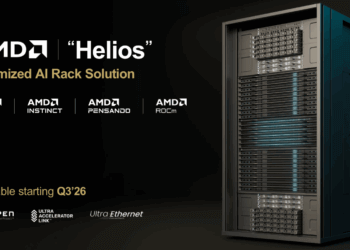
The Helios platform integrates AMD Instinct MI455X GPUs, next-generation AMD EPYC “Venice” CPUs, AMD Pensando Vulcano NICs, and the ROCm open software ecosystem. AMD designed the architecture as a rack-scale system to support AI training and inference workloads, focusing on performance density, operational efficiency, and deployment flexibility. TCS and AMD will co-develop infrastructure designs and work with hyperscalers and AI-native firms to accelerate large-scale AI data center build-outs across India.
TCS established HyperVault in 2025 to deliver gigawatt-scale AI-ready infrastructure for hyperscalers, AI companies, and enterprises. Under the expanded partnership, the companies will offer an AI-ready data center blueprint aimed at reducing time-to-deployment and supporting hybrid modernization efforts. The move positions India as a growing hub for AI infrastructure investment, supported by domestic compute capacity and sovereign data strategies.
- 200MW AI-ready data center blueprint for India
- Rack-scale “Helios” platform integrating MI455X GPUs, EPYC “Venice” CPUs, and Pensando Vulcano NICs
- Focus on AI training and inference for enterprise and hyperscale deployments
- Support for sovereign AI factories and national AI initiatives
- Collaboration executed through TCS subsidiary HyperVault AI Data Center Limited
“AI adoption is accelerating from pilots to large-scale deployments, and that shift requires a new blueprint for compute infrastructure. With ‘Helios,’ we are delivering an open, rack-scale AI platform designed for performance, efficiency, and long-term flexibility. Together with TCS, we are enabling enterprises across India to deploy AI at scale today while building the compute foundation of tomorrow,” said Dr. Lisa Su, Chair and CEO, AMD.
🌐 Analysis: Helios represents AMD’s push toward rack-scale AI system design, where compute, memory bandwidth, and networking converge as a single architectural unit rather than discrete server components. By tightly integrating Instinct MI455X GPUs with EPYC “Venice” CPUs and Pensando Vulcano SmartNICs, AMD can optimize east-west traffic, GPU-to-GPU communication, and I/O offload at the rack level. This approach aligns with hyperscaler trends that treat the rack as the fundamental deployment block for AI clusters, improving power distribution, thermal efficiency, and cable management while simplifying scaling.
The 200MW blueprint signals deployment at data center campus scale rather than isolated clusters. At that magnitude, architectural consistency across racks becomes critical for workload orchestration, fabric topology design, and power provisioning. Rack-scale integration allows AMD to define reference networking patterns—potentially leveraging high-radix leaf-spine or AI-optimized fabrics—to reduce latency and congestion during large-model training. Pensando DPUs also introduce programmable data path capabilities that can offload storage, security, and networking services, freeing CPU and GPU resources for AI tasks.
Strategically, the India deployment positions AMD to anchor sovereign AI infrastructure with a full-stack offering that spans CPUs, GPUs, networking silicon, and software. As competitors such as NVIDIA promote vertically integrated AI racks and Intel advances Gaudi-based clusters, AMD’s Helios strategy emphasizes openness through ROCm and modular rack design. If executed at scale, the Helios reference architecture could evolve into a repeatable template for national AI factories beyond India, reinforcing rack-scale standardization as the next battleground in AI infrastructure.
| Specification | AMD “Helios” Rack-Scale AI | Conventional 19″ Enterprise Rack |
|---|---|---|
| Design Philosophy | Rack as unified AI compute system | Discrete servers aggregated in rack |
| Primary Workload | Large-scale AI training & inference | Mixed enterprise workloads |
| Compute Density | GPU-dense (Instinct MI455X + EPYC “Venice”) | CPU-dominant, limited GPU per server |
| Max Rack Power (Typical AI Deployment Range) | ~80–150 kW per rack (AI GPU-dense design) | ~5–15 kW per rack (enterprise IT) |
| Interconnect Model | Optimized east-west AI fabric at rack scale | Standard Ethernet leaf-spine aggregation |
| Networking Acceleration | Integrated Pensando Vulcano DPUs | NIC-only, minimal programmable offload |
| Cooling Strategy | Designed for advanced air or liquid cooling | Primarily air-cooled |
| Scalability Model | Modular rack blocks scaled to campus (200MW blueprint) | Server-by-server scaling |
| Target Deployment | Sovereign AI factories & hyperscale AI DCs | Enterprise IT rooms & colocation |
| *AI rack power range reflects industry norms for GPU-dense racks. Actual Helios rack limits depend on configuration and cooling strategy. | ||