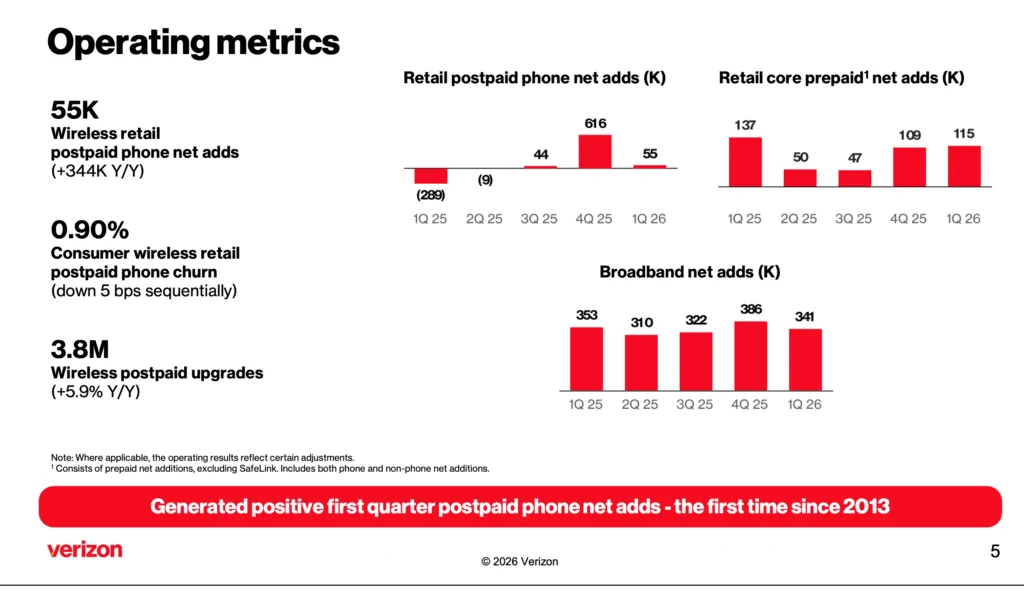
Verizon posted first-quarter 2026 results showing steady infrastructure-led growth, with fiber and fixed wireless access (FWA) continuing to scale as central pillars of its broadband strategy. The company reported $34.4 billion in revenue, up 2.9% year-over-year, alongside capital expenditures of $4.2 billion as it maintained investment across mobility and fiber networks. Broadband net additions reached 341,000 in the quarter, including 214,000 FWA adds and 127,000 fiber adds, bringing total broadband connections to approximately 16.8 million.
Network economics improved as Verizon balanced promotional discipline with infrastructure utilization. Mobility and broadband service revenue grew 1.6% year-over-year to $22.9 billion, despite a temporary 80 basis point impact from a January outage. The company also reported its first positive first-quarter postpaid phone net additions since 2013, reflecting improved churn and customer acquisition efficiency. Adjusted EBITDA rose 6.7% to $13.4 billion, marking a company record, while free cash flow reached $3.8 billion.
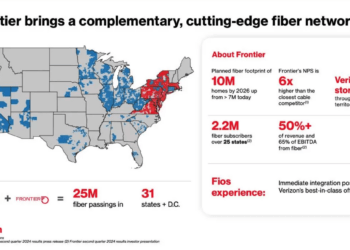
Infrastructure integration also played a role in the quarter, with Frontier Communications results included starting January 20, 2026. Verizon continues to position fiber as a long-term strategic asset while using FWA to accelerate broadband coverage and monetization. The company reaffirmed full-year capital spending of $16.0–$16.5 billion and expects continued broadband-led service revenue growth of 2–3%, signaling a sustained focus on network capacity, densification, and last-mile expansion.
• Broadband net additions: 341,000 total (214,000 FWA, 127,000 fiber)
• Total broadband connections: ~16.8 million
• Capital expenditures: $4.2 billion in Q1; $16.0–$16.5 billion expected for full year
• Mobility & broadband service revenue: $22.9 billion (+1.6% YoY)
• Adjusted EBITDA: $13.4 billion (+6.7% YoY), company record
• Free cash flow: $3.8 billion (+4.0% YoY)
• Postpaid phone net adds: 55,000 (first positive Q1 since 2013; +340,000 YoY improvement)
• Wireless retail connections: 146.8 million
“Our first-quarter 2026 results show that our turnaround is not only progressing, it is gaining momentum,” said Verizon CEO Dan Schulman. “We are beginning to reclaim our market leadership by putting the customer at the center of everything we do, reducing friction to increase loyalty and create genuine value.”
🌐 Analysis: Verizon’s results reinforce a broader industry shift toward hybrid broadband architectures that combine fiber depth with wireless last-mile delivery. Fixed wireless access continues to serve as a rapid deployment tool for coverage expansion, while fiber remains critical for long-term capacity, especially as AI-driven traffic and edge workloads increase network demand.
🌐 Analysis: Compared to peers, Verizon’s dual-track approach mirrors strategies from AT&T and T-Mobile, but its integration of Frontier assets highlights a more aggressive push into fiber ownership. The key question remains whether FWA growth can sustain performance under rising network load, particularly as AI applications and high-bandwidth services place new demands on spectrum and backhaul infrastructure.
🌐 We’re tracking the latest developments in AI infrastructure and data center networking. Follow our ongoing coverage at: https://convergedigest.com/category/ai-infrastructure/