
• Home
  • About
  • Events Calendar
  • Blueprint Guidelines
  • Privacy Policy
  • Manage Email Delivery
  • NextGenInfra.io
No Result
View All Result
Converge Digest
Monday, June 8, 2026
  • Home
  • About
  • Events Calendar
  • Blueprint Guidelines
  • Privacy Policy
  • Manage Email Delivery
  • NextGenInfra.io
No Result
View All Result
Converge Digest
No Result
View All Result

Home » SpaceXAI Details Gigawatt-Scale AI Data Centers in LEO

SpaceXAI Details Gigawatt-Scale AI Data Centers in LEO

June 8, 2026
in All, Space
A A

SpaceX is exploring an ambitious concept for deploying AI compute infrastructure in Low Earth Orbit (LEO), leveraging Starship launch capacity, Starlink networking technology, and solar-powered satellite platforms to create what executives describe as “AI satellites” operating as orbital data centers.

In a recently posted discussion on X featuring Elon Musk and SpaceX engineers, the company outlined a roadmap that could eventually scale from individual AI-enabled satellites carrying GPU clusters to multi-gigawatt orbital computing infrastructure. The concept is based on locating AI workloads directly in space, where solar energy is abundant and thermal management can be achieved through radiative cooling systems.

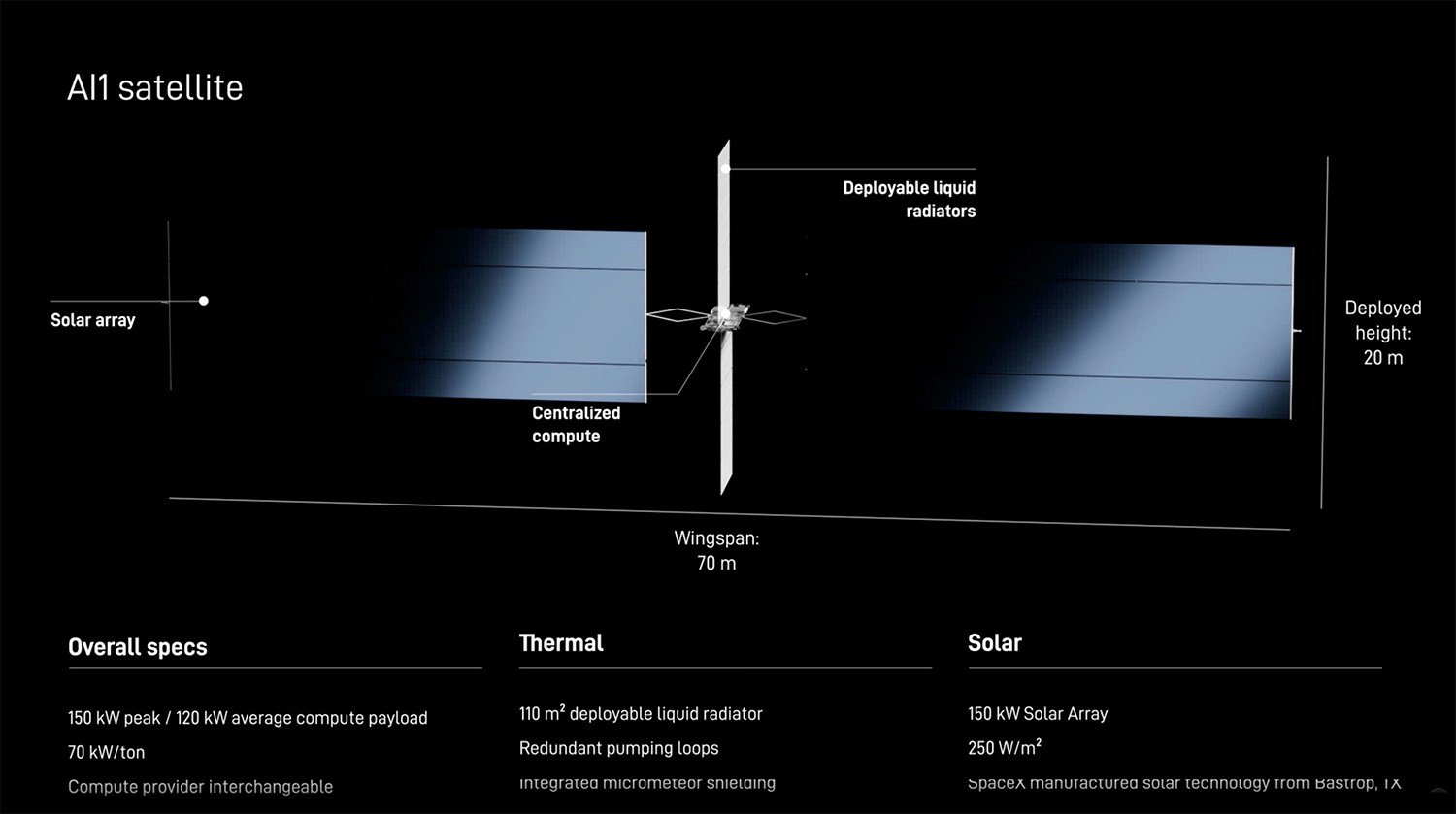
According to the discussion, the initial AI satellite design would operate at approximately 120-150 kW of compute power, roughly equivalent to a single modern AI rack based on NVIDIA GB300-class systems. The satellites would rely on large solar arrays and radiator panels derived from technologies already developed for next-generation Starlink satellites. Rather than functioning as communications satellites, the platforms would primarily consist of solar cells, radiators, compute hardware, and optical interconnects.

SpaceX executives suggested the satellites would operate at altitudes between 600 and 800 kilometers and connect either directly to each other through laser links or through the existing Starlink constellation. The company estimates latency to ground-based users could remain relatively low due to the proximity of LEO, potentially only a few milliseconds of additional propagation delay.

The discussion emphasized that the key enablers are already being developed within SpaceX. Starship is expected to dramatically increase payload capacity to orbit, while Starlink provides an operational model for large satellite constellations and optical networking in space. The company also noted plans for dedicated solar array and AI satellite manufacturing facilities in Texas.

Musk framed the initiative within a broader vision of expanding humanity’s ability to harness solar energy beyond Earth’s surface. He argued that terrestrial constraints—including land availability, weather, and energy distribution—ultimately limit the scale of AI infrastructure that can be built on Earth. By moving compute directly into space, SpaceX believes future AI systems could access vastly larger amounts of solar power while avoiding many terrestrial infrastructure bottlenecks.

Profile: SpaceX AI Satellite Concept
Orbit600–800 km Low Earth Orbit
Power120–150 kW per satellite
ComputeApprox. one NVIDIA GB300-class AI rack
ConnectivityOptical laser links and Starlink constellation integration
Solar Array Assumption~250 W/m²
Radiator Assumption~1,400 W/m², double-sided radiators oriented knife-edge to the Sun
Approx. Wingspan~70 meters
Cooling MethodPassive radiative cooling into space
LatencyPotentially a few milliseconds of propagation delay from LEO
ManufacturingPlanned SpaceX solar array and AI satellite production facilities in Texas
Orbital Scale Analysis: Terrestrial vs. Space-Based AI Infrastructure
Evaluating the structural engineering metrics required for a theoretical SpaceXAI orbital constellation to match the 300 MW footprint of xAI’s Colossus 1 supercomputer in Memphis. Assumes each satellite yields the density of a single NVIDIA GB300 NVL72 rack domain.
Architectural MetricTerrestrial: Colossus 1Orbital Target & ScaleEngineering Reality
Total Cluster Power300 MW (300,000 kW) 135 kW per sat
2,222 Satellites Required
Matches xAI Memphis continuous power target payload.
Compute Density100,000+ Terrestrial GPUs 72 GPUs per sat
160,000 Total GPUs in Orbit
Equivalent to 2,222 integrated GB300 NVL72 rack domains.
Thermal RejectionDirect Liquid Cooling (DLC) Deployable Radiative Panels
Vacuum Insulation Challenge
Space requires massive surface structures to radiate thermal signatures without air.
Primary Power SourceTVA Grid + Gas Turbines Photovoltaic Solar Wings
2,222x ISS-Scale Footprints
Each satellite demands a collection area exceeding current space station capabilities (~120kW).
Fabric / InterconnectSpectrum-X / InfiniBand Fabric Inter-Satellite Laser Links
Terabit Space Mesh Fabric
Requires syncing sub-millisecond fabrics across dynamic, moving orbital nodes.
Tags: SpaceXAI
ShareTweetShareSummarizeSummarize
Previous Post

Google and Intersect Plan Texas Data Center with 1 GW+ Dedicated Energy

Next Post

Amazon, Corning Sign Multibillion-Dollar Deal

Jim Carroll

Jim Carroll

Editor and Publisher, Converge! Network Digest, Optical Networks Daily - Covering the full stack of network convergence from Silicon Valley

Related Posts

No Content Available

Categories

  • 5G / 6G / Wi-Fi
  • AI Infrastructure
  • All
  • Automotive Networking
  • Blueprints
  • Clouds and Carriers
  • Data Centers
  • Enterprise
  • Explainer
  • Feature
  • Financials
  • Last Mile / Middle Mile
  • Legal / Regulatory
  • Optical
  • Quantum
  • Research
  • Security
  • Semiconductors
  • Space
  • Start-ups
  • Subsea
  • Sustainability
  • Video
  • Webinars

Archives

Tags

5G All AT&T Australia AWS Blueprint columns BroadbandWireless Broadcom China Ciena Cisco Data Centers Dell'Oro Ericsson FCC Financial Financials Huawei Infinera Intel Japan Juniper Last Mile Last Mille LTE Mergers and Acquisitions Mobile NFV Nokia Optical Packet Systems PacketVoice People Regulatory Satellite SDN Service Providers Silicon Silicon Valley StandardsWatch Storage TTP UK Verizon Wi-Fi
Converge Digest

A private dossier for networking and telecoms

Follow Us

  • Home
  • About
  • Events Calendar
  • Blueprint Guidelines
  • Privacy Policy
  • Manage Email Delivery
  • NextGenInfra.io

© 2026 Converge Digest - A private dossier for networking and telecoms.

No Result
View All Result
  • Home
  • About
  • Events Calendar
  • Blueprint Guidelines
  • Privacy Policy
  • Manage Email Delivery
  • NextGenInfra.io

© 2026 Converge Digest - A private dossier for networking and telecoms.

This website uses cookies. By continuing to use this website you are giving consent to cookies being used. Visit our Privacy and Cookie Policy.
Go to mobile version

