


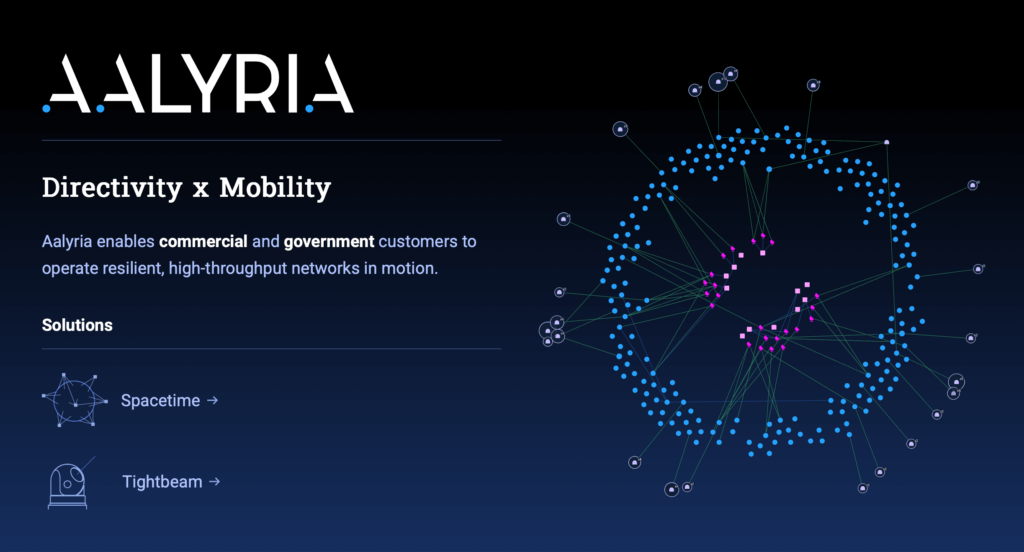
Aalyria secured $100 million in Series B funding to expand its space-based communications and network orchestration platforms, pushing its valuation to $1.3 billion. The round was led by Battery Ventures and J2 Ventures, with participation from DYNE and other investors. The Livermore, California–based company plans to use the capital to scale deployment of its Spacetime orchestration software and Tightbeam optical communications terminals.
Founded in 2021 by CEO Chris Taylor and CTO Brian Barritt following the acquisition of intellectual property developed at Google and Lawrence Livermore National Laboratory, Aalyria focuses on enabling resilient, high-throughput networks in motion. Its Spacetime platform manages and optimizes directional wireless links in real time, coordinating satellites, aircraft, ships, ground stations, and terrestrial networks as conditions shift. Tightbeam uses laser-based optical communications to deliver secure, high-capacity data links through the atmosphere, addressing the limitations of traditional broadcast wireless systems in aerospace and defense environments.
Aalyria reports deployments supporting next-generation Low Earth Orbit (LEO) constellations and U.S. government missions. The company counts Telesat, NASA, Airbus, Keysight Technologies, the European Space Agency, and others among its partners. Telesat confirmed that Spacetime’s dynamic routing and spectrum-aware resource management will integrate into its Telesat Lightspeed LEO architecture to strengthen end-to-end service delivery.
- $100 million Series B; $1.3 billion valuation
- Led by Battery Ventures and J2 Ventures; DYNE and others participated
- Spacetime software orchestrates directional networks across space, air, land, and sea
- Tightbeam laser terminals deliver high-capacity optical links through the atmosphere
- Deployments include LEO constellations and U.S. government missions
- Headquarters: Livermore, California; offices in Washington, D.C., Pittsburgh, and London
“We started Aalyria to build what space has been missing: a true communications and networking layer that scales with human and market demand,” said Chris Taylor, CEO of Aalyria. “This funding accelerates our path to becoming that ubiquitous control plane: the digital cartilage that connects thousands of independent satellites, aircraft, ships, fiber, and ground stations into a single, intelligent network that can route around failures, optimize for mission priorities, and adapt in real-time.”
🌐 Analysis: Aalyria’s funding reflects growing investor focus on software-defined orchestration and optical interconnects as LEO constellations scale toward tens of thousands of satellites. As operators such as Telesat advance next-generation architectures and governments prioritize resilient space-domain awareness, integrated control planes that unify multi-orbit and multi-domain assets are emerging as a core layer of the space communications stack.
At the physical layer, space-based laser communications are moving toward terabit-class throughput. SpaceX has outlined upgrades to its Starlink inter-satellite optical links to support multi-gigabit and higher aggregate capacities per satellite, positioning optical crosslinks as the backbone of its mesh architecture. Blue Origin has also discussed high-capacity optical relay concepts for future space infrastructure, including ambitions around Tbps-class inter-satellite connectivity to support lunar and deep-space missions. These developments signal a shift from incremental bandwidth gains to optical scaling strategies more aligned with terrestrial fiber network economics.
As optical crosslinks scale toward Tbps regimes, orchestration software becomes critical. High-capacity laser terminals create dynamic, directional meshes that must manage pointing, acquisition, tracking, spectrum allocation, and routing across rapidly moving nodes. Platforms such as Aalyria’s Spacetime aim to abstract that complexity into a programmable control layer, allowing operators to treat space assets as an integrated network fabric rather than discrete links. The convergence of terabit-class optical hardware and AI-driven control planes will likely define the competitive landscape for next-generation space communications.
🌐 We’re tracking the latest developments in space infrastructure and satellite networking. Follow our ongoing coverage at: https://convergedigest.com/category/space