


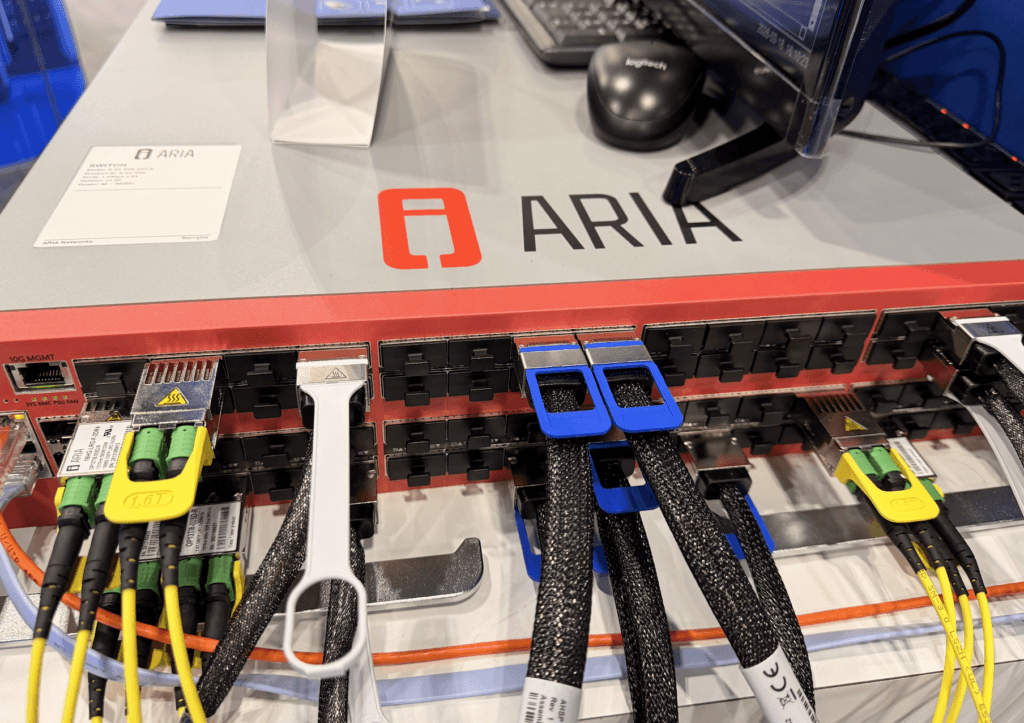
Aria Networks introduced its “Deep Networking” platform, positioning the network as a primary lever for improving token efficiency and Model Flop Utilization (MFU) in large-scale AI clusters. The company also disclosed $125 million in funding backed by Sutter Hill Ventures, Atreides Management, Valor Equity Partners, and Eclipse Ventures, alongside new board participation from Atreides’ Gavin Baker.
The platform integrates hardened SONiC, fine-grained telemetry, and distributed intelligent agents to create what Aria describes as an AI-native network stack. The system targets both training and inference clusters, where network performance directly impacts gradient synchronization, KV cache movement, and job scheduling across thousands of accelerators. Aria argues that even marginal improvements in MFU can offset total network cost, given that networking typically represents 10–15% of AI infrastructure spend but influences overall system efficiency.
Aria’s architecture centers on five pillars: AI-optimized switching hardware supporting 800GbE and 1.6T Ethernet, telemetry with 100–10,000x higher resolution than conventional tools, intelligent agents embedded across the stack, domain-aware decision-making, and continuous software updates. The system enables intent-based configuration, real-time optimization, and autonomous fine-tuning of routing, congestion, and failover. Aria also embeds field deployment engineers directly within customer teams to co-develop and optimize AI factory environments.
- Introduces “Deep Networking,” an AI-native approach focused on token efficiency and MFU
- Raises $125M with participation from Sutter Hill Ventures, Atreides, Valor Equity, and Eclipse
- Supports 800GbE and 1.6T Ethernet switching in air- and liquid-cooled configurations
- Delivers 100–10,000x higher telemetry resolution across switches, optics, and hosts
- Uses distributed intelligent agents for real-time network optimization and automation
- Enables intent-based configuration and continuous adaptive tuning of AI workloads
- Targets both training and inference clusters, including large-scale disaggregated inference
- Aligns with industry trends toward Ethernet-based AI fabrics and liquid-cooled infrastructure
“The network has become a key obstacle in AI infrastructure. Deep Networking changes that – and the economics prove it: a 10% gain in tokens per second is a 10% gain in revenue. What this team has built and shipped in such a short time is extraordinary,” said Mansour Karam, Founder & CEO of Aria Networks.
“Proprietary fabrics are a thing of the past. With its 1.6Tbps launch, combined with a telemetry-centric software architecture, Aria Networks is proving that the highest-performance AI networks on the planet are being built on a foundation of open, scalable Ethernet such as Broadcom’s Tomahawk 6 switch series,” said Hasan Siraj, Vice President of Product Marketing, Core Switching Group at Broadcom.
🌐 Analysis: Aria Networks enters a competitive segment where hyperscalers and vendors such as Broadcom, NVIDIA, and Cisco increasingly position the network as a determinant of AI system efficiency rather than a transport layer. The emphasis on token efficiency and MFU aligns with broader industry shifts toward measurable workload-level KPIs for AI infrastructure ROI.
Mansour Karam previously co-founded Apstra and served as its CEO, where he helped pioneer intent-based networking (IBN) as a model for automating data center operations. Apstra’s software allowed operators to define high-level network intent—such as performance, resiliency, and policy requirements—and continuously validate that the underlying infrastructure met those objectives through closed-loop telemetry and analytics. This approach reduced configuration errors and improved operational reliability at scale, particularly in complex, multi-vendor environments. In 2021, Juniper Networks acquired Apstra to integrate its IBN capabilities into Juniper’s data center portfolio, marking a significant step toward software-defined, automated network operations.
🌐 Analysis: The combination of SONiC-based openness, high-resolution telemetry, and agent-driven control reflects ongoing momentum toward Ethernet-based AI fabrics and software-defined optimization, particularly as clusters scale to 1.6T interconnects and liquid-cooled, megawatt-class deployments.