


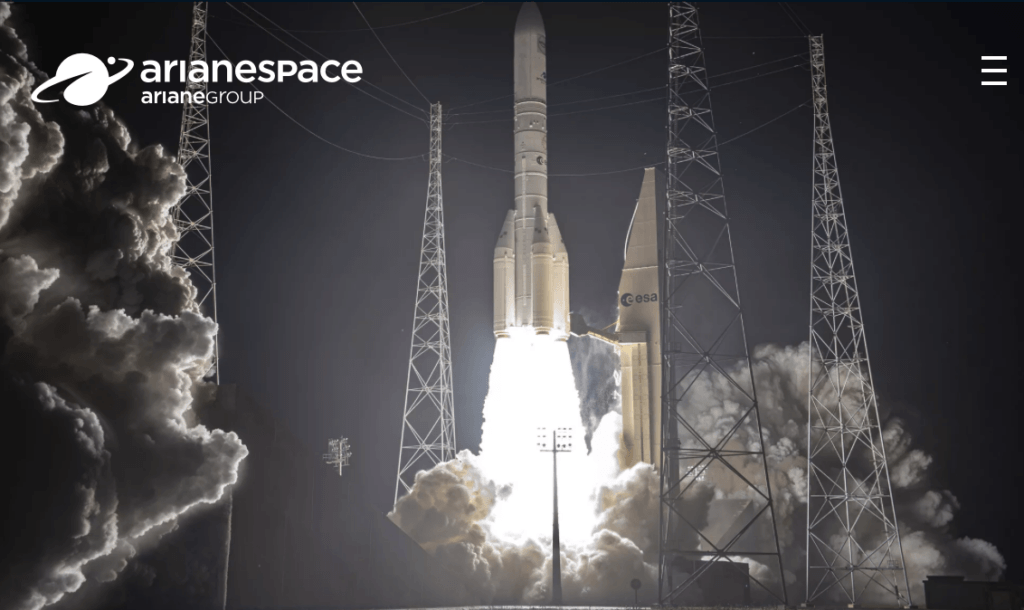
Arianespace launched 32 Amazon Leo satellites into low Earth orbit on April 30, using the four-booster Ariane 64 configuration from Europe’s Spaceport in Kourou, French Guiana.
Mission VA268, also designated LE-02 by Amazon Leo, lifted off at 5:57 a.m. local time and completed its deployment sequence in 1 hour and 54 minutes. The satellites reached low Earth orbit at approximately 465 km, with separation completed across 12 phases.
The mission marked the second Ariane 6 launch for Amazon Leo and the second of 18 planned Arianespace missions supporting Amazon’s LEO broadband constellation. Amazon Leo aims to deliver fast internet connectivity to communities and users beyond the reach of existing terrestrial networks.
- 32 Amazon Leo satellites deployed on VA268 / LE-02
- 64 Amazon Leo satellites launched by Ariane 6 so far in the campaign
- 7th Ariane 6 flight overall
- 2nd Ariane 64 mission using the four-booster configuration
- 360th Arianespace launch
- 2nd Arianespace launch of 2026
- Satellites deployed at approximately 465 km altitude
- Ariane 64 stood about 62 m tall, with a 20 m fairing
The previous Arianespace launch for Amazon’s LEO constellation (prior to VA268 / LE-02 on April 30, 2026) took place on March 6, 2026. That mission—VA263 / LE-01—was the first Ariane 6 launch dedicated to Amazon Leo, deploying an initial batch of 32 satellites and marking the start of Arianespace’s contracted series of 18 launches for the constellation.
“This second launch for Amazon Leo marks another milestone in Ariane 6’s ramp-up, demonstrating our ability to meet the growing needs of the constellation market and to deliver reliable, competitive solutions to our customers. We thank Amazon for its trust and remain fully mobilised to ensure the success of this partnership,” said David Cavaillolès, CEO of Arianespace.
Ariane 64 (Ariane 6 Four-Booster Configuration) – Key Specifications
| Parameter | Specification |
|---|---|
| Launch Vehicle | Ariane 64 (Ariane 6 with four solid rocket boosters) |
| Manufacturer | ArianeGroup (operated by Arianespace) |
| Launch Site | Guiana Space Centre, Kourou, French Guiana |
| Total Height | ~62 meters (~203 feet) |
| Lift-off Mass | ~870 metric tons (~959 short tons) |
| Core Stage | Cryogenic (liquid hydrogen / liquid oxygen) |
| Core Engine | Vulcain 2.1 engine |
| Upper Stage | Cryogenic upper stage with restart capability |
| Upper Stage Engine | Vinci engine (reignitable) |
| Solid Boosters | 4 × P120C solid rocket boosters |
| Payload to LEO | Up to ~21.5 metric tons (~23.7 short tons) |
| Payload to GTO | Up to ~11.5 metric tons (~12.7 short tons) |
| Fairing Length | Up to ~20 meters (~65.6 feet) |
| Fairing Diameter | 5.4 meters (~17.7 feet) |
| Typical Mission Profile | Multi-satellite deployment, dual payloads, constellation launches |
| Notable Capability | Multiple restart upper stage enables complex orbital insertions and phased deployments |
🌐 Analysis: The launch reinforces Europe’s effort to bring Ariane 6 into regular commercial service at a time when LEO constellation deployments require repeatable heavy-lift capacity and multi-satellite deployment precision. Amazon Leo’s use of Ariane 6 also reflects the broader need for launch diversity as large broadband constellations scale beyond single-provider launch strategies.
Amazon Leo (Project Kuiper) Launch Strategy – Multi-Provider Overview (May 2026)
| Provider | Vehicle | Launches | 2026 Status | Role & Notes |
|---|---|---|---|---|
| Arianespace | Ariane 6 / Ariane 64 | 18 | Active; ramping cadence |
Early deployment backbone (Europe). ~30+ satellites per launch. Missions: Mar 6 (LE-01), Apr 30 (LE-02). Four-booster Ariane 64 now validated. |
| ULA | Vulcan Centaur | 38 | Early operational phase |
Primary U.S. deployment engine. High satellite density per launch. Ramp tied to BE-4 supply and cadence scaling. |
| Blue Origin | New Glenn | 12 | Pending debut |
Future high-capacity platform. Large fairing for dense stacking. Timeline depends on New Glenn entry into service. |
| SpaceX | Falcon 9 | 3 | Near-term support |
Gap-filler for early deployment. High cadence, proven system. Used to mitigate schedule risk. |
| Total Program | — | ~70+ | Multi-year rollout |
Typical payload: ~30–45 satellites/launch. Phased deployment across 2026–2027+. Multi-provider strategy reduces launch risk and accelerates time-to-service. |