


Arista Networks reported first quarter 2026 revenue of $2.709 billion, up 35.1% year-over-year, as hyperscale AI infrastructure spending continued to drive strong demand for high-speed Ethernet switching, AI spine architectures, and optical interconnect technologies. Net income reached $1.02 billion, while operating cash flow surged to $1.69 billion. The company also guided for approximately $2.8 billion in Q2 revenue, signaling continued momentum in AI cluster deployments and cloud-scale networking upgrades.
During the quarter, Arista highlighted several initiatives targeting next-generation AI data centers. The company introduced its XPO high-density liquid-cooled pluggable optics architecture, designed to reduce networking racks by up to 75% and lower floor space requirements by as much as 44% compared to traditional pluggable optics deployments. The XPO initiative, developed within the newly announced XPO MSA ecosystem, aims to support shorter copper and RF cable runs for AI scale-up networks while addressing power and thermal constraints in large GPU clusters.
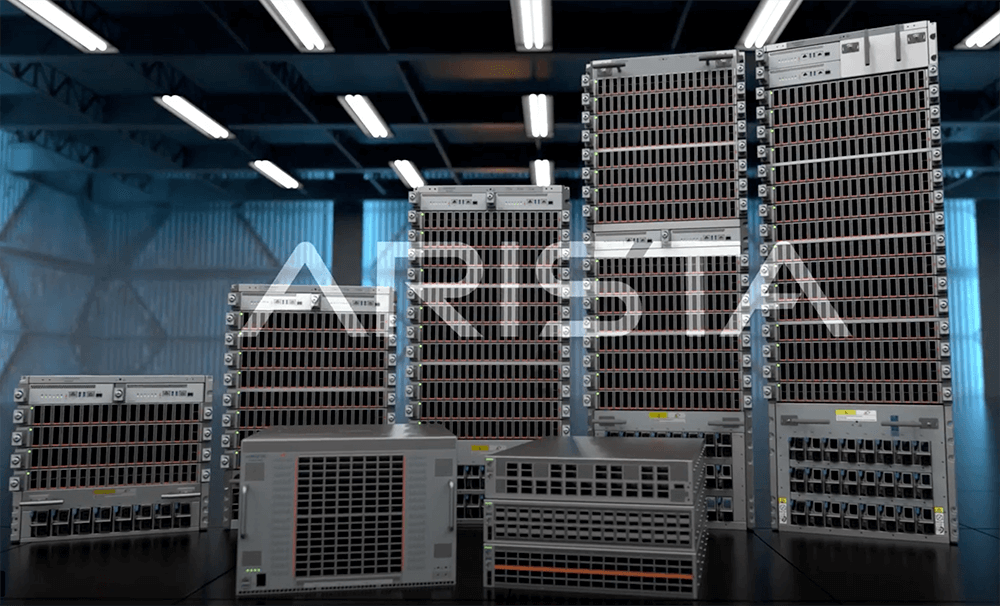
Arista also expanded its AI networking portfolio with the introduction of its universal AI spine architecture powered by the Arista 7800 platform. The design incorporates Virtual Output Queuing (VOQ) to reduce head-of-line blocking and large packet buffers to absorb AI traffic microbursts while mitigating Priority Flow Control (PFC) congestion events. CEO Jayshree Ullal said the company is “uniquely positioned to deliver the mission-critical confluence of secure client-to-campus-to-cloud and AI networking.” CFO Chantelle Breithaupt added that the company’s results demonstrate “high-quality growth while maintaining a rigorous focus on the bottom line.”
- Q1 2026 revenue: $2.709 billion, up 35.1% year-over-year
- Product revenue: $2.31 billion
- Service revenue: $397.7 million
- GAAP operating margin: 42.7%
- Non-GAAP operating margin: 47.8%
- GAAP diluted EPS: $0.80
- Non-GAAP diluted EPS: $0.87
- Operating cash flow: $1.69 billion
- Cash and marketable securities: approximately $12.35 billion
- Q2 2026 revenue guidance: approximately $2.8 billion
- 2026 Net Promoter Score (NPS): 89, with 94% of customers rated as strongly positive
“Arista is off to a strong start in Q1 2026, with both our results and our industry-leading net promoter score,” said Jayshree Ullal, Chairperson and CEO of Arista Networks. “We are uniquely positioned to deliver the mission-critical confluence of secure client-to-campus-to-cloud and AI networking.”

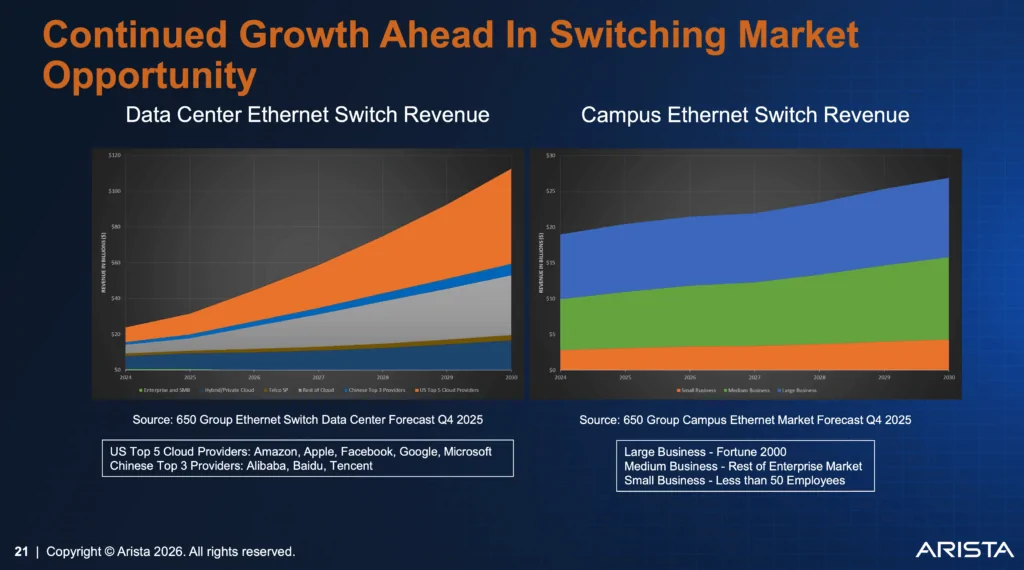

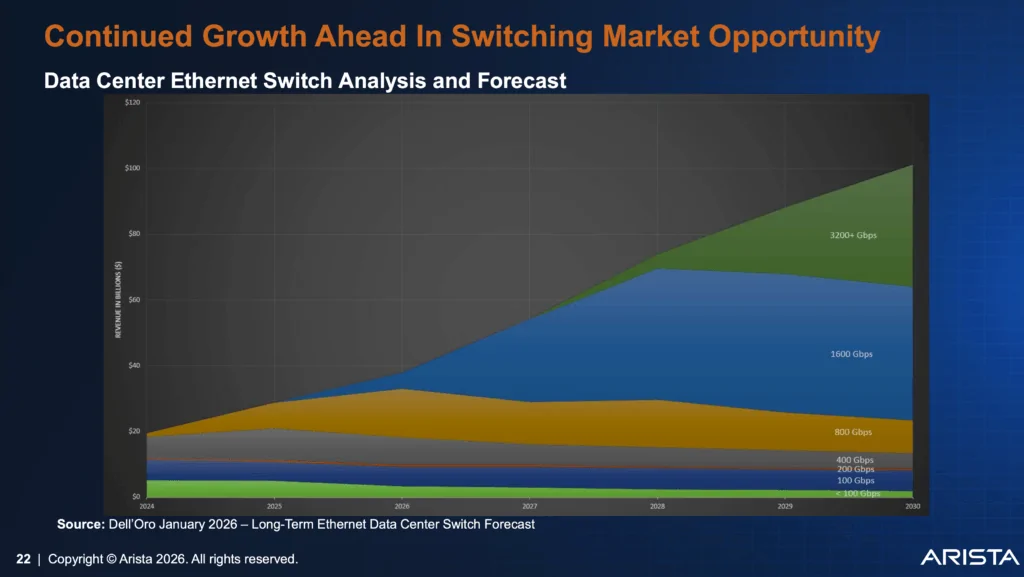
Addendum: Key points from Arista’s Q1 2026 investor call
- Arista said it now holds the No. 1 market share position in high-speed switching above 10G Ethernet, according to major market analysts for 2025.
- Management framed AI networking around three deployment modes: scale-up, scale-out, and scale-across.
- Scale-up remains a 2027-and-beyond opportunity for Arista, tied to ESUN Ethernet scale-up specifications, co-packaged copper, open CPO, collectives acceleration, and memory acceleration.
- Arista said it has 5–7 active scale-up rack opportunities in engineering, with some involving multiple racks at the same customer.
- Scale-out remains Arista’s core AI networking heritage, with more than 100 cumulative customers now deploying 800G Ethernet.
- Arista expects 1.6T Ethernet deployments to reach production scale in 2027.
- Scale-across emerged as a major AI growth vector, especially where data centers must distribute workloads across regions or sites due to power constraints.
- Management said scale-across could represent at least one-third of Arista’s 2026 AI revenue target.
- Arista raised its 2026 AI fabrics revenue target to $3.5 billion, more than doubling annually.
- The company raised its full-year 2026 revenue outlook to approximately $11.5 billion, implying 27.7% growth.
- Arista described demand as the strongest Jayshree Ullal has seen during her tenure, but said supply constraints now span wafers, silicon, CPUs, optics, and memory.
- Management warned that supply constraints could last one to two years, not just one or two quarters.
- Arista said 52-week lead times are becoming common for key components, with reservation requirements extending beyond that.
- Purchase commitments rose to $8.9 billion, largely for chips tied to new products and AI deployments.
- Arista said it may accept gross margin pressure to secure supply and avoid leaving customer AI infrastructure underutilized.
- Management said large cloud customers Microsoft and Meta remain long-standing 10%+ customers, while one or two additional customers could reach that threshold depending on shipment availability.
- NeoCloud and sovereign cloud customers were described as important growth areas, especially because they often rely on Arista for design, EOS, and deployment expertise.
- Arista cited a NeoCloud win where a customer moved from white-box infrastructure to Arista’s “blue box” AI leaf-spine architecture using 800G Ethernet and AMD MI-series accelerators.
- The company said it sees growing opportunity with diverse accelerators, including AMD GPUs and TPUs, especially in scale-across and multi-tenant AI environments.
- Arista said back-end AI networking activity now dominates customer attention, with front-end upgrades likely to follow as CPU, storage, and wide-area connectivity must keep pace.
- Management now sees front-end-to-back-end networking pressure closer to 1:1 rather than the previous 2:1 framework.
- Arista said XPO could influence the next decade of pluggable optics much as OSFP shaped the previous decade.
- Management positioned XPO as complementary to OSFP: OSFP remains suitable for 400G and 800G, while XPO becomes more important at 1.6T and 3.2T-class speeds.
- XPO received support from more than 100 vendors, far above Arista’s initial expectations.
- Deferred revenue increased because AI deployments now require longer qualification cycles, including customer facility readiness, GPU availability, rack-and-stack work, cabling, testing, and acceptance.
- Arista said AI qualification cycles that once ran 2–4 quarters can now stretch to 6–8 quarters.
- Enterprise momentum broadened beyond AI, with highlighted wins in insurance, manufacturing, service provider routing, campus networking, observability, and monitoring fabrics.
- VeloCloud integration is adding branch and campus use cases while opening a managed service provider channel motion.
- Arista reaffirmed its 2026 campus revenue target of $1.25 billion.
- Management said it does not expect services revenue to become a much larger share of sales; Arista remains product-led even as it provides more network design assistance.
🌐 Analysis: Arista continues to benefit from one of the strongest AI infrastructure spending cycles in networking history, as hyperscalers rapidly scale Ethernet-based AI fabrics for training and inference clusters. The company has increasingly positioned Ethernet as an alternative to proprietary AI interconnect ecosystems by emphasizing large-scale, low-latency AI spine architectures combined with advanced congestion management and high-density optics integration.
🌐 The XPO initiative also reflects a broader industry push toward tightly integrated optical and electrical interconnect designs optimized for AI clusters. Competitors including NVIDIA, Broadcom, Cisco, and Juniper are all advancing new AI fabric architectures, while the industry simultaneously explores co-packaged optics, linear pluggable optics, and liquid-cooled interconnect systems to reduce power consumption and rack complexity at hyperscale deployments.

