


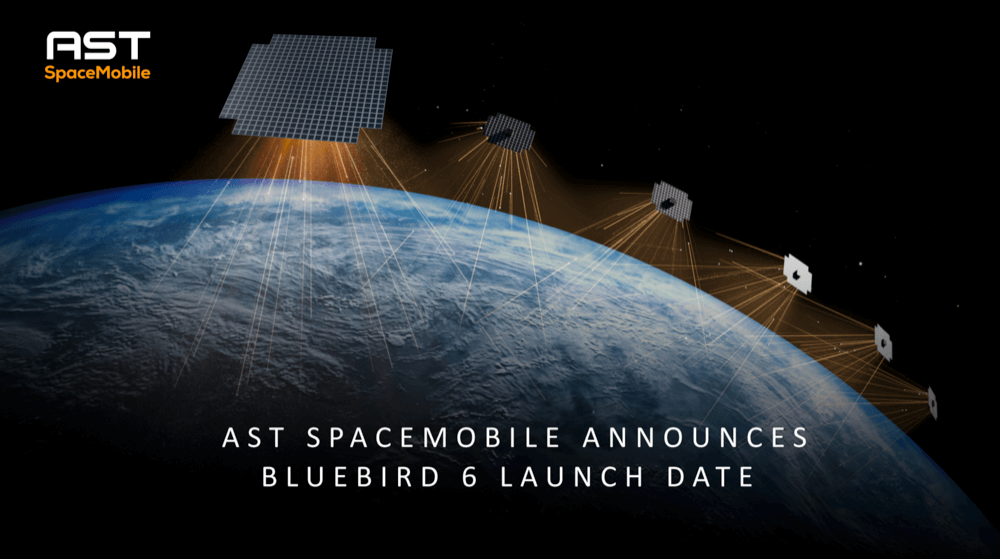
AST SpaceMobile outlined plans for a mid-June 2026 launch of three next-generation BlueBird satellites aboard a SpaceX Falcon 9 rocket, maintaining deployment momentum after the off-nominal orbit and subsequent de-orbit of BlueBird 7 following its April 19 mission on Blue Origin’s New Glenn vehicle. The update appeared on the company’s official X account on May 6, 2026, confirming a shift in launch provider strategy as AST SpaceMobile accelerates rollout of its direct-to-device satellite broadband constellation for standard 4G and 5G smartphones.
The upcoming Block 2 BlueBird satellites feature large phased-array antennas and AST SpaceMobile’s proprietary AST5000 ASIC processor, designed to support peak throughput rates of up to 120 Mbps per cell. The company stated that 32 additional next-generation satellites are already in advanced stages of assembly. AST SpaceMobile also highlighted the scale of its Texas manufacturing operation, which exceeds 500,000 square feet (46,500 square meters) at full production capacity.
The deployment plan reinforces AST SpaceMobile’s strategy of integrating non-terrestrial networking infrastructure directly with terrestrial mobile carrier networks, including partnerships with AT&T and Verizon. The architecture aims to extend broadband cellular coverage into underserved and remote regions without requiring specialized handsets or external antennas. AST SpaceMobile indicated it intends to sustain a launch cadence averaging one mission every one to two months through the remainder of 2026, supporting more than $1.2 billion in contracted revenue commitments tied to its space-based cellular broadband platform.
- Mid-June 2026 launch planned for three Block 2 BlueBird satellites aboard Falcon 9
- 32 next-generation satellites currently in advanced assembly stages
- AST5000 ASIC processor targets peak throughput of 120 Mbps per cell
- Manufacturing footprint exceeds 500,000 square feet (46,500 square meters)
- Planned deployment cadence averages one launch every one to two months through 2026
- Network designed for direct connectivity to unmodified 4G and 5G smartphones
- Supports integration with terrestrial carrier partners including AT&T and Verizon
“Announcement: Mid-June launch of three Bluebird satellites aboard a Falcon 9 rocket. 32 next-generation satellites at advanced stages of assembly to be ready for launch. Network deployment with a launch every one to two months on average. Space-based cellular broadband. Built in Texas.”
🌐 Analysis: AST SpaceMobile continues to position itself as one of the most ambitious entrants in the emerging direct-to-device satellite connectivity sector, competing against initiatives from SpaceX/T-Mobile, Lynk Global, and other non-terrestrial network providers pursuing 3GPP-compliant satellite-to-phone architectures. The company’s emphasis on large phased-array satellites and terrestrial spectrum partnerships differentiates its approach from traditional satellite broadband systems that require dedicated terminals.
🌐 The switch from New Glenn to Falcon 9 also highlights the growing operational importance of launch reliability and cadence for next-generation space infrastructure deployments. With satellite production now scaling and launch frequency accelerating, AST SpaceMobile faces the broader industry challenge of transitioning from demonstration missions to commercially sustainable global service delivery while competitors simultaneously expand low Earth orbit mobile connectivity offerings.