


AT&T reported Q4 2025 revenue of $33.5 billion, adjusted EPS of $0.52, adjusted EBITDA of $11.2 billion, and free cash flow of $4.2 billion. For full-year 2025, AT&T posted revenue of $125.6 billion, adjusted EPS of $2.12, adjusted EBITDA of $46.4 billion, and free cash flow of $16.6 billion, while holding annual capital investment essentially flat at about $22.0 billion.
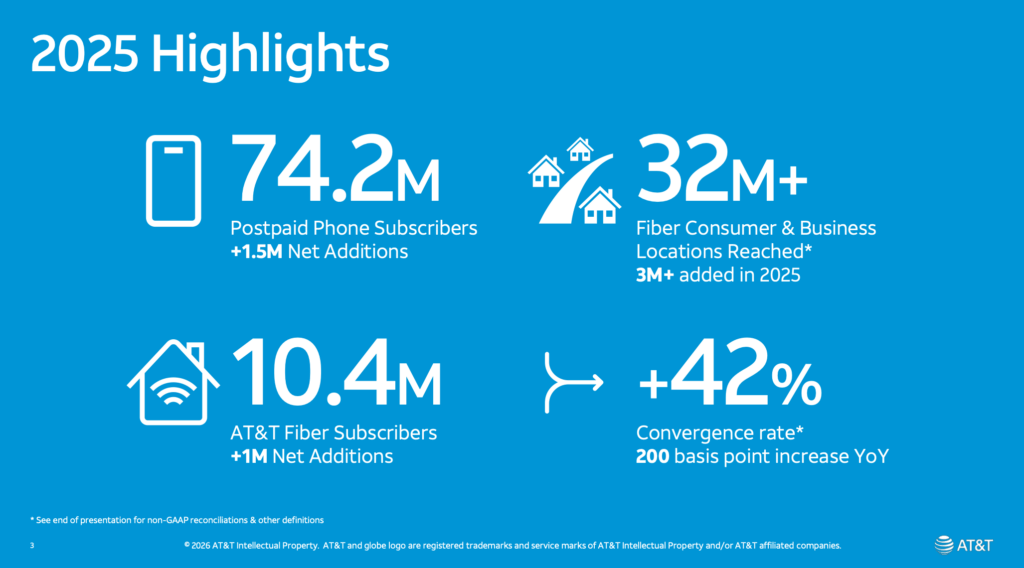
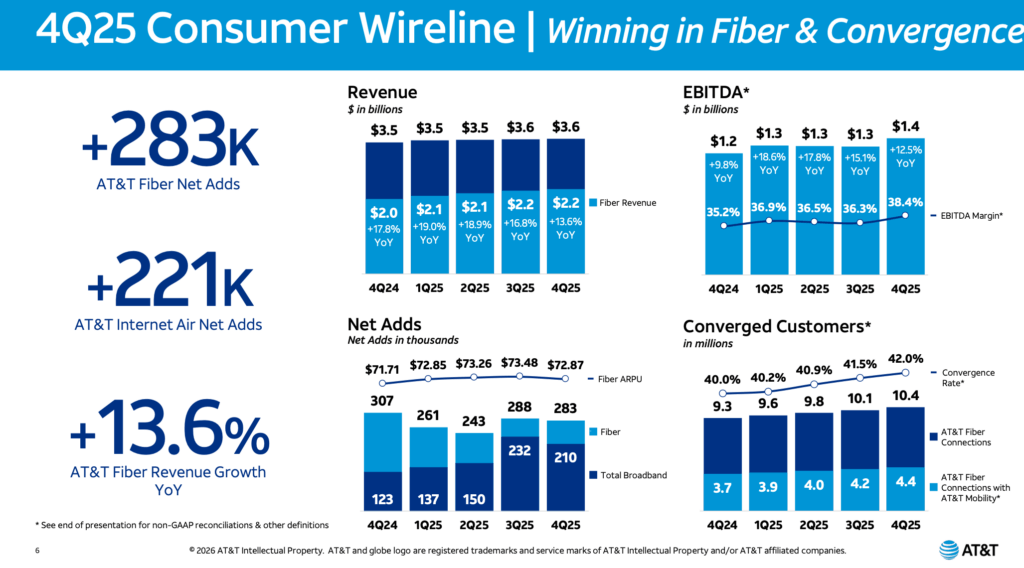
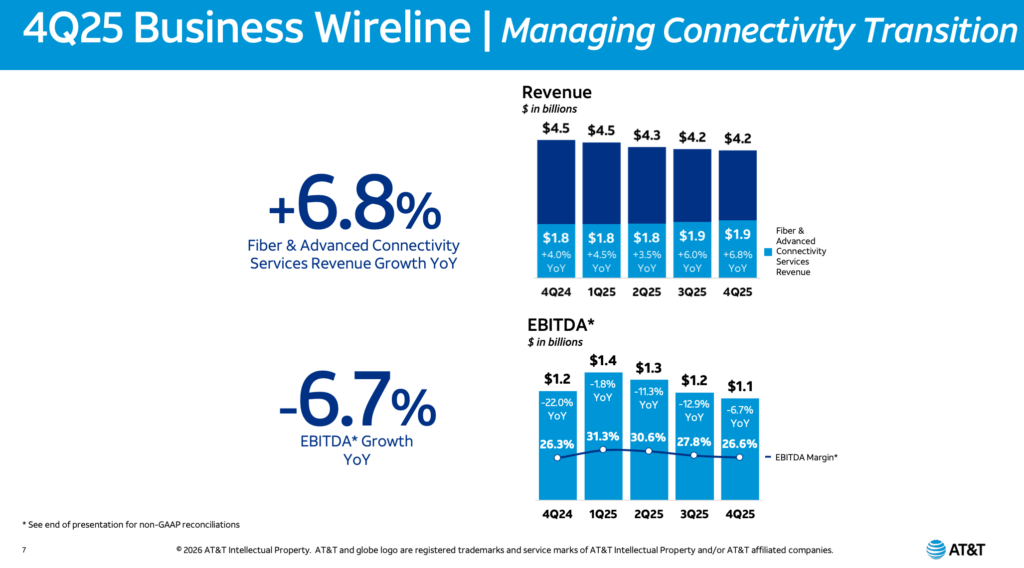
The company tied its operating narrative to “converged” service adoption and access-network mix. AT&T said 42% of AT&T Fiber households also subscribe to AT&T wireless, and it pointed to Q4 net adds of 283,000 fiber subscribers plus 221,000 AT&T Internet Air subscribers as evidence that fiber and fixed wireless access (FWA) now operate as complementary engines for broadband growth. AT&T also disclosed 32.0 million consumer and business locations passed with fiber and said it will restructure segment reporting starting in Q1 2026 around “Advanced Connectivity” (domestic 5G + fiber), “Legacy” (copper-based services), and “Latin America” (Mexico wireless).
For 2026–2028, AT&T forecast low-single-digit annual service revenue growth, adjusted EBITDA growth rising toward 5%+ by 2028, and free cash flow stepping up from $18B+ (2026) to $21B+ (2028). Management linked that outlook to continued 5G and fiber investment (capital investment of $23–$24 billion per year) and to two previously announced deals expected to close in 2026: the acquisition of substantially all of Lumen’s Mass Markets fiber business (expected in the first half of 2026) and the purchase of EchoStar spectrum licenses (AT&T said the spectrum deal targets a mid-2026 close). AT&T also reiterated its goal to power down most of its copper network by the end of 2029 as it migrates customers to fiber and 5G-based services.
- Q4 2025: revenue $33.5B; adjusted EPS $0.52; adjusted EBITDA $11.2B; capex $6.8B; free cash flow $4.2B
- FY 2025: revenue $125.6B; adjusted EPS $2.12; adjusted EBITDA $46.4B; capital investment $22.0B; free cash flow $16.6B
- Converged penetration: 42% of AT&T Fiber households also take AT&T wireless (company-defined convergence metric)
- Q4 broadband adds: 283,000 fiber net adds; 221,000 Internet Air net adds; 32.0M locations passed with fiber
- Segment reporting (Q1 2026): Advanced Connectivity, Legacy, Latin America; AT&T provided recast historicals for 2023–2025
- 2026–2028 targets: capital investment $23–$24B annually; free cash flow rising to $21B+ by 2028; $45B+ planned shareholder returns (dividends + buybacks)
- Network transition: AT&T targets broad copper power-down by end of 2029; Legacy revenue decline of 20%+ in 2026 (per company outlook)
“We achieved or surpassed all of our consolidated full-year guidance for 2025,” said John Stankey, AT&T Chairman and CEO. “With new investments in spectrum and fiber, we’re set to win more customers in more categories and geographies across the U.S.”
AT&T Wireless Subscribers, Churn & ARPU (Year-End)
End-of-period (12/31) values| Metric (Year-End) | 2023 | 2024 | 2025 |
|---|---|---|---|
| Total Wireless Subscribers (000s) | 106,340 | 108,223 | 109,173 |
| Phone Subscribers (000s) | 88,713 | 89,966 | 90,844 |
| • Postpaid Phone Subscribers (000s) | 71,255 | 72,749 | 74,214 |
| • Prepaid Phone Subscribers (000s) | 17,458 | 17,217 | 16,630 |
| Postpaid Phone Churn | 0.84% | 0.85% | 0.98% |
| Prepaid Phone Churn | 2.86% | 2.61% | 2.75% |
| Phone ARPU ($/month) | $52.35 | $52.92 | $52.85 |
| Postpaid Phone ARPU ($/month) | $56.23 | $56.72 | $56.57 |
| Prepaid Phone ARPU ($/month) | $36.63 | $36.99 | $36.49 |
AT&T Internet Connections (Fiber & Fixed Wireless) – Year-End
End-of-period (12/31) values| Metric (Year-End, 000s) | 2023 | 2024 | 2025 |
|---|---|---|---|
| Total Internet Connections | 9,215 | 10,939 | 13,128 |
| Fiber Connections (Total) | 8,824 | 9,928 | 11,088 |
| • AT&T Fiber (Consumer) | 8,307 | 9,331 | 10,406 |
| • AT&T Business Fiber | 517 | 597 | 682 |
| Fixed Wireless Connections (Total) | 391 | 1,011 | 2,040 |
| • AT&T Internet Air (Consumer FWA) | 93 | 634 | 1,497 |
| • Business Fixed Wireless Access | 298 | 377 | 543 |
| % AT&T Fiber connections with AT&T Wireless | 38.8% | 40.0% | 42.0% |
See AT&T Financial and Operational Trends
🌐 Analysis: The three-year subscriber data show AT&T’s access strategy consolidating around higher-retention, converged relationships, with postpaid wireless subscribers rising from 71.3 million in 2023 to 74.2 million in 2025 while postpaid churn stayed below 1% through 2024 and only ticked up modestly in 2025. At the same time, ARPU stability across both postpaid wireless (roughly $56–$57/month) and fiber broadband underscores that AT&T is prioritizing mix quality and bundle attachment over aggressive price-led growth, using convergence to defend revenue per user rather than relying on headline subscriber additions alone.
On the fixed side, the numbers highlight a dual-track broadband architecture: fiber remains the dominant growth engine, expanding from 8.8 million to 11.1 million connections between 2023 and 2025, while fixed wireless access scaled rapidly from a niche offering (391,000 connections in 2023) to a material second access rail at more than 2.0 million connections in 2025. The sharp rise in AT&T Internet Air—alongside steady growth in business fixed wireless—suggests AT&T is using FWA tactically to accelerate footprint expansion and customer acquisition where fiber economics or timelines are less favorable, while still anchoring long-term value in fiber-backed convergence, as reflected by the increase in fiber households also taking wireless from 38.8% to 42.0% over the period.