


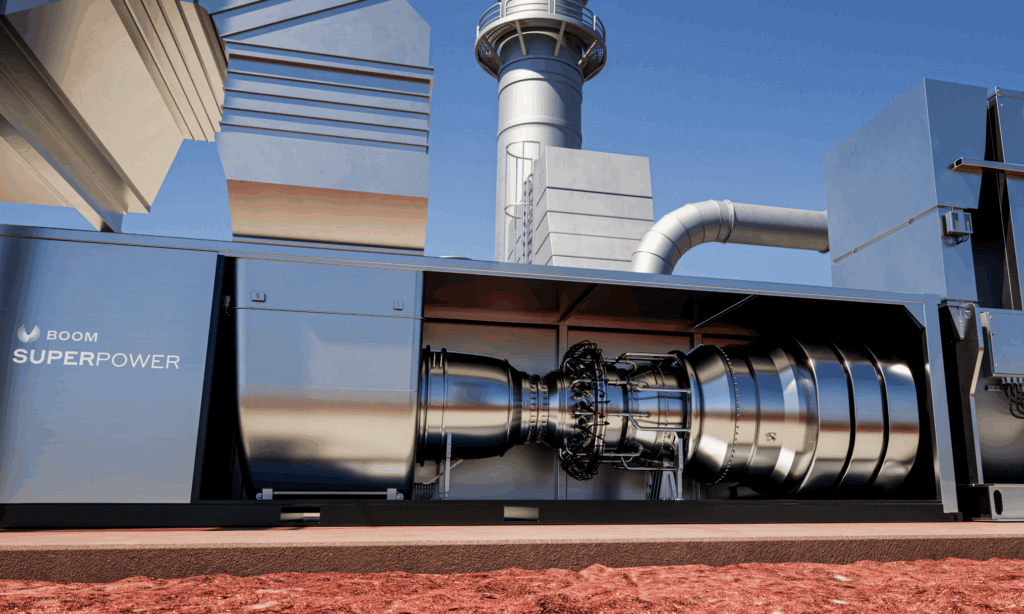
Boom Supersonic, which is developing commercial supersonic aircraft, unveiled its new 42 MW Superpower natural-gas turbine for data centers and confirmed Crusoe as the launch customer with an order for 29 units. The company also raised $300 million in new funding led by Darsana Capital Partners, joined by Altimeter Capital, ARK Invest, Bessemer Venture Partners, Robinhood Ventures, and Y Combinator. Boom said revenue from the Superpower turbine business will help finance certification of its Overture supersonic airliner and development of the Symphony engine that powers both the aircraft and the turbine.
Superpower uses the same supersonic-derived core technologies as Symphony, including extreme-temperature materials and high-pressure engine architecture optimized for sustained output in harsh thermal environments. Unlike many aeroderivative turbines, Superpower maintains full 42 MW capacity even above 110°F (43.3°C), operates without water, and fits in a shipping-container footprint—attributes positioned for deployment in power-constrained AI data center regions. Boom expects total turbine production to reach more than four gigawatts annually by 2030.
“Supersonic technology is an accelerant—of course for faster flight, but now for artificial intelligence as well,” said Blake Scholl, founder and CEO of Boom Supersonic. “With this financing and our first order for Superpower, Boom is funded to deliver both our engine and our airliner.”
Key points
- Boom reports more than $1.25B in Superpower turbine backlog
- Crusoe orders 29 turbines to power natural-gas-driven AI data centers
- $300M Series B led by Darsana Capital Partners
- Superpower delivers 42 MW, full output above 110°F (43.3°C), no-water operation
- Production targets exceed 4 GW annually by 2030
- Funding supports Symphony engine development and Overture certification
- Boom’s airliner order book totals 130 aircraft, including United, American, and Japan Airlines
- Engine-core testing begins in 2026 at Boom’s Colorado facility
Analysis
Boom has pursued supersonic passenger aviation since 2014, beginning with conceptual designs for Overture and its XB-1 demonstrator. The company pivoted heavily into engine development after legacy propulsion suppliers declined to design a bespoke supersonic engine, prompting Boom to launch the in-house Symphony program in 2022. That decision created significant technical and financial requirements—factors that have historically challenged commercial supersonic projects. The Superpower turbine represents Boom’s effort to monetize its high-temperature engine core earlier in the development cycle, generating revenue and field data while reducing reliance on external financing.
Boom’s backlog for Superpower marks its first major commercial traction outside aviation and reflects growing demand for fast-deployable energy solutions for AI data centers. Crusoe’s order also aligns with the broader industry trend toward natural-gas micro-grids and containerized power systems built close to AI clusters to avoid regional transmission delays. If Boom succeeds in scaling turbine deliveries and meeting its 2026 Symphony test schedule, the dual-use engine strategy could provide a bridge toward eventual certification of Overture, positioning Boom among the few companies attempting both a next-generation commercial aircraft and an industrial-scale power business in parallel.
🌐 We’re tracking the latest developments in aerospace, energy systems, and AI infrastructure. Follow our ongoing coverage at: https://convergedigest.com/category/ai-infrastructure/
🌐 We’re launching the “Data Center Networking for AI” series on NextGenInfra.io and inviting companies building real solutions—silicon, optics, fabrics, switches, software, orchestration—to share their views on video and in our expert report. To get involved, send a note to jcarroll@convergedigest.com or info@nextgeninfra.io.