


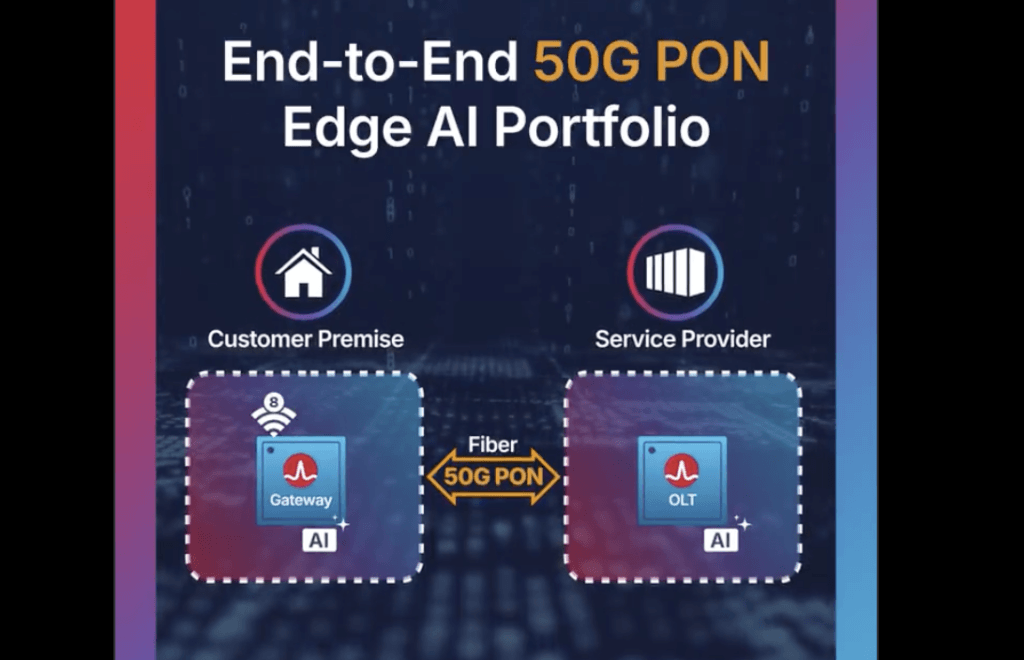
Broadcom introduced the BCM68850, a 50G ITU-PON home gateway SoC with an integrated neural processing unit and native Wi-Fi 8 compatibility, targeting the next generation of fiber broadband gateways. The company said the new device completes its end-to-end 50G PON portfolio, spanning the BCM68660 OLT, BCM55050 ONT, and BCM68850 CPE gateway.
The BCM68850 targets operators preparing for higher-bandwidth residential and enterprise services, including AI-assisted applications, multi-stream ultra-high-definition telepresence, and low-latency edge workloads. By integrating an NPU into the gateway SoC, Broadcom aims to support local AI inference, anomaly detection, predictive bandwidth optimization, and reduced dependence on cloud processing for some latency-sensitive functions.
Broadcom said the BCM68850 and BCM55050 are currently sampling to early access customers and partners. The company positions the platform as part of a broader NPU-accelerated portfolio across fiber, cable, set-top box, and Wi-Fi products.
| Broadcom 50G PON Edge AI Portfolio | |
| BCM68850 | 50G ITU-PON home gateway SoC with integrated NPU and Wi-Fi 8 compatibility |
| BCM55050 | 50G ONT device for customer premises deployments |
| BCM68660 | 50G PON OLT platform for the central office side of the access network |
| Edge AI functions | Local inference, anomaly detection, predictive bandwidth optimization, and privacy-sensitive on-premises processing |
| Security | Enhanced security algorithms, including post-quantum cryptography support |
“The BCM68850 is a defining milestone for global fiber networks; we are reshaping the broadband edge as the central intelligence hub of the home,” said Philip Radtke, vice president of product marketing for Broadcom’s Wireless and Broadband Communications Division. “This flagship SoC joins our established lineup of NPU-accelerated fiber, cable, set-top box, and Wi-Fi solutions, ensuring operators can efficiently deploy edge-intelligent broadband regardless of the access medium and extend that intelligence all the way to the edge.”
🌐 Analysis: Broadcom is extending the AI infrastructure discussion into the broadband access network, where gateways increasingly need to manage latency, telemetry, security, and local inference rather than simply forward traffic. The BCM68850 also ties 50G PON to the Wi-Fi 8 cycle, giving operators a silicon roadmap that links fiber access upgrades, customer-premises intelligence, and future home networking requirements.
Addendum: The Evolution of PON
Passive Optical Network technology has steadily advanced from basic fiber access for voice and broadband into a high-capacity platform for multi-gigabit residential, enterprise, and mobile transport services. The original concept behind PON was straightforward: use passive splitters in the outside plant instead of powered electronics, lowering operating costs while extending fiber deeper into the access network.
Two standards tracks emerged. International Telecommunication Union developed APON, BPON, GPON, XGS-PON, and now 50G-PON, while Institute of Electrical and Electronics Engineers defined EPON and 10G-EPON. GPON became the dominant platform for telecom operators globally, while EPON gained strong adoption among cable operators and in Asia because of its Ethernet-native architecture.
Today, the industry is entering the 50G-PON era. Unlike earlier upgrades focused mainly on bandwidth, 50G-PON introduces enough capacity and sufficiently low latency to support dense Wi-Fi 8 environments, enterprise access, 5G transport, cloud gaming, AI-assisted home networking, and future edge compute services. Broadcom’s BCM68850 reflects that shift by combining 50G optical access with onboard AI acceleration in the gateway itself—bringing intelligence directly into customer premises equipment rather than relying solely on the cloud.
Evolution of PON Standards
| Evolution of Passive Optical Network (PON) Standards | |||||
| Standard | Year | Down | Up | Split | Technical Notes |
| APON/BPON | 1998–2001 | 622 Mbps | 155 Mbps | 1:16–1:32 | First ATM-based PON systems for early voice and broadband access. |
| EPON | 2004 | 1.25 Gbps | 1.25 Gbps | 1:32–1:64 | Ethernet-native PON widely adopted in Asia and cable broadband networks. |
| GPON | 2008 | 2.5 Gbps | 1.25 Gbps | 1:32–1:64 | Established the global baseline for FTTH deployments. |
| 10G-EPON | 2009 | 10 Gbps | 10 Gbps | 1:32–1:64 | Higher-capacity EPON for MSO and fiber access upgrades. |
| XG-PON | 2010 | 10 Gbps | 2.5 Gbps | 1:64 | Early asymmetric 10G PON later overtaken by XGS-PON. |
| NG-PON2 | 2015 | 40 Gbps | 10–40 Gbps | 1:64 | TWDM-based architecture for wavelength flexibility and enterprise/mobile transport. |
| XGS-PON | 2016 | 10 Gbps | 10 Gbps | 1:64–1:128 | Today’s dominant standard for multi-gig residential and business fiber broadband. |
| 25GS-PON | 2020 | 25 Gbps | 25 Gbps | 1:32–1:64 | Used for enterprise access, premium services, and mobile transport. |
| 50G-PON | 2021+ | 50 Gbps | 12.5 / 25 / 50 Gbps | 1:32–1:64 | Designed for next-generation broadband, mobile xHaul, Wi-Fi 8, and AI-enabled edge services. |