

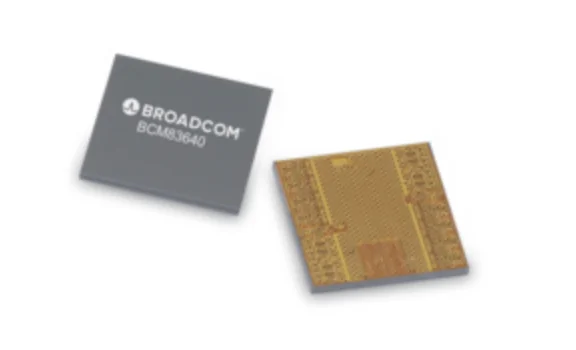
Broadcom introduced the Taurus BCM83640, the industry’s first optical DSP supporting 400Gbps per lane PAM4 signaling, targeting next-generation AI data center interconnects. Fabricated on a 3nm process, the new DSP enables 1.6Tbps optical transceivers and sets the stage for future 3.2Tbps modules and 204.8Tbps switching platforms designed for hyperscale AI clusters.
The Taurus BCM83640 integrates eight electrical lanes to four optical lanes in a monolithic 1.6Tbps PAM4 DSP architecture with an integrated laser driver. The device doubles the throughput per optical lane compared with current 200G/lane technologies and supports a new generation of pluggable modules designed to increase bandwidth density while lowering power consumption in large-scale GPU fabrics. The platform also supports interoperability with Broadcom’s 400G electro-absorption modulated lasers (EML) and photodiodes and complies with IEEE and OIF optical standards.
Broadcom positions the move to 400G/lane optics as a key architectural step toward next-generation switching systems. With 1.6Tbps modules built on the Taurus platform, a single 1RU switch could support up to 102.4Tbps of switching capacity. The same 400G/lane signaling will enable 3.2Tbps optical modules and future switching platforms reaching 204.8Tbps capacity, aligning with the bandwidth requirements of rapidly scaling AI clusters.
• Taurus BCM83640 optical DSP built on a 3nm process
• First optical DSP supporting 400Gbps per lane PAM4 signaling
• Monolithic 1.6Tbps (8:4) architecture with integrated laser driver
• Enables low-power 1.6Tbps pluggable optical modules
• Supports interoperability with Broadcom 400G EML lasers and photodiodes
• Compliant with IEEE and OIF optical interface standards
• Supports optical modules from 1.6Tbps to 3.2Tbps
• Enables up to 102.4Tbps switching capacity in a 1RU system
• Forms the foundation for future 204.8Tbps switching platforms
“Broadcom’s 400G/lane Taurus platform of optical DSPs is laying the foundation for next-generation AI networks and data center connectivity,” said Vijay Janapaty, vice president and general manager of Broadcom’s Physical Layer Products Division. “Taurus, the industry’s first 1.6T DSP based on 400G/lane I/O, doubles the throughput per lane to enable the next generation of 3.2T optical modules.”
🌐 Analysis: The move to 400G/lane optics represents the next scaling step for optical interconnects as hyperscale AI clusters push beyond the limits of 200G/lane signaling. Broadcom’s announcement aligns with the industry roadmap toward 1.6Tbps pluggables and future 3.2Tbps optics, which will support the emerging generation of 102.4Tbps and 204.8Tbps Ethernet switch silicon expected later this decade.
At the same time, the announcement arrives as multiple vendors—including CPO developers such as Ayar Labs and photonic interconnect startups—race to redefine optical connectivity inside AI systems, highlighting growing competition between advanced pluggable optics, linear pluggable optics (LPO), and co-packaged optics architectures.
🌐 We’re tracking the latest developments in networking silicon. Follow our ongoing coverage at: https://convergedigest.com/category/semiconductors/