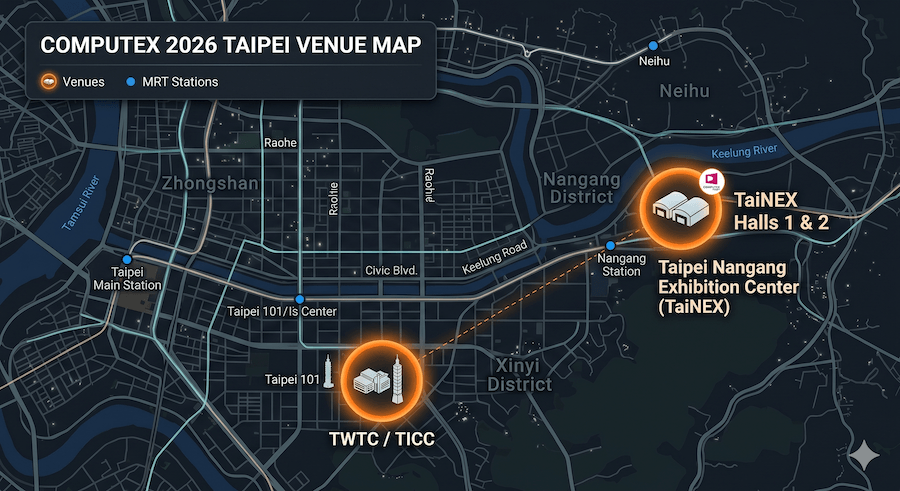
TAIPEI — COMPUTEX has evolved far beyond its roots as a PC trade show. Over the past several years, it has become one of the world’s most important gathering points for the global AI infrastructure industry—a place where semiconductor roadmaps, server architectures, networking platforms, optical technologies, and data center systems increasingly come into view together. This year’s event, running June 2–5 in Taipei, arrives at a moment when global investment in AI infrastructure continues to accelerate, and Taiwan sits at the center of that buildout. With 1,500 exhibitors from 33 countries spread across 6,000 booths, organizers are positioning COMPUTEX 2026 as the largest in the show’s history and a global showcase for the technologies powering the next phase of AI deployment.
The Expanding Taiwan Stack
Taiwan’s role in that story continues to expand well beyond chip manufacturing. While TSMC remains the foundational supplier of advanced process technology for the world’s leading AI processors, the broader AI supply chain on the island now spans the full hardware stack—from advanced packaging and high-bandwidth memory integration to server assembly, thermal systems, optical interconnect, and rack-scale deployment.
- ITRI Market Projections: Taiwan’s Industrial Technology Research Institute (ITRI) reports that AI scaling is driving simultaneous upsurges across both upstream and downstream electronics fabrication.
“ITRI projects Taiwan’s semiconductor output will reach US$247.2 billion in 2026, up 18.3% year-over-year, with AI semiconductors and high-performance computing serving as the primary growth engine.”
- ODM System Migration: The momentum is increasingly visible beyond raw silicon fabrication, as traditional design houses pivot toward end-to-end infrastructure generation.
“ODMs such as Foxconn, Quanta, Wistron, Inventec, and Wiwynn are moving deeper into AI server manufacturing, while suppliers across power, cooling, optics, and connectivity scale alongside them.”
Edgecore Networks and the All-Photonics Era
Among the networking-focused previews, Edgecore Networks is setting the pace for next-generation optical fabric discussions. The emphasis reflects a broader shift underway across the industry as optical connectivity moves deeper into AI system design. What was once largely a pluggable optics conversation at the network edge is increasingly becoming a discussion about photonic integration inside the cluster itself.
The company said its exhibition will highlight collaboration across silicon, optics, and system design to demonstrate how AI clusters are accelerating a transition toward increasingly photonic-centric infrastructure. Planned demonstrations will span high-performance Ethernet switching platforms, optical transport, co-packaged optics, photonic interconnect technologies, and open networking architectures aimed at hyperscale and AI factory deployments.
Wiwynn’s Co-Packaged Optics & Rack-Scale Integration
Wiwynn will present a rack-scale AI infrastructure blueprint spanning compute, storage, liquid cooling, optical interconnect, and high-voltage DC power delivery. The company said its exhibit includes next-generation AI server platforms developed with Wistron, optical scale-up designs, and system-level technologies aimed at higher power density in AI data centers.
The showcase includes readiness for NVIDIA Vera Rubin NVL72, a liquid-cooled rack-scale platform combining 72 NVIDIA Rubin GPUs and 36 NVIDIA Vera CPUs, as well as AMD’s Helios rack-scale solution based on the OCP ORv3 Open Rack Wide specification. Wiwynn said the AMD platform uses AMD Instinct MI400 Series GPUs, 6th Gen AMD EPYC CPUs, AMD Pensando networking, and the ROCm software stack.
Wiwynn also highlights an 800 VDC rack-level power architecture developed with Delta and TE Connectivity, along with a CPO-based optical scale-up rack design created with partners including Ayar Labs and GUC. The optical design integrates an AI ASIC with 2.5D advanced packaging, Ayar Labs TeraPHY optical engines, ELSFP SuperNova remote light sources, fiber routing, and in-chassis liquid cooling for optical connections.
- Computex 2026 booth: J0106, TaiNEX1
- AI compute: NVIDIA Vera Rubin NVL72 and AMD Helios rack-scale platforms
- Storage: prototype server using 96 liquid-cooled E3.S SSDs for high-IOPS workloads including GNN and vector databases
- Power: 800 VDC rack-level architecture with power rack, liquid-cooled busbar, and 800V-to-50V power distribution board
- Optical interconnect: CPO-based optical scale-up rack with Ayar Labs TeraPHY optical engines and ELSFP SuperNova remote light sources
- Cooling: 6kW double-sided cold plate with liquid metal TIM for AI ASICs up to 6kW
Marvell Tackles the AI Connectivity Bottleneck
Marvell Technology will use its keynote at COMPUTEX 2026 to make the case that connectivity has become a core enabler of AI scaling. Chairman and CEO Matt Murphy plans to outline how Marvell’s silicon and interconnect technologies support the links between compute, memory, storage, and networking inside AI data centers, enabling larger and more efficient AI deployments.
During the keynote, titled The Future of AI Scaling Depends on Connectivity, Jensen Huang will join Matt Murphy on stage. The two CEOs are expected to discuss how Marvell Technology and NVIDIA are expanding their collaboration—first announced in March—to give customers more options and flexibility as they build next-generation AI infrastructure.
The keynote, titled The Future of AI Scaling Depends on Connectivity, takes place on June 2 at 10:30 a.m. Taipei time (7:30 p.m. PDT on June 1) at the Taipei Nangang Exhibition Center, Hall 2, 7F.


Astera Labs and Smart Fabric Switching
Astera Labs is also planning an extensive technical showcase centered on AI connectivity infrastructure. Astera has become an increasingly important name in rack-scale AI architecture as hyperscalers move toward larger, more disaggregated accelerator clusters with increasingly complex requirements around memory sharing, connectivity, and fabric management.
- First Public Scorpio Demonstrations: The company is utilizing the event to transition its latest high-density fabric switching hardware from announcement to live evaluation.
“COMPUTEX will include the first public demonstration of its Scorpio X-Series 320-lane Smart Fabric Switch, alongside presentations on PCIe 6 connectivity, CXL infrastructure, linear optical connectivity, and 200G-per-lane Ethernet.”

COMPUTEX Event Overview
| Parameter | Details & Strategic Focus |
|---|---|
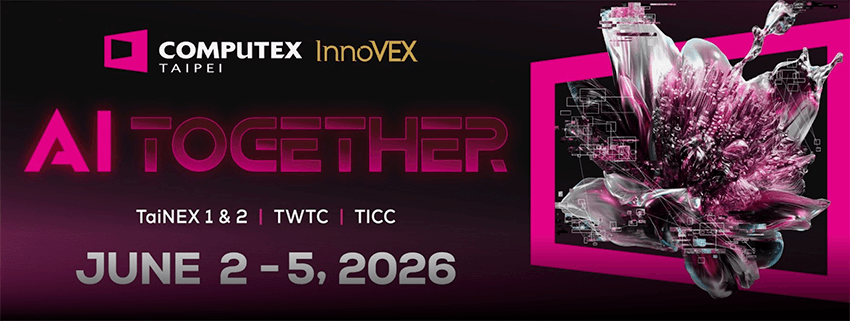
| Official Dates | June 2 – June 5, 2026 |
| Core Theme | “AI Together” — Accelerating global AI deployment and hardware convergence. |
| Key Pillars | AI & Computing, Robotics & Mobility, Next-Gen Innovations, Green Energy Technologies. |
| Primary Venues |
TaiNEX Halls 1 & 2: Core hardware ecosystem, server stacks, silicon fabs, and InnoVEX startup floor. TWTC & TICC: Global forums, specialized technology pavilions, and international keynotes. |
Benchmark Metrics (Based on COMPUTEX 2025)
| Metric | 2025 Benchmarks & Scale |
|---|---|
| Total Attendance | 86,521 business buyers from 152 countries (Top markets: Japan, USA, South Korea, Vietnam, India). |
| Exhibitor Footprint | 1,400+ companies across 4,800 physical booths. |
| Exhibition Area | 80,000 square meters spanning Taipei’s flagship complexes. |
| InnoVEX (Startups) | 450 tech startups from 24 countries (experienced a 12.5% YoY expansion). |
Historical Evolution & Milestones
| Era / Year | Historical Milestone & Industry Impact |
|---|---|
| 1981 (Inception) | Founded as the Taipei Computer Show by Stan Shih (TCA). Launched at Songshan Airport Exhibition Hall for local SMEs. |
| 1984 (Global Push) | Officially rebranded to COMPUTEX TAIPEI to pivot toward international business-to-business (B2B) trade. |
| 1986 (Scaling Era) | Relocated to the newly built TWTC Exhibition Hall, attracting global industry titans like Intel and Texas Instruments. |
| 2016 (Venture Pivot) | Launched InnoVEX, establishing a permanent matchmaking ecosystem for global startups, capital, and factories. |
| Present Day | Recognized alongside IFA as the world’s co-eminent hardware expo, serving as the launchpad for global AI infrastructure. |