


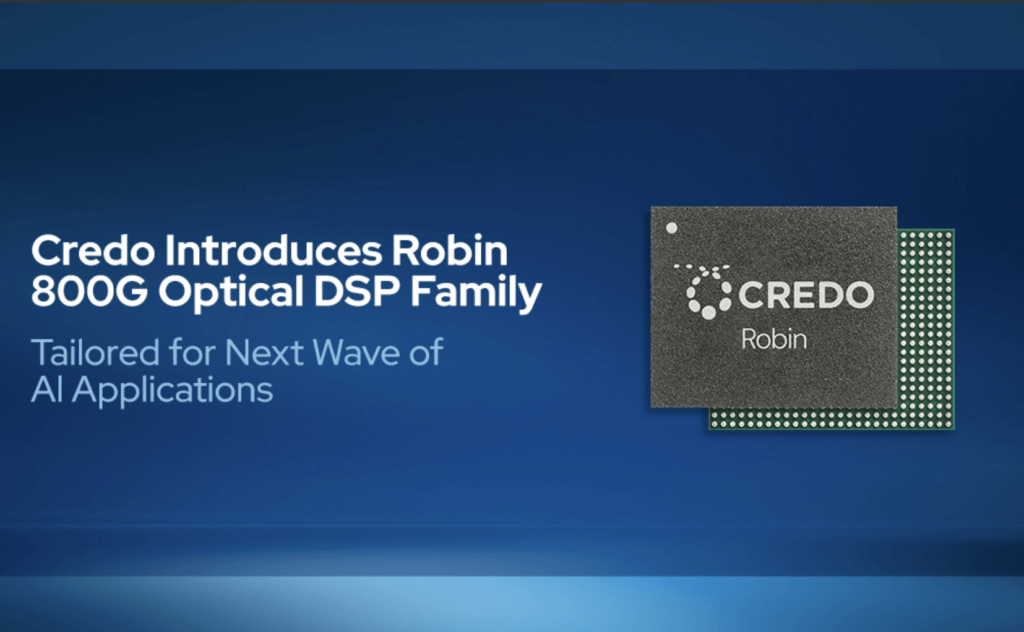
Credo introduced its Robin optical DSP family, a new line of 800G and 400G devices aimed at AI-driven data center networks. The product line targets rising demand for higher-performance, lower-power optical interconnects in hyperscale AI infrastructure, where transceiver density, signal integrity, and manufacturing efficiency increasingly shape deployment economics.
Built on Credo’s sixth-generation DSP architecture, the Robin family supports both fully retimed optics and Linear Receive Optics configurations. Credo said the new devices integrate low-power, high-swing laser drivers operating up to 3.3Vpp and offer variants with integrated silicon photonics and EML drivers for single-mode applications. The company also said the compact substrate can reduce PCB space by up to 50% compared with competing devices, which could simplify board design and lower manufacturing cost.
The launch positions Credo to address a volume market that LightCounting expects to expand sharply over the next two years. According to LightCounting Analyst-at-Large Bob Wheeler, 800G and 400G transceivers are expected to account for the majority of AI transceiver shipments in 2026 and 2027, totaling more than 120 million units combined. Credo said the Robin DSP family is available now.
| Product | Data Rate | Type | Target Application | Notable Specs / Features |
|---|---|---|---|---|
| Robin 800 | 800G | DSP | Multimode optics | AI-optimized transceivers; compact substrate; low-power design |
| Robin 802 | 800G | DSP | Single-mode optics | Integrated SiPh and EML driver |
| Robin 850 | 800G | LRO DSP | Multimode optics | Linear Receive Optics variant for power-sensitive deployments |
| Robin 852 | 800G | LRO DSP | Single-mode optics | Integrated SiPh and EML driver; LRO architecture |
| Robin 400 | 400G | DSP | Multimode optics | 400G transceiver deployments for AI infrastructure |
| Robin 402 | 400G | DSP | Single-mode optics | Integrated SiPh and EML driver |
| Family-wide | 400G / 800G | DSP / LRO DSP | AI data center optics | Up to 3.3Vpp laser drivers; up to 50% PCB space savings; standard PCB materials and SMT processes; enhanced receiver sensitivity and BER; Ethernet link health monitoring |
• Credo launched a new Robin optical DSP family for 800G and 400G transceivers used in AI data center networks.
• The lineup includes fully retimed and Linear Receive Optics variants.
• Certain models integrate silicon photonics and EML drivers for single-mode applications.
• Credo said the devices support up to 3.3Vpp laser driver operation.
• The company said the compact substrate can save up to 50% of PCB space versus competing devices.
• Credo said the family is designed for standard PCB materials and SMT manufacturing processes.
• Product availability is immediate.
“By substantially reducing the footprint, integrating low-power laser drivers, and easing supply-chain constraints, our customers simplify PCB design, improve yields, and enhance margins,” said Chris Collins, AVP of Sales & Optical Product Marketing at Credo.
🌐 Analysis: Credo is broadening its optical silicon portfolio as AI cluster operators push for lower-power, denser, and easier-to-manufacture interconnects at 400G and 800G. The Robin launch also reflects a wider market shift toward tighter integration of DSPs, laser drivers, and optical engines as vendors compete to reduce module complexity, cost, and power across large-scale AI fabrics.