


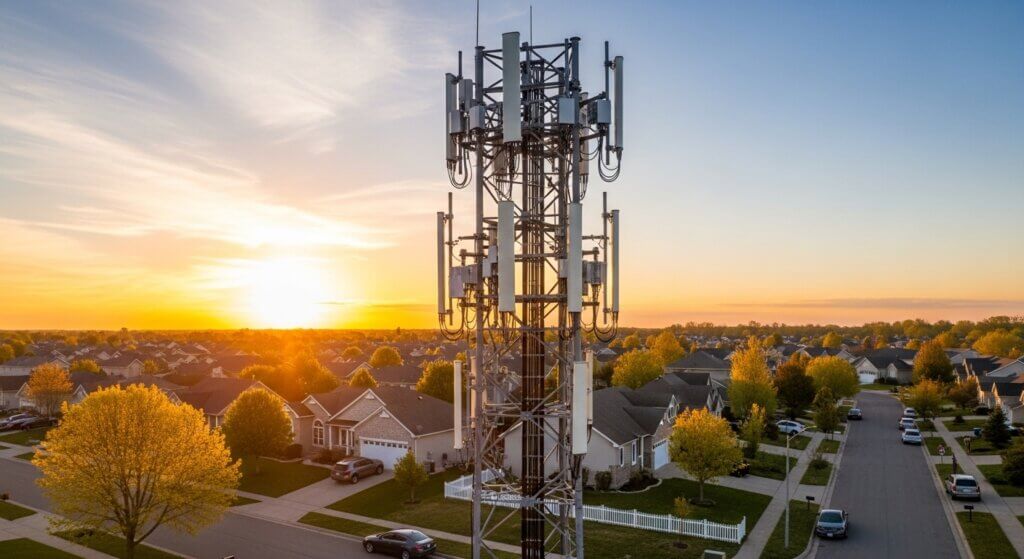
NTT DOCOMO and SK Telecom have jointly published a new white paper detailing the architectural and operational requirements needed to advance virtualized RAN (vRAN) toward AI-native RAN (AI-RAN), positioning the radio access network as a future platform for both connectivity and distributed AI computing. The paper reflects ongoing collaboration between the two operators since 2022, focused on 5G evolution and 6G readiness.
The report identifies three foundational capabilities required to unlock the full value of vRAN: strict hardware–software separation, large-scale resource pooling, and the integration of AI compute into RAN infrastructure. Together, these elements are designed to shift RAN from a fixed-function system into a flexible, cloud-like platform capable of dynamically allocating compute resources across both telecom and AI workloads.
A central theme is the transition from purpose-built base station hardware to disaggregated, software-defined architectures running on general-purpose servers and accelerators. The operators argue that this shift enables faster innovation cycles, reduced vendor lock-in, and improved total cost of ownership—while also laying the groundwork for AI-native network operations and services.
Masafumi Masuda, Senior Vice President at NTT DOCOMO, emphasized that the collaboration aims to “share advanced concepts and innovative technologies with the world to realize the 6G era,” while SK Telecom’s Takki Yu highlighted the role of the white paper in accelerating ecosystem alignment across operators and vendors.
Key Points:
- Defines three critical enablers for next-gen RAN:• Hardware/software decoupling• Resource pooling across distributed infrastructure• AI workload integration into RAN platforms
- Positions vRAN as a stepping stone toward AI-RAN and 6G architectures
- Introduces xPU-based infrastructure (CPU, GPU, NPU) for mixed telecom + AI workloads
- Emphasizes orchestration systems to maintain SLA performance while running AI tasks
- Highlights need for tighter collaboration between operators and vendors to deliver virtualization-native features
- Builds on prior joint work (2023–2024) covering green networking, 6G requirements, and vRAN deployment models
The white paper stresses that while vRAN adoption is accelerating globally, key virtualization-native capabilities—particularly resource pooling and dynamic scaling—remain underdeveloped across vendor implementations.
Analysis: 🌐
This paper is one of the clearest operator-driven blueprints yet for how RAN evolves into a dual-purpose infrastructure layer—supporting both mobile connectivity and distributed AI inference/training at the edge.
The most important technical takeaway is the emphasis on resource pooling as the economic engine of vRAN. According to the white paper’s quantitative analysis, enabling Layer 1 and Layer 2 pooling can reduce required server counts to as low as 26–36% of baseline levels, with corresponding power reductions to ~23–27% in some scenarios. This is a critical data point for operators evaluating the real TCO benefits of vRAN versus traditional RAN.
Equally significant is the shift toward AI-RAN, where base station infrastructure becomes an edge compute platform. By leveraging xPU architectures and intelligent orchestration, operators could monetize excess capacity by running AI workloads—effectively turning RAN into a distributed AI cloud. This aligns closely with broader industry moves (e.g., NVIDIA AI-RAN concepts) and suggests a convergence between telecom infrastructure and hyperscale AI compute models.
However, the paper also implicitly highlights a major gap: vendor readiness. Many of the features identified—particularly hardware abstraction, pooling, and SLA-aware orchestration—are still immature or inconsistently implemented. This creates an opportunity for new entrants and open ecosystem players, especially those aligned with O-RAN and cloud-native architectures.
Bottom line: DOCOMO and SKT are signaling that vRAN alone is not the end goal—the real prize is AI-RAN, where network infrastructure becomes programmable, monetizable compute at scale.
| What is vRAN (Virtualized Radio Access Network)? | |
|---|---|
| Definition | vRAN is a cloud-based architecture that decouples radio access network (RAN) software from proprietary hardware, allowing base station functions to run on general-purpose servers and accelerators. |
| Traditional RAN | Uses tightly integrated, purpose-built hardware and software from a single vendor, optimized for performance but limited in flexibility and upgradeability. |
| vRAN Architecture | Baseband functions (Layer 1–3) are virtualized and run as software workloads on x86/ARM servers with accelerators (GPU, FPGA, ASIC), managed via cloud orchestration platforms. |
| Key Components |
• RU (Radio Unit) • DU (Distributed Unit) • CU (Central Unit) • Virtualization layer (containers/VMs) • xPU hardware (CPU, GPU, NPU, accelerators) |
| Core Principles |
• Hardware/software separation • Disaggregation and open interfaces • Cloud-native deployment • Centralized orchestration and automation |
| Key Benefits |
• Reduced vendor lock-in • Lower CAPEX via commodity hardware • Faster feature deployment via software updates • Elastic scaling of network resources • Improved automation and lifecycle management |
| Resource Pooling | Allows compute resources to be shared across multiple cells and sites, improving utilization, reducing idle capacity, and lowering power consumption. |
| AI Integration (AI-RAN) | Enables base station infrastructure to run AI workloads alongside telecom functions, transforming RAN into a distributed edge compute platform. |
| Challenges |
• Real-time latency constraints on general-purpose hardware • Integration complexity across multi-vendor environments • Dependency on accelerators (L1 processing) • Immature support for advanced features like pooling and orchestration |
| Future Direction | vRAN is evolving toward AI-RAN and 6G architectures, where networks function as programmable, cloud-like infrastructure supporting both connectivity and AI services. |
| What is AI-RAN (AI-Native Radio Access Network)? | |
|---|---|
| Definition | AI-RAN is an evolution of vRAN where artificial intelligence is deeply integrated into the radio access network, enabling the infrastructure to both optimize network operations and execute AI workloads. |
| Core Concept | Transforms the RAN from a single-purpose communications system into a dual-purpose platform that supports both mobile connectivity and distributed AI computing. |
| Architecture Foundation | Built on vRAN principles: disaggregated software, cloud-native infrastructure, and general-purpose hardware enhanced with AI accelerators (GPU, NPU, TPU). |
| xPU Infrastructure | Uses heterogeneous compute (CPU, GPU, NPU, FPGA) to support both RAN signal processing and AI workloads within the same infrastructure. |
| AI Workloads |
• Network optimization (RAN tuning, traffic prediction) • Edge AI inference (vision, robotics, IoT) • Distributed AI model execution • Autonomous network operations (AIOps) |
| Key Capability: Orchestration | Intelligent orchestration dynamically allocates compute resources between RAN and AI workloads, ensuring SLA compliance for telecom services while maximizing infrastructure utilization. |
| Resource Pooling | Shared compute pools enable flexible allocation of resources across cells and AI applications, improving efficiency, reducing idle capacity, and lowering power consumption. |
| Key Benefits |
• Monetization of excess RAN compute capacity • Reduced total cost of ownership (TCO) • Improved network performance via AI optimization • New edge AI service opportunities • Convergence of telecom and cloud infrastructure |
| Use Cases |
• Smart cities and video analytics • Autonomous systems and robotics • Industrial AI at the edge • Real-time network automation and optimization |
| Technical Challenges |
• Ensuring real-time RAN performance under shared workloads • Scheduling and isolation between AI and telecom tasks • Hardware/software dependency on accelerators • Complexity of orchestration and lifecycle management |
| Future Direction | AI-RAN is expected to be a foundational architecture for 6G, enabling networks to act as distributed AI platforms that seamlessly integrate connectivity, compute, and intelligence. |
🌐 We’re tracking the latest developments in Open RAN, vRAN, and AI-native network architectures. Follow ongoing coverage at: convergedigest.com/tag/open-ran