


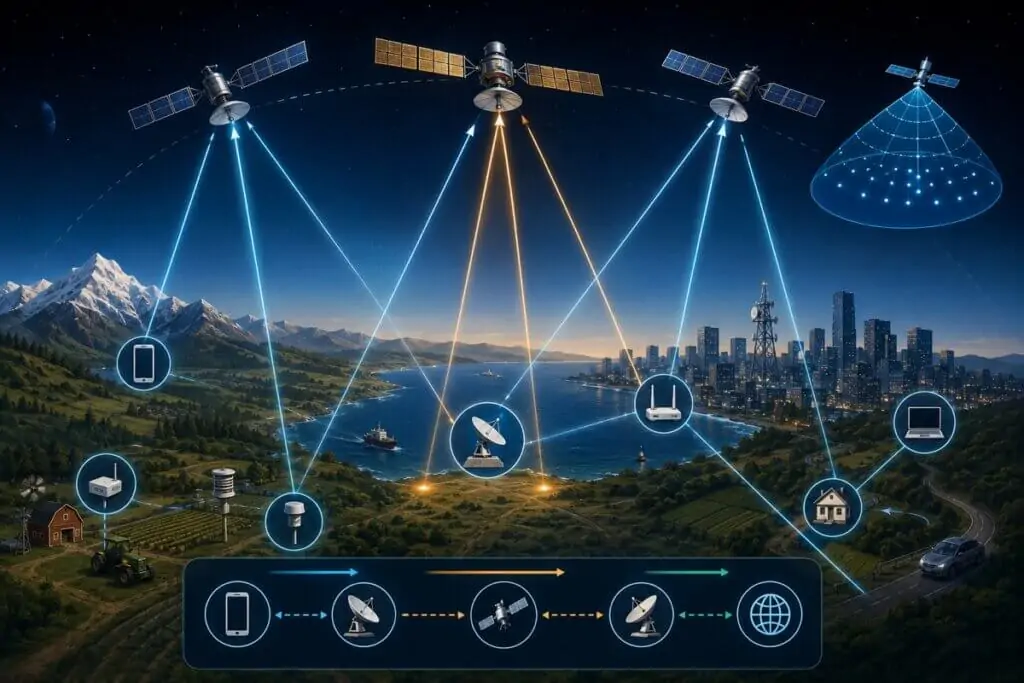
The Federal Communications Commission will consider a proposal to let consumer and industrial devices communicate directly with satellites across three heavily used unlicensed spectrum bands. The Notice of Proposed Rulemaking targets 902–928 MHz, 2400–2483.5 MHz, and 5725–5850 MHz—more than 225 MHz of spectrum used by Wi-Fi, Bluetooth, IoT sensors, wireless broadband systems, medical devices, industrial equipment, and other Part 15 technologies. The proposal would add mobile-satellite service Earth-to-space allocations while retaining the existing Part 15 power ceiling, generally up to 36 dBm, or 4 watts EIRP. The draft remains subject to change and is scheduled for tentative consideration at the FCC’s August 6, 2026 open meeting.
The proposal could create a second regulatory path for direct-to-device connectivity alongside the FCC’s Supplemental Coverage from Space framework. SCS lets satellites reuse licensed terrestrial mobile spectrum through partnerships with spectrum licensees. The new approach would instead let Part 15-compliant equipment communicate with authorized satellites in unlicensed bands, potentially through a “license by rule” mechanism that avoids individual earth-station applications. The FCC also seeks comment on blanket licensing, satellite authorization under Part 25, equipment certification, international coordination, and a list of approved satellites that eligible devices could access without additional authorization.
The technical scope remains asymmetric. The FCC proposes Earth-to-space operation in all three bands but only seeks comment on satellite downlinks, initially focusing on the 5725–5850 MHz U-NII-3 band. Downlinks pose a more difficult coexistence problem because a satellite beam can illuminate a large geographic area and raise the noise floor for many terrestrial receivers simultaneously. The proceeding asks industry to develop limits for power flux density, beam footprints, aggregate constellation emissions, out-of-band emissions, duty cycles, contention protocols, elevation angles, and geographic operation. It also examines Wi-Fi and Bluetooth use inside spacecraft, extravehicular communications, inter-satellite links, in-space servicing and manufacturing, and unintended electromagnetic emissions from satellite electronics.
• Proposed uplink bands: 902–928 MHz, 2400–2483.5 MHz, and 5725–5850 MHz.
• Combined spectrum under consideration: 234.5 MHz, described by the FCC as more than 225 MHz.
• Maximum terrestrial transmission level: Existing Part 15 limits would generally remain at 36 dBm, or 4 watts EIRP.
• Proposed regulatory status: Satellite links would operate on an unprotected, non-interference basis. They could not cause harmful interference to authorized services and could not claim protection from interference.
• Eligible equipment: Potentially billions of existing or future Wi-Fi, Bluetooth, IoT, wireless broadband, and other Part 15 devices, although actual satellite compatibility would depend on link budgets, protocols, antenna characteristics, firmware, and satellite network support.
• Licensing options: The FCC asks whether user devices should receive authorization through license by rule, a streamlined blanket Part 25 license, or another framework.
• Satellite authorization: U.S.-licensed systems and foreign-licensed systems with U.S. market access could seek authority to support the service.
• Uplink precedent: Hubble Network received authorization for satellites to receive Bluetooth Low Energy transmissions from 100-milliwatt terrestrial devices within a narrow portion of the 2.4 GHz band. That authorization required a waiver because the band lacks a general satellite allocation.
• Downlink focus: The FCC identifies 5725–5850 MHz as the initial candidate because higher frequencies support smaller, more directional satellite antennas than 902 MHz or 2.4 GHz.
• Wi-Fi coexistence: Satellite transmissions could affect carrier sensing, listen-before-talk behavior, frequency reuse, packet scheduling, and the noise floor experienced by outdoor access points and wireless internet service providers.
• Aggregate interference: The proceeding asks whether limits should cover each constellation individually or the combined energy from all visible satellites and beams operated by multiple companies.
• Geographic controls: The FCC asks whether satellite downlinks should operate only in rural, remote, underserved, or low-population areas where terrestrial alternatives remain limited.
• Radio astronomy: The Commission requests analysis of potential effects at observatories and on S/X Celestial Reference Frame measurements, including whether geofencing should protect sensitive sites.
• International constraints: The proposed U.S. allocations do not appear in the International Telecommunication Union’s global allocation table. Operations would therefore need to comply with ITU Radio Regulation No. 4.4 and immediately eliminate interference to internationally compliant services.
• Spacecraft connectivity: The FCC proposes explicitly permitting certified Wi-Fi, Bluetooth, smartphones, tablets, laptops, and other Part 15 devices inside shielded spacecraft, subject to mission, agency, treaty, and licensing restrictions.
• In-space applications: The agency requests technical proposals for astronaut communications, robotic systems, radar, positioning sensors, inter-spacecraft links, extravehicular activity, and in-space servicing, assembly, and manufacturing.
• Unintentional emissions: The FCC also investigates unintended radiation from satellite power supplies and digital electronics, including reported emissions between 40–70 MHz and 110–188 MHz that may affect radio astronomy receivers.
“Unlocking unlicensed bands for D2D promises to open up new services that seamlessly integrate devices across terrestrial and satellite platforms and provide consumers with another option for connectivity,” the FCC stated.
🌐 Analysis: The proposal could expand satellite connectivity beyond carrier-controlled spectrum and create an addressable device base that includes Wi-Fi, Bluetooth, and industrial IoT equipment rather than only cellular handsets. The decisive issue will be whether satellite operators can close useful links while keeping aggregate interference low enough to preserve outdoor Wi-Fi, WISP networks, federal radiolocation systems, amateur services, and radio astronomy.
| FCC Profile: Unlicensed Spectrum for Direct-to-Device | ||||||||||||||||||||||||
| ||||||||||||||||||||||||
| Recent Converge Digest Coverage | ||||||||||||||||||||||||
| ||||||||||||||||||||||||
| Space Coverage We’re tracking satellite networking, direct-to-device services, spectrum policy and hybrid space-terrestrial infrastructure. Follow ongoing coverage on Converge Digest. |