


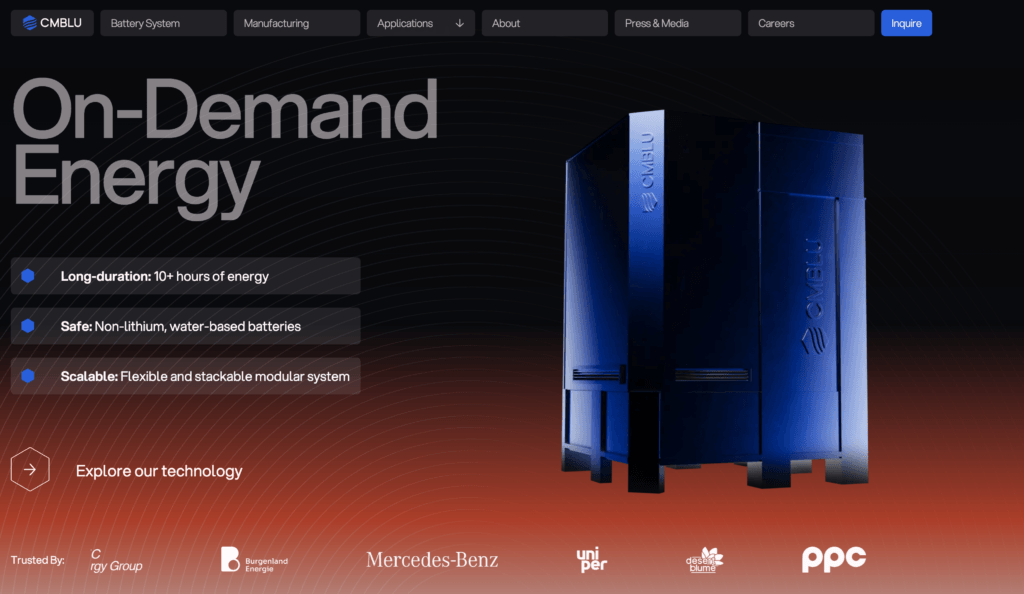
CMBlu Energy crossed the €1 billion valuation mark following a €50 million initial close of its Series C round, signaling rising investor focus on long-duration energy storage as a critical enabler of AI data center growth. The financing drew participation from Samsung Ventures and existing backers including STRABAG SE, as the company accelerates commercialization of its non-lithium SolidFlow battery platform.
The Germany-based company positions SolidFlow as a purpose-built architecture for multi-hour energy storage, delivering 10+ hours of dispatchable capacity aimed at hyperscale and utility deployments. The system uses non-flammable, water-based electrolytes and solid energy storage materials, avoiding lithium supply chains while enabling decoupled scaling of power and energy capacity. CMBlu argues this approach addresses a structural bottleneck for AI infrastructure—ensuring reliable, multi-hour power availability as electricity demand outpaces grid expansion.
CMBlu has already secured a 5 GWh framework agreement with Uniper, highlighting early traction with European utilities. The company states its systems can support use cases such as powering a 1 GW data center for five hours or sustaining a 500 MW facility for ten hours, effectively bridging overnight renewable gaps. Proceeds from the Series C will fund manufacturing scale-up and early deployments across Europe and the United States.
- €50M initial Series C close; valuation surpasses €1B
- Investors include Samsung Ventures and STRABAG SE
- SolidFlow battery targets 10+ hour long-duration storage
- Non-lithium design uses water-based electrolytes and recyclable materials
- 5 GWh framework agreement signed with Uniper
- Positioned for AI data centers, utilities, and industrial energy resilience
- Manufacturing expansion planned in Germany, U.S., and Greece
“Our SolidFlow technology is redefining energy storage by combining inherent safety with a streamlined permitting pathway – enabling faster, more predictable deployment at scale,” said Constantin Eis, CEO of CMBlu.
🌐 Analysis: Long-duration energy storage is emerging as a gating factor for AI infrastructure, particularly as hyperscalers push toward 24/7 carbon-free energy goals and multi-gigawatt campuses. CMBlu’s non-lithium approach aligns with a broader industry shift that includes flow batteries, iron-air systems, and sodium-based chemistries from companies such as Form Energy and Natron Energy, all targeting multi-hour to multi-day storage economics.