


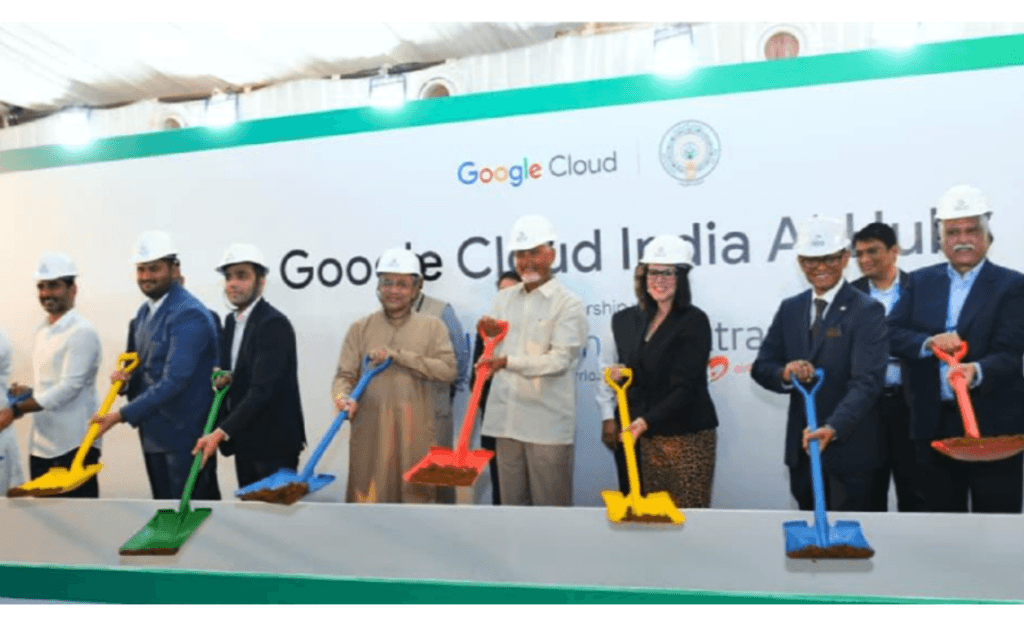
Google has begun construction on a major AI hub in Visakhapatnam (Vizag), India, marking the formal launch of a $15 billion, five-year investment (2026–2030) to build a national AI infrastructure platform aligned with the country’s “Viksit Bharat 2047” vision. Located on the eastern coast of India along the Bay of Bengal in the state of Andhra Pradesh, Visakhapatnam is a major port city and emerging digital infrastructure hub. The project—Google’s largest digital infrastructure investment in India to date—will deliver a gigawatt-scale AI ecosystem spanning three data center campuses, developed in partnership with AdaniConneX and Nxtra by Airtel. The facility is designed to provide high-performance, low-latency compute capacity for enterprises, startups, and research institutions scaling AI workloads.
The initiative integrates subsea and terrestrial connectivity through the America-India Connect program, including multiple international cable landings in Visakhapatnam to enhance route diversity and global resilience. The hub also incorporates a long-term clean energy strategy focused on new transmission infrastructure, renewable generation, and energy storage systems to support India’s national target of 500 GW of non-fossil fuel capacity by 2030. Google and its partners are positioning Vizag as a new AI infrastructure hub with nearly 1 GW of capacity in a single location, supported by ultra-low latency fiber networks and next-generation cable landing facilities.
Beyond infrastructure, Google is coupling the buildout with a coordinated industrial and community development strategy. The project includes workforce training programs, SME integration into infrastructure supply chains, and targeted initiatives in water sustainability, fisheries modernization, and digital inclusion. Programs such as the STAR workforce initiative, ICT Academy partnerships, and the NARI Shakti program aim to train thousands of workers, students, and entrepreneurs, while the Bharat AI Shakti Conclave establishes a framework for building a regional AI Industrial Corridor tied to local procurement and ecosystem development.
- $15 billion investment over five years (2026–2030) to build India AI infrastructure
- Gigawatt-scale AI hub spanning three data center campuses in Visakhapatnam
- Located in Andhra Pradesh on India’s east coast along the Bay of Bengal, a key port and connectivity hub
- Partnerships with AdaniConneX and Nxtra by Airtel for infrastructure development
- America-India Connect initiative enables multiple subsea cable landings for global connectivity
- Nearly 1 GW of AI compute capacity planned at a single site
- Clean energy strategy aligned with India’s 500 GW non-fossil fuel target by 2030
- Workforce programs: 1,000+ workers and 1,200+ students/educators trained in AI and infrastructure skills
- Community programs include water management, fisheries digitization, and digital literacy
- NARI Shakti initiative to support 10,000+ women-led micro-enterprises
- AI Industrial Corridor strategy integrates local SMEs into global infrastructure supply chains
“Today’s groundbreaking is a powerful realization of our shared vision with the Indian government, and an inflection point for the country’s AI-native future,” said Thomas Kurian, CEO of Google Cloud.
🌐 Analysis: The choice of Visakhapatnam reflects a deliberate infrastructure strategy that aligns geography with hyperscale AI requirements. As a coastal city with direct access to subsea cable landings, Vizag offers lower-latency international connectivity and improved route diversity compared to inland locations. The region also provides access to large contiguous land parcels and scalable power infrastructure—critical for deploying gigawatt-scale data centers—while benefiting from state-level incentives and a relatively less congested development environment than established hubs like Mumbai or Chennai. This mirrors a broader industry shift toward “next-wave” data center geographies, where hyperscalers balance connectivity, power availability, and regulatory alignment to build vertically integrated AI regions. In India’s case, the east coast positioning also strengthens redundancy in national network topology while opening new corridors for global traffic between Asia and the United States.
| Google Data Center Expansions (AI Infrastructure Buildout, 2023–2026) | |||
|---|---|---|---|
| Region | Location | Timeline | Details |
| United States | |||
| US | Texas (multiple sites) | 2023–2026 | Multi-campus AI/cloud expansion; widely reported multi-year investment approaching ~$40B across sites. |
| US | Wilbarger County, TX | 2026 | Next-gen “air-cooled” data center design targeting minimal or zero operational water usage. |
| US | Red Oak, TX | 2023–2024 | Dallas-area campus expansion supporting high-density AI workloads. |
| US | Pine Island, MN | 2026 | ~$1B-scale project paired with new wind and solar energy capacity. |
| US | Chesterfield, VA | 2026 | Part of a broader multi-billion Virginia expansion tied to Ashburn ecosystem growth. |
| US | Lenoir, NC | 2026 | ~$1B expansion of an existing campus to support AI and cloud services. |
| US | Cedar Rapids, IA | 2026 | Multi-year investment (reported up to ~$7B) for high-density AI infrastructure. |
| US | The Dalles, OR | 2025 | ~$600M facility expansion; one of Google’s longest-running hyperscale sites. |
| US | Fort Wayne, IN | 2024 | New Midwest campus supporting regional cloud and AI demand growth. |
| Europe | |||
| Europe | UK (Hertfordshire) | 2025 | ~£5B AI data center and research investment tied to sovereign AI and DeepMind ecosystem. |
| Europe | Germany (Frankfurt region) | 2025–2026 | Expansion in Dietzenbach/Hanau supporting Europe’s largest interconnect hub. |
| Europe | Belgium (Saint-Ghislain / Farciennes) | 2025 | ~$5.8B commitment across existing campus and new site development. |
| Europe | Norway (Skien) | 2026 | ~€600M greenfield site leveraging hydroelectric power. |
| Europe | Netherlands | Ongoing | Sustainability-focused development with advanced cooling techniques. |
| Asia-Pacific & Latin America | |||
| APAC | India (Visakhapatnam) | 2025–2030 | $15B AI hub with gigawatt-scale compute, subsea connectivity, and national AI ecosystem focus. |
| APAC | Thailand & Malaysia | 2024–2025 | New cloud regions and first major hyperscale deployments in Southeast Asia. |
| APAC | Japan (Chiba) | Ongoing | Expansion tied to regional cloud growth and AI infrastructure demand. |
| LATAM | Chile (Quilicura) | Ongoing | Expansion with subsea cable integration (Humboldt route) linking South America to Asia. |