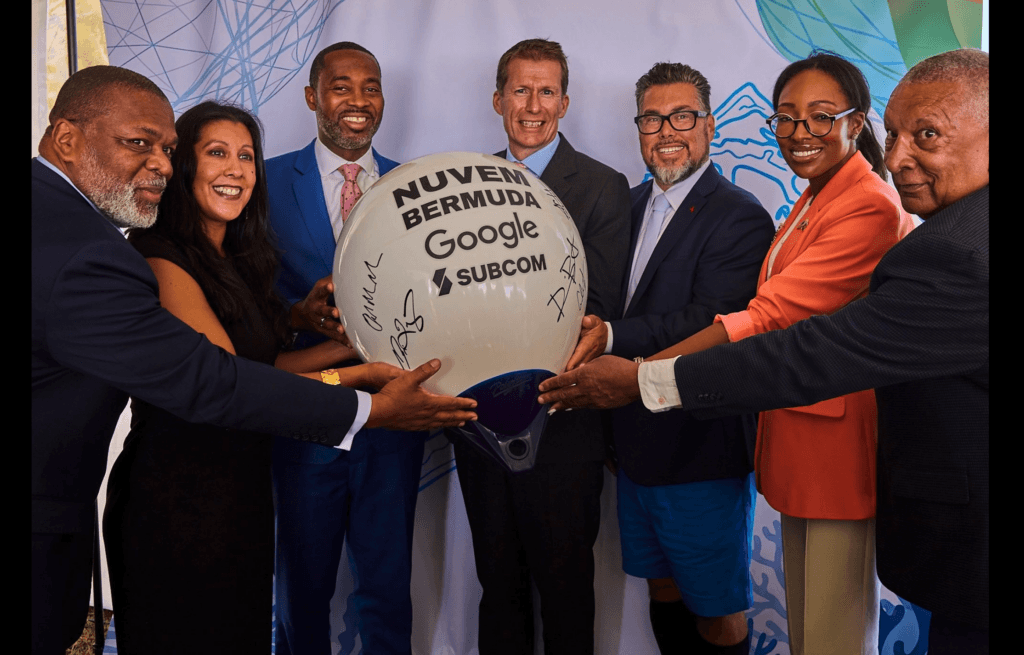
Google’s Nuvem and Sol subsea cable systems have officially landed in Bermuda, marking a significant expansion of the island’s international digital infrastructure and reinforcing its role as a strategic connectivity hub in the Atlantic. Government officials, representatives from the Bermuda Business Development Agency, Google, and project partners participated in a ceremony recognizing the milestone.
The Nuvem and Sol systems are designed to strengthen international connectivity, improve network resilience, and support growing demand for secure digital infrastructure. Bermuda’s geographic location in the mid-Atlantic has historically made it an important communications waypoint, and government officials said the new cable systems further enhance the island’s position within global digital networks. The infrastructure is expected to support economic development initiatives across financial services, insurance, reinsurance, fintech, digital assets, and other technology-driven sectors.
Officials emphasized that resilient international connectivity has become increasingly important for economic security, disaster preparedness, and business continuity. The Bermuda government said the project will help attract additional investment, support future technology industries, and provide a foundation for continued growth as demand for cloud services, AI infrastructure, and international digital connectivity continues to increase.
• Google’s Nuvem and Sol cable systems have landed in Bermuda.
• The project strengthens international connectivity and network resilience.
• Bermuda continues to position itself as a strategic Atlantic digital hub.
• Infrastructure supports financial services, insurance, fintech, and digital industries.
• Officials cited economic development, business continuity, and resilience benefits.
• The systems will support growing demand for global digital infrastructure.
• Bermuda Business Development Agency highlighted the project’s investment significance.
“For centuries, Bermuda’s location in the Atlantic has been one of our greatest strengths. Today, that advantage continues to position our island at the centre of the connections that drive the global economy,” said Bermuda Premier David Burt.
🌐 Analysis
The Bermuda landing forms part of Google’s continuing investment in global subsea cable infrastructure. Major cloud providers increasingly view ownership and control of submarine cable systems as strategic assets that support cloud services, AI infrastructure, enterprise connectivity, and network resilience. Over the past decade, hyperscalers including Google, Meta, Microsoft, and Amazon have become some of the largest investors in subsea communications infrastructure worldwide.
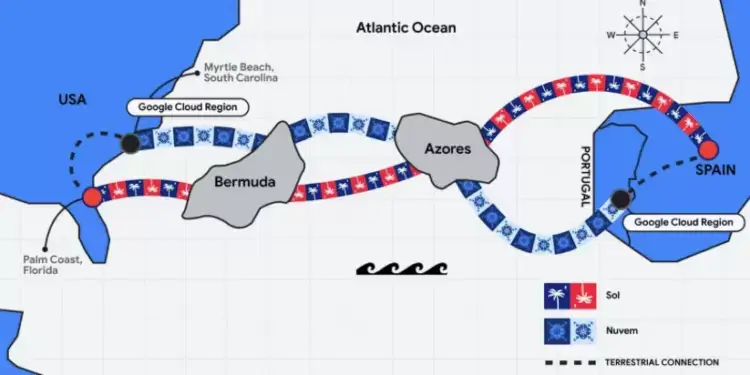
Bermuda occupies a strategically valuable location along transatlantic routes connecting North America, Latin America, the Caribbean, and Europe. The addition of Nuvem and Sol enhances route diversity and provides additional resiliency for traffic traversing the Atlantic. Route diversity has become increasingly important as governments, enterprises, and cloud operators seek to reduce single points of failure across international communications networks.
| Infrastructure Focus: Nuvem & Sol Transatlantic Systems | |
|---|---|
| Project Sponsor | Google (Private Transoceanic Optical Backbone) |
| System Architecture | Dual-Corridor Transatlantic Mesh Terrestrial Failover Interconnect |
| 1. Nuvem Cable System (Eastbound Corridor) | |
| Timeline Status | Announced: Sept 2023 • Ready for Service (RFS): H2 2026 |
| Total System Length | ~7,194 km (6,900 km Main Trunk • 170 km Bermuda branch • 124 km Azores branch) |
| Landing Topography | Myrtle Beach, SC, US (DC BLOX MYR1 CLS) • Bermuda (Devonshire & Annie’s Bay Hubs) • Azores (São Miguel) • Sines, Portugal |
| Optical Specifications | 16 Fiber Pairs (FPs) 24 Tbps per FP Capacity ~384 Tbps Total Design Capacity |
| 2. Sol Cable System (Southeastern Corridor) | |
| Timeline Status | Announced: July 2025 • Ready for Service (RFS): 2028 |
| Total System Length | ~8,153 km (The only direct in-service fiber pipeline linking Florida to continental Europe) |
| Landing Topography | Palm Coast, FL, US (DC BLOX Hub) • Bermuda • Azores • Santander, Spain (Telxius CLS) |
| Wet Plant Architecture | 16 Fiber Pairs (FPs) US Manufactured Turnkey Supplier: SubCom |
| System Mesh & Failover Logic | |
| Terrestrial Core | A dedicated backhaul dark-fiber network physically links the Palm Coast, FL landing hub to Google’s primary South Carolina Cloud Region. |
| Twin-Failover Logic | If a commercial shipping anchor drag or a North Atlantic seismic event severs a fiber pair on the Nuvem line, automated optical routing engines instantly re-route the packet stream down the Florida-South Carolina terrestrial corridor and shoot it across the ocean via Sol. This dual-path layout prevents traffic from bottlenecking at traditional, congested northern gateways like New Jersey. |