


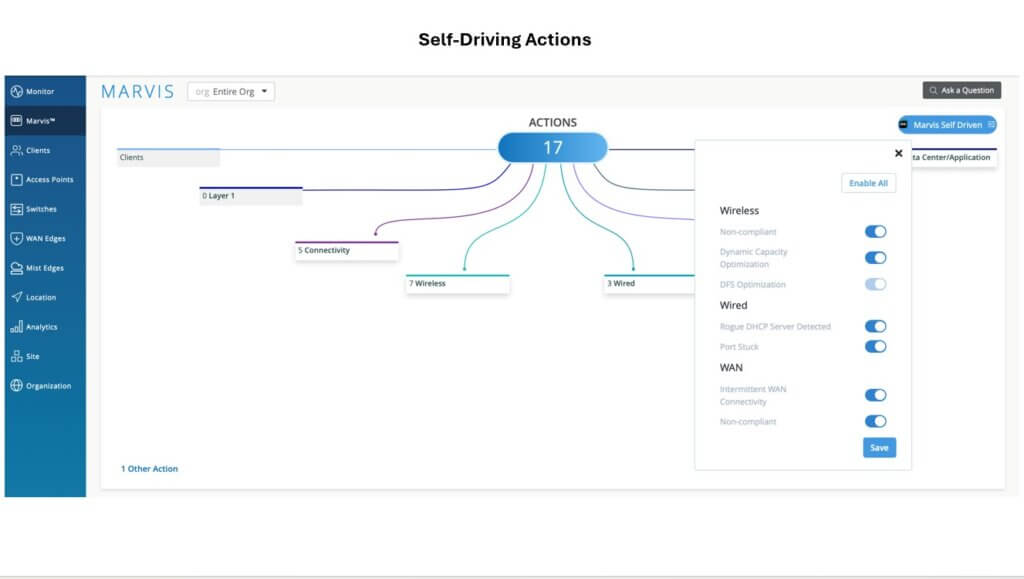
HPE introduced new self-driving network capabilities across HPE Mist and HPE Aruba Central, moving its AI-native networking strategy from operational insights toward autonomous remediation. The new architecture uses microservices, autonomous agents, and an agentic mesh to detect, diagnose, and resolve network issues in real time without human intervention.
The company said the new self-driving actions target common enterprise network problems, including wireless capacity bottlenecks, VLAN misconfiguration, rogue DHCP servers, DFS channel disruption, client roaming issues, and first-connect Wi-Fi latency. HPE also expanded OpenRoaming integration and added Zero Trust enhancements, including inline microsegmentation and NAC sandbox testing.
The UK Ministry of Justice cited a roughly 75% reduction in Service Desk tickets and the in-house management of about 15,000 devices after deploying HPE Self-driving Network capabilities across a complex, multi-vendor digital estate.
- Dynamic Capacity Optimization adjusts RF parameters including band selection, channel bandwidth, and power levels based on learned utilization patterns.
- Autonomous Missing VLAN Remediation fixes access-layer VLAN errors to prevent client traffic blackholing.
- Rogue DHCP Protection detects and remediates unauthorized DHCP servers.
- Real-time DFS optimization helps avoid frequently impacted wireless channels.
- Client Roaming Optimization analyzes connectivity and location metrics to improve mobility.
- User Experience Latency Metrics provide visibility from first Wi-Fi connection through cloud access.
- OpenRoaming integration simplifies secure Wi-Fi access across locations.
- Inline Microsegmentation extends consistent wired and wireless policy enforcement.
- NAC dry-run testing validates policies before deployment.
- HPE Networking 723H APs are now generally available as dual-platform Wi-Fi 7 access points supporting either HPE Mist or HPE Aruba Central.
“The self-driving network is no longer aspirational; it’s operational,” said Rami Rahim, executive vice president, president and general manager, Networking, HPE. “The network HPE now delivers represents a pivotal shift for our customers, and marks a breakaway moment for them to capture the benefits of the next frontier of autonomous actions.”

🌐 Analysis: HPE is positioning autonomous networking as the next stage of enterprise AIOps, shifting the value proposition from dashboards and recommendations to closed-loop remediation. The announcement also reflects the strategic importance of HPE’s Juniper acquisition path, with Mist’s AI-native architecture becoming a central pillar for HPE’s broader networking portfolio.