


HPE accelerated the integration of Juniper Networks into its portfolio by rolling out unified AIOps, shared hardware platforms, and deeper full-stack observability across compute, storage, networking, and cloud—marking a major step in the company’s AI-native networking strategy. Announced at HPE Discover Barcelona 2025, the updates arrive just five months after HPE closed the Juniper acquisition and signal a rapid consolidation of Aruba Central and Juniper Mist into a common operational and data model. The expansion also introduces new AI-optimized switches and routers, including HPE’s first OEM platform based on Broadcom’s Tomahawk 6 silicon.
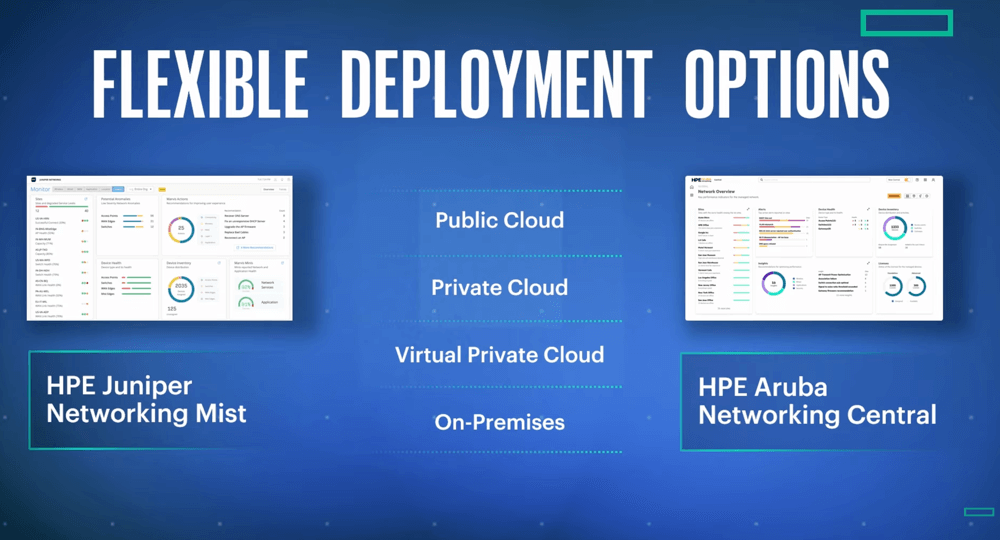
HPE is aligning Aruba and Juniper under a shared agentic AI and microservices framework that allows AIOps models, telemetry, and automation features to operate consistently across both platforms. LEM video assurance from Mist is now coming to Aruba Central, while Aruba’s Agentic Mesh anomaly-reasoning engine will run on Mist—bringing cross-domain, bidirectional AIOps capabilities. HPE is also introducing new Wi-Fi 7 access points that work natively with both management systems, while Aruba Central On-Prem 3.0 adds generative and traditional AIOps, proactive client insights, and a redesigned UI for secure on-premises deployments.
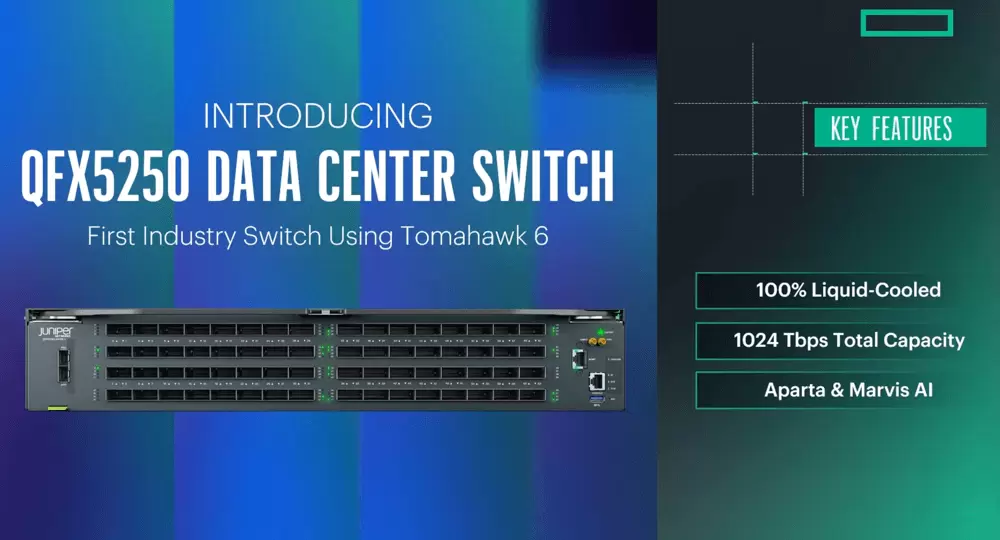
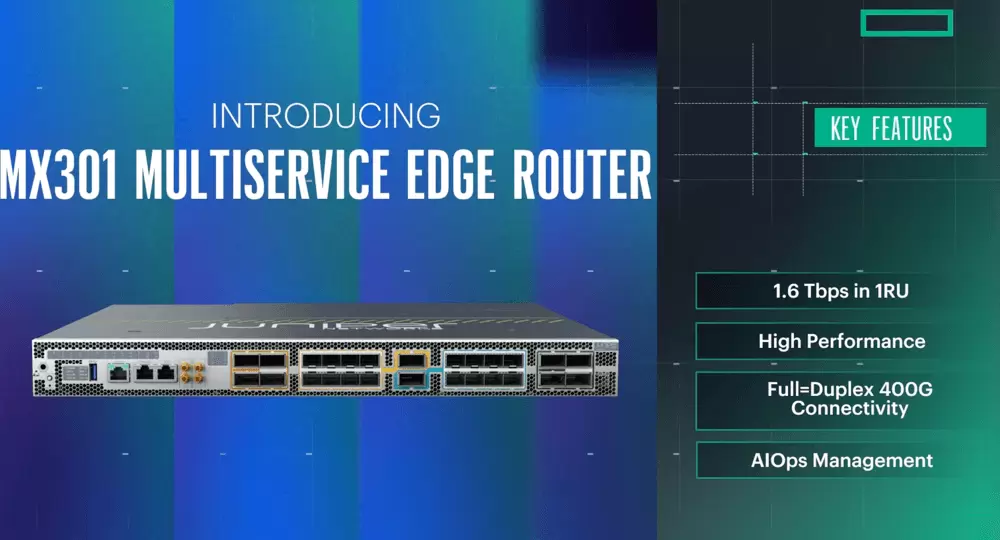
On the hardware front, HPE expanded its Networks for AI portfolio with the debut of the HPE Juniper Networking QFX5250, an Ultra Ethernet Transport-ready switch built on Broadcom Tomahawk 6. Delivering 102.4Tbps of bandwidth, the QFX5250 is engineered for GPU-to-GPU connectivity in large-scale AI fabrics and benefits from HPE’s liquid cooling expertise and Junos automation capabilities. HPE also introduced the MX301 multiservice edge router, a compact 1RU platform delivering 1.6Tbps and 400G services for inference, metro, enterprise routing, and mobile backhaul use cases—an indication that HPE sees edge inferencing as a critical growth area.
HPE further expanded its AI factory networking portfolio through new collaborations with NVIDIA and AMD. The company extended Spectrum-X and long-haul DCI solutions using Juniper MX and PTX routing, creating higher-scale on-ramps into GPU clusters across regions and clouds. Meanwhile, AMD’s new “Helios” rack-scale architecture integrates a purpose-built HPE Juniper scale-up switch designed with Broadcom—offering 260TB/s of Ethernet-based scale-up bandwidth for trillion-parameter training and high-volume inference. These additions target the transition toward Ethernet-first AI architectures, where latency, determinism, and power efficiency drive competitive differentiation.
To tie these domains together, HPE advanced its hybrid AIOps strategy with major updates to HPE OpsRamp Software and its integration with GreenLake Intelligence. OpsRamp now aggregates telemetry from Apstra, Compute Ops Management, Aruba Central, and Mist into a single hybrid command center with predictive assurance, agentic root-causing, and new AI agents for sustainability, wellness, and cross-domain analytics. Support for the Model Context Protocol (MCP) enables third-party AI agents to plug into HPE’s operational model without code, allowing customers to extend automation across multi-vendor environments. HPE Financial Services is supporting the shift with 0% financing for AIOps software subscriptions and new incentives for deploying AI-ready networking systems.
• Unified AIOps across Aruba Central and Mist built on a shared agentic AI framework
• Mist LEM video experience assurance added to Aruba Central
• Aruba Agentic Mesh anomaly-reasoning extended to Mist
• New cross-platform Wi-Fi 7 APs for buyer protection
• QFX5250: 102.4Tbps Ultra Ethernet Transport-ready switch using Broadcom Tomahawk 6
• MX301: 1.6Tbps, 400G compact edge router for inference, metro, and mobile backhaul
• Extended NVIDIA Spectrum-X, MX/PTX DCI integrations, and AMD “Helios” scale-up Ethernet switch
• OpsRamp unified hybrid command center with Apstra, Compute Ops Management, and GreenLake
• MCP support for third-party AI agents and agentic root-causing
• 0% financing for AIOps software and incentives for AI-ready networking refreshes
“By delivering autonomous, high-performing networks, HPE is poised to disrupt the networking industry with future-ready solutions that redefine user experiences and provide robust, secure connectivity across all environments,” said Rami Rahim, executive vice president, president and general manager, Networking, HPE.

🌐 Analysis:
HPE is moving faster than expected to fuse Aruba and Juniper into a unified AIOps and silicon strategy, with Broadcom Tomahawk 6 now anchoring the company’s highest-performance AI data center switching portfolio. HPE’s integration of OpsRamp, Apstra, and GreenLake provides a more vertically aligned automation stack spanning full-stack observability to large-scale AI-optimized switching.
PE used the Barcelona keynote to draw a clear architectural line between AI for Networking and Networking for AI, positioning its post-Juniper portfolio as the only one capable of delivering both at scale. On the AI for Networking side, Antonio Neri and Rami Rahim linked HPE’s strategy to a larger shift toward agentic AI, framing the network as one of the first enterprise systems that must operate with autonomous reasoning, predictive decision-making, and end-to-end cross-domain context. The messaging emphasized that networks must now self-configure, self-heal, and self-optimize across campus, branch, WAN, and data center. With the unification of Aruba Central and Juniper Mist—two of the largest network AIOps data lakes—HPE is accelerating toward a single engine capable of learning from billions of devices and propagating the same reasoning models across private cloud, public cloud, and on-prem deployments. The keynote underscored that this convergence is happening in weeks, not years, with LEM, Marvis Actions, Agentic Mesh, and organizational insights rapidly cross-pollinating between platforms.
On the Networking for AI dimension, HPE drew a detailed map of what modern AI data centers require—from scale-up accelerator fabrics to scale-out cluster networking, edge on-ramps, and long-haul DCI. Rami Rahim highlighted that AI is transforming network requirements faster than any prior technology wave, and that East-West traffic, ultra-low latency, deep buffers, liquid cooling, and open Ethernet standards are now mandatory. The debut of the QFX5250 (Tomahawk 6), the MX301 multiservice edge router, and the AMD Helios scale-up Ethernet switch reflect this broader view: HPE aims to deliver networking at every layer of the AI compute stack, from GPU pods within a rack to multi-cloud routing paths across continents. The keynote emphasized open, standards-based Ethernet—rooted in Ultra Ethernet Transport—as an alternative to proprietary interconnects, with the combined HPE–Juniper R&D engine accelerating Ethernet’s entry into scale-up domains previously dominated by InfiniBand.
A major theme throughout Antonio’s remarks is that AI-ready networking cannot be separated from secure, sovereign, and resilient hybrid cloud architectures. HPE’s integration of OpsRamp, Apstra, Compute Ops Manager, GreenLake Intelligence, and MCP creates a unified operational model for networking, compute, storage, and cloud. This multi-domain intelligence aligns with HPE’s thesis that customers will increasingly manage large fleets of AI agents that require deterministic, secure, and responsive network behavior. Compared to competitors, HPE is differentiating through the breadth of its stack—combining AIOps, switching, routing, silicon partnerships, storage fabrics, and hybrid cloud orchestration under a single agentic framework.
These insights suggest that HPE’s post-Juniper strategy is not just about merging product lines but reshaping the architecture of enterprise networks around AI agents, open Ethernet fabrics, unified observability, and full-stack automation. The Barcelona announcements show HPE pushing aggressively toward a future where networking is no longer a collection of boxes, but an AI-native system that spans from edge sensors to multi-petaflop training clusters—operated increasingly by autonomous software rather than humans.