


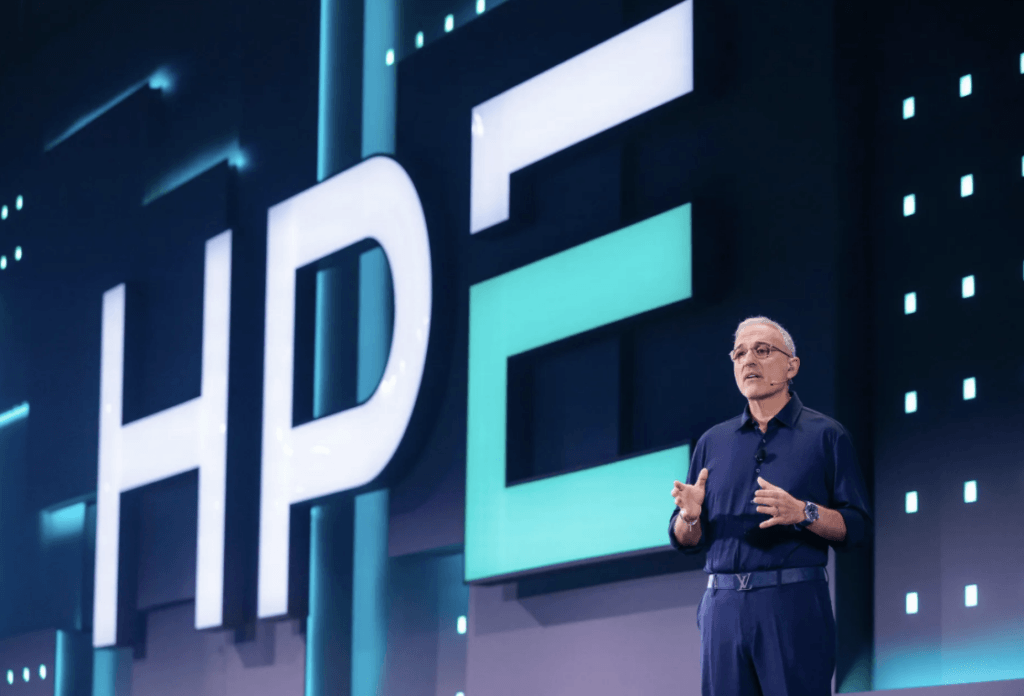
LAS VEGAS — HPE Discover 2026 opened with a broad thesis from CEO Antonio Neri: the future of AI will depend as much on networking, governance, security, power, and operations as it does on compute. In a keynote that reflected HPE’s first full year operating with Juniper Networks as part of the company, Neri positioned networking as the foundational layer connecting AI factories, agentic enterprises, hybrid cloud environments, sovereign AI deployments, and emerging quantum computing platforms. The recurring theme throughout the presentation was simple: “Architecting for AI starts with your network.”
Rather than focusing solely on new products, Neri connected a series of HPE initiatives into an AI-focused architecture. The keynote highlighted HPE Juniper Networking for AI fabrics, GreenLake Intelligence for agentic operations, Private Cloud AI for enterprise AI deployments, confidential computing for data protection, sovereign AI solutions for regulated industries, and HPE’s growing role in hybrid quantum-classical computing. Neri argued that AI infrastructure is entering a new phase where performance depends on how efficiently organizations can move, secure, govern, and operationalize data across distributed environments. “The performance of your entire operation depends on the network,” he said, emphasizing that every token, model update, and AI-driven decision ultimately traverses the network.
Networking occupied the center of the keynote and reflected the growing influence of Juniper technology within HPE’s broader portfolio. Neri showcased new HPE Juniper Networking platforms spanning scale-up, scale-out, and scale-across AI architectures, including new QFX switching systems, PTX routing platforms, and SRX security appliances. He also highlighted continued integration between Aruba Networking and Juniper’s Mist AI and Marvis technologies, describing HPE’s vision for self-driving networks that can identify problems, optimize performance, and remediate issues autonomously. The keynote reinforced HPE’s strategy of treating networking not as a standalone infrastructure layer but as the operational control plane for AI-era computing.
• Networking presented as the foundation for AI factories, agentic enterprises, and hybrid cloud infrastructure.
• Juniper technologies featured prominently across AI networking, routing, security, and operations.
• GreenLake Intelligence positioned as HPE’s agentic operations platform for hybrid environments.
• Private Cloud AI expanded with new governance, data management, and agentic AI capabilities.
• Sovereign AI and confidential computing highlighted as critical requirements for regulated industries.
• HPE emphasized AI networking across scale-up, scale-out, and scale-across architectures.
• Quantum computing featured as a long-term strategic pillar integrated with HPC and AI infrastructure.
• Sustainability, power consumption, and energy efficiency identified as major future constraints on AI growth.
“The performance of your entire operation depends on the network. Every byte, every token, every decision, all of it crosses the network.”

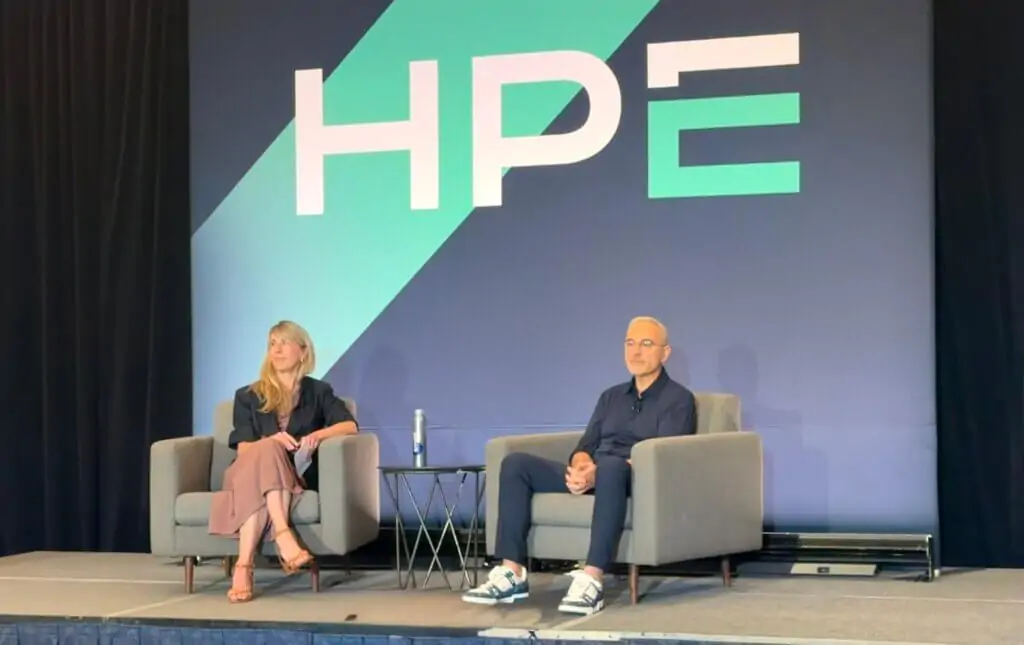
Q&A with Antonio Neri
Jim Carroll: You described the network as the foundation for AI. What do you see as the major bottlenecks for this next wave of AI deployment? Is it scale-up, scale-out, or scale-across networking?
Antonio Neri: “It depends on the customer segment. The goal is always the same: getting to the first token faster, at the lowest cost per token, and in the most sustainable way. Energy and networking are two key elements, but storage and memory are also important factors.
For large AI service providers and model builders, time-to-market with the latest technology is critical so they can operate at the lowest cost per token in a sustainable way. Networking plays a massive role in that. Different models require different infrastructure architectures, and customers need the flexibility to choose what works best for their environment.”
“For enterprises, it’s a different challenge. It’s really about time-to-value. If I invest a dollar to automate processes and drive agentic workflows across my business, I need to see business outcomes much faster than before. That’s why the AI Factory with NVIDIA is so important. But it’s not just infrastructure. It’s everything that sits on top of it—the virtualization layer, the container layer, the AI inferencing layer, the applications, the models, the data, and the context. The value comes from getting from deployment to outcomes faster than ever before.”
“When I spend time with customers, they’re concerned about cost, security, governance, and control. That’s why Private Cloud AI and our integrated approach are so important.”
Jim Carroll: And the harder question: World Cup predictions? Is it really Argentina again?
Antonio Neri: “I can tell you it’s harder this time because of the expanded format. To win the World Cup, you have to play one more game than before. Argentina has an amazing team, but everything has to work together over the course of the tournament.”
“My top teams are England, France, Argentina, and Spain. We’ll see.”
🌐 Analysis
Neri’s keynote marks an important milestone in HPE’s post-Juniper era. During the past year, HPE has moved beyond explaining why it acquired Juniper and is now demonstrating how Juniper’s technologies fit into a broader architectural strategy. Networking was no longer presented as a separate business segment but as the connective tissue linking AI factories, cloud platforms, enterprise operations, security, and data infrastructure. The integration of Aruba, Mist, Marvis, QFX, PTX, and SRX technologies throughout the keynote underscored how deeply Juniper assets are becoming embedded across the HPE portfolio.
The message also arrives against a backdrop of strong financial performance. HPE recently reported record revenue and significant networking growth following the Juniper acquisition. As competitors continue to focus heavily on GPUs and accelerated computing, HPE is advancing a differentiated narrative: AI success will increasingly depend on the ability to connect, govern, secure, power, and operate distributed systems at scale. Neri’s keynote suggests HPE sees networking as the control plane that ties those requirements together.