


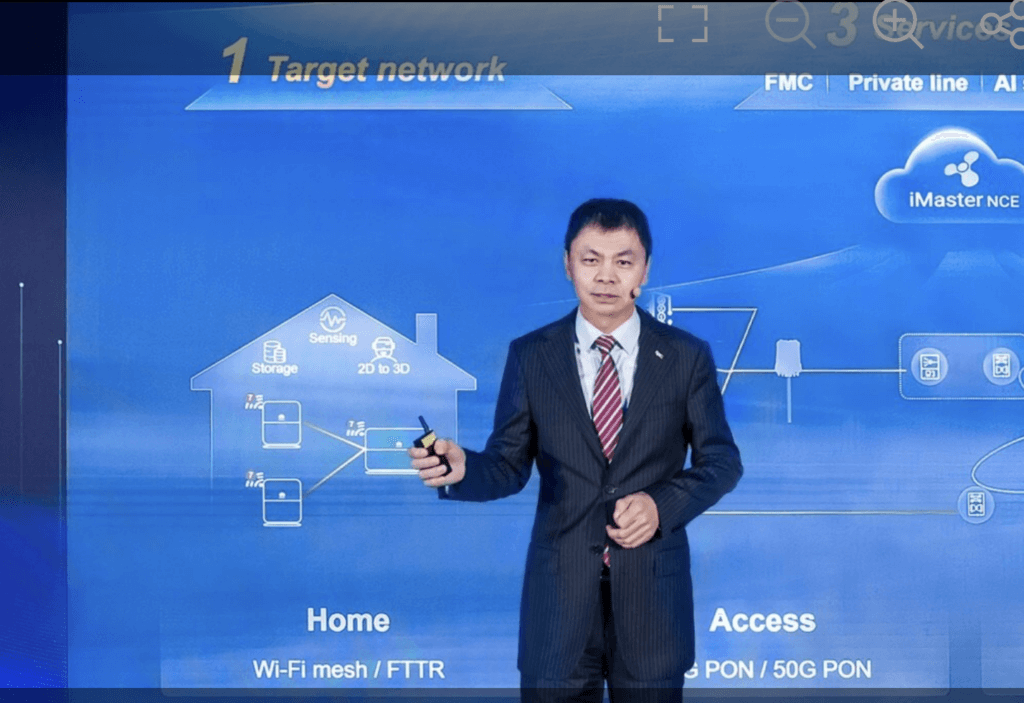
Huawei has outlined a roadmap for an AI-centric all-optical target network designed to support emerging AI services and next-generation broadband applications. Speaking at the Green All-Optical Network Forum hosted by IDATE, Kim Jin, Vice President of Huawei’s Optical Business Product Line, described how operators must upgrade network bandwidth, reliability, coverage, and latency to support AI-driven workloads and premium digital experiences.
The vision features a multi-layer architecture spanning access, metro, and backbone networks, combined with AI-assisted operations. Huawei said the approach will help operators deploy “Agentic UBB” networks capable of delivering differentiated services and maintaining consistent performance for AI-driven applications and consumer broadband services.
• Wi-Fi 7 tri-band FTTR (Fiber-to-the-Room) architecture designed to deliver stable 4 Gbps connectivity in each room, with whole-home roaming under 10 ms and improved signal penetration through AI-based interference mitigation.
• Next-generation PON capabilities including OLT application-level PON slicing and Wi-Fi air-interface scheduling to provide deterministic connectivity and dedicated channels for latency-sensitive or premium applications.
• Metro optical cross-connect (OXC) architecture extending all-optical switching deeper into metro networks to reduce end-to-end latency and support mesh network topologies designed for AI workloads.
• Backbone evolution toward 400G and 800G optical transmission combined with Super C+L band spectrum expansion and full-format submarine cable transport to address bandwidth demand for data center interconnect and international traffic.
• Zero-outage optical networking approach using coordinated hardware-software monitoring, eOTDR diagnostics, and wavelength-switched optical networking (WSON) capable of switching within 50 ms to improve network resilience.
• AI-assisted operations tools including FANSpirit for optical access troubleshooting and OTNSpirit for intelligent path selection based on bandwidth, latency, and reliability metrics.
Kim Jin said, “The AI era brings operators a once-in-ten-years new chance. Huawei is committed to working with industry partners to build an AI-centric all-optical target network. This will keep improving user experience, unlock more network value, and achieve win-win growth in the AI era.”
🌐 Analysis: Huawei’s proposal aligns with a broader industry shift toward optical infrastructure optimized for AI traffic patterns. Hyperscale AI clusters and distributed compute models require deterministic latency, higher optical capacity, and tighter integration between access, metro, and data-center networks. The emphasis on 400G and 800G transport also reflects accelerating adoption of high-capacity optics across backbone and DCI networks.
Operators and vendors across the ecosystem are exploring similar architectures as AI workloads place new demands on broadband and optical infrastructure. Work in standards bodies and industry forums increasingly focuses on integrating high-capacity optics, programmable networks, and AI-driven operations to support emerging AI-native services and distributed computing environments.
🌐 We’re tracking the latest developments in optical networking. Follow our ongoing coverage at: https://convergedigest.com/category/optical/
🌐 We’re launching the “Data Center Networking for AI” series on NextGenInfra.io and inviting companies building real solutions—silicon, optics, fabrics, switches, software, orchestration—to share their views on video and in our expert report. To get involved, send a note to jcarroll@convergedigest.com or info@nextgeninfra.io.