


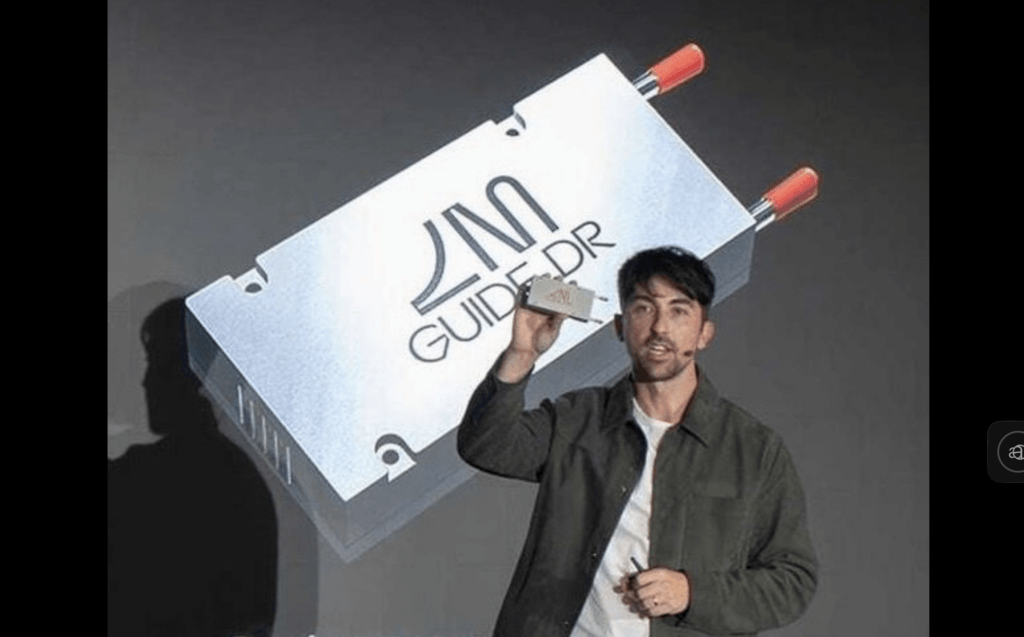
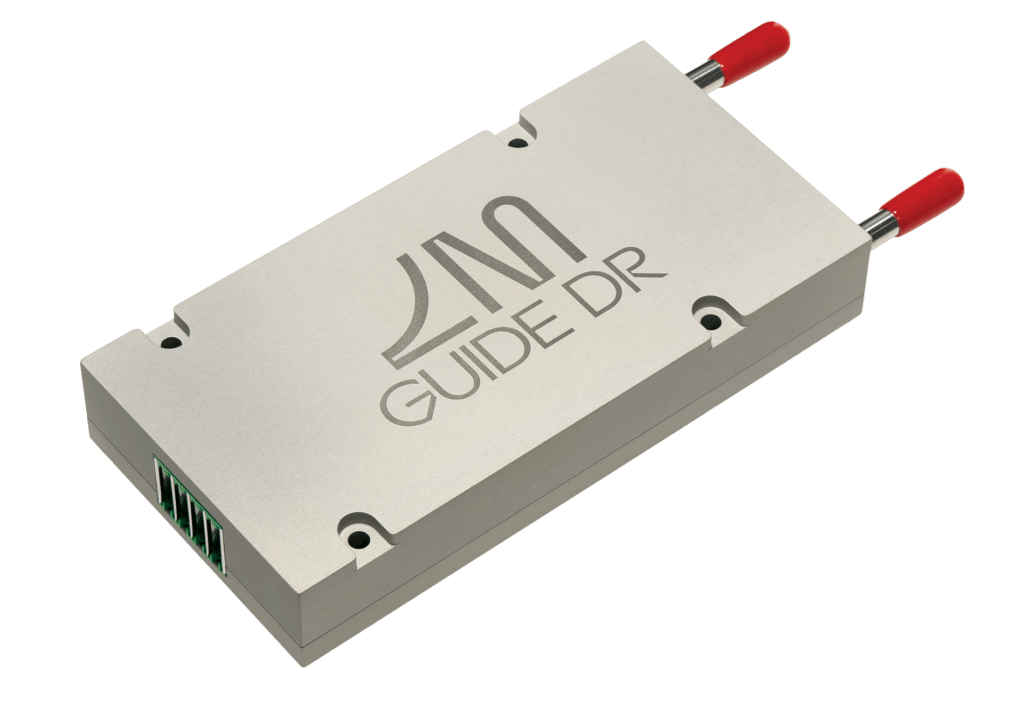
Lightmatter introduced Guide DR, a liquid-cooled Laser Network Interface Card designed to move high-density laser sources inside AI system chassis and relieve the front-panel constraints facing co-packaged optics and near-package optics deployments.
The new Guide DR module uses OCP NIC 3.0 dimensions and targets OCP MHS/MGX system tray integration. Lightmatter said each module can support up to 51.2 Tbps of aggregate optical bandwidth, while four modules can support up to 204.8 Tbps of CPO scale-up switching bandwidth in a 1RU tray.
Guide DR targets Lightmatter’s Passage L20 optical interconnect platform and other high-bandwidth AI scale-up architectures. The company said the design enables approximately four times the rack density of conventional External Laser Small Form Factor Pluggables by moving the laser source away from the faceplate and into a liquid-cooled in-chassis module.
• Supplies 200 mW of optical power per fiber across up to 64 fibers
• Drives 256 lanes at 200G each
• Supports up to 51.2 Tbps per module
• Enables more than 200 Tbps of scale-up bandwidth using four modules in a 1RU switch tray
• Uses OCP NIC 3.0 dimensions
• Designed for OCP MHS/MGX integration
• Supports OIF CMIS 5.3 management and IEEE DR optics
• Includes I2C/I3C control interfaces for telemetry, internal temperatures, and laser diode drive current
• Uses a liquid-cooled cold plate package design for A2 ASHRAE-compliant environments
• Sampling begins in Q4 2026
“With Guide DR, we are removing the physical barriers to next-generation AI infrastructure by delivering the foundational laser innovation required to scale co-packaged optics,” said Nick Harris, Ph.D., Founder and CEO of Lightmatter. “As the industry scales from 200G ports to beyond, traditional light source solutions are hitting a wall. By integrating a high-density, liquid-cooled light source into a standard NIC form factor within the chassis, we unlock the massive optical power necessary for next-generation interconnects in a single 1 RU footprint. This architecture enables the system-level reliability hyperscale operators require, while maintaining the modularity the industry expects.”

Event Summary: Lightmatter InterConnect 2026
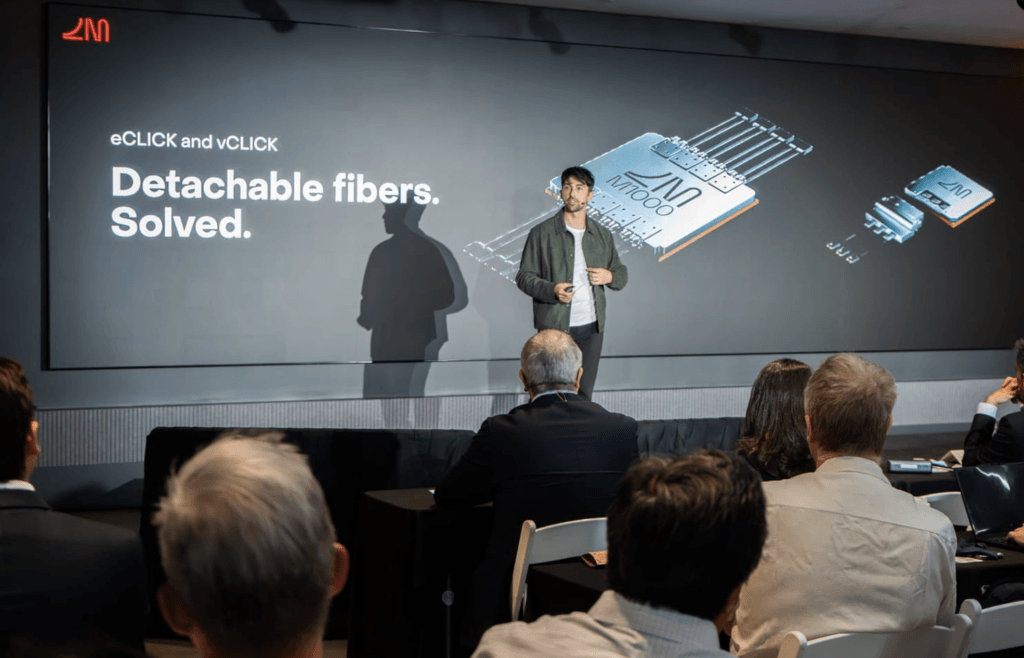
Lightmatter used its InterConnect 2026 event in Mountain View on 21-May-2026 to position silicon photonics as a foundational technology for next-generation AI systems. The company demonstrated hardware spanning near-package optics, co-packaged optics, photonic interposers, detachable fiber systems, and liquid-cooled laser architectures. Executives repeatedly emphasized that AI infrastructure now depends as much on interconnect architecture as on GPUs and XPUs themselves.
The company outlined a manufacturing and deployment flow that stretches from 300 mm silicon photonics fabrication through advanced packaging, optical validation, rack integration, and data center deployment. Lightmatter said its Passage platforms rely on high-precision lithography, optical circuit switching, advanced chip-on-wafer packaging, and extensive wafer-level testing. The company highlighted partnerships with GlobalFoundries, ASE/ISE, Amkor, Qualcomm, Cadence, Synopsys, ODM partners, and Open Compute Project contributors as key parts of the ecosystem required to commercialize photonic AI interconnects at scale.
Executives focused heavily on AI workload behavior and the role of optical networking in accelerating both training and inference. Lightmatter argued that larger optical scale-up domains can sharply reduce training times and improve inference responsiveness by allowing GPUs and XPUs to communicate across far larger fabrics than copper-based systems permit. The company also stressed the operational side of deployment, including rack design, fiber routing, firmware control, telemetry, serviceability, and laser reliability as critical factors for large-scale AI factories.

• Lightmatter presented Passage as a unified photonic interconnect platform spanning NPO, CPO, XPO, and photonic interposer architectures.
• The company demonstrated the Passage M1 1000 photonic interposer with 114 Tbps of optical I/O and 256 fibers across 16 optical connectors.
• Lightmatter said a full rack configuration can deliver approximately 1.4 PBps of aggregate optical bandwidth.
• The company highlighted eClick and VClick detachable fiber systems as mechanisms for serviceable co-packaged optics and photonic interposer deployments.
• Executives identified DWDM and BiDi optical links as central to future AI networking architectures.
• Lightmatter said BiDi technology can eliminate roughly half of the fiber and connector requirements inside large AI clusters.
• The company described Guide DR as a new internal laser architecture designed to replace multiple external laser pluggables while dramatically increasing optical density.
• Executives said the new LNIC form factor integrates directly into OCP MGX-style systems and enables higher-density optical switching configurations.
• Panel discussions pointed to 2027–2028 as the initial deployment window for broader XPO, NPO, and CPO adoption in hyperscale AI systems.
🌐 Analysis: Guide DR addresses one of the practical constraints in CPO and NPO adoption: the power, cooling, fiber routing, and faceplate space needed to support external laser sources at AI cluster scale. The move toward an internal, liquid-cooled laser NIC also fits the broader AI infrastructure shift toward higher-density scale-up fabrics, where optical I/O, switch tray mechanics, and thermal design now shape system architecture as much as SerDes speed or switch ASIC capacity.