


arvell moved to expand its AI data-center connectivity roadmap by agreeing to acquire Celestial AI in a definitive deal valued at approximately $3.25 billion upfront, with contingent equity that could lift the total above $5 billion based on revenue milestones. The acquisition targets Celestial AI’s Photonic Fabric optical interconnect platform, which delivers 16 Tbps chiplets designed for next-generation scale-up fabrics connecting XPUs across packages, systems, and racks. Marvell expects the business to begin contributing revenue in the second half of fiscal 2028, reaching a $500 million annualized run rate by the fourth quarter of fiscal 2028 and $1 billion by the fourth quarter of fiscal 2029.
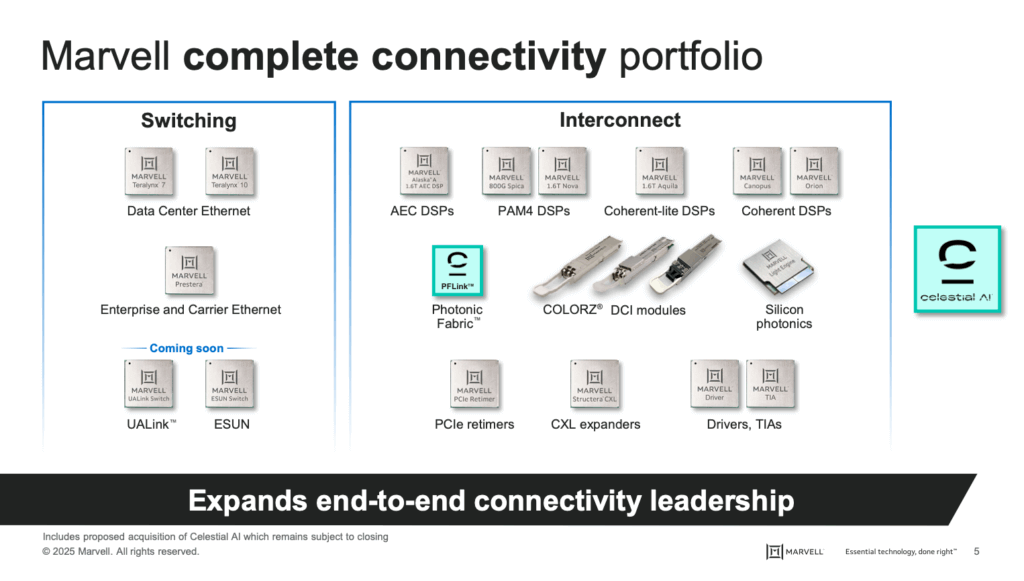
The deal positions Marvell to extend its connectivity portfolio—including Ethernet switching, DCI optics, custom silicon, and its UALink-based scale-up roadmap—into the short-reach optical domain that AI systems increasingly require as copper reaches limits in bandwidth, latency, power, and thermal reach. Celestial AI’s Photonic Fabric chiplets integrate electrical and optical components in a compact form factor and can be co-packaged directly with XPUs and scale-up switches, enabling optical links to originate from the center of the die and freeing die-edge area for additional HBM capacity. The company reports active engagements with multiple hyperscalers preparing multi-rack AI clusters that will transition high-speed XPU links from copper to optics.
Under the agreement, Marvell will pay $1 billion in cash and issue approximately 27.2 million shares valued at $2.25 billion based on the 10-day volume-weighted average price. Earn-outs totaling another ~27.2 million shares will be paid if Celestial AI achieves at least $500 million in cumulative revenue by the end of Marvell’s fiscal 2029 (one-third of the earn-out), and up to $2 billion in cumulative revenue by the same date (full earn-out). Closing is expected in the first quarter of calendar 2026, subject to regulatory review.
• Upfront value: $3.25 billion in cash and stock
• Earn-out potential: Up to ~$2.25 billion additional in equity
• Product target: 16 Tbps Photonic Fabric chiplets for optical scale-up fabrics
• Revenue outlook: $500 million annualized run-rate (Q4 FY28); $1 billion annualized (Q4 FY29)
• Integration: Co-packaged optical I/O for XPUs and scale-up switches, aligned with Marvell’s UALink roadmap
“The acquisition of Celestial AI is a transformative step in Marvell’s evolution and expands our leadership in AI connectivity, as scale-up becomes the next frontier in AI infrastructure,” said Matt Murphy, Chairman and CEO of Marvell.


🌐 Analysis:
Celestial AI brings a deep optical-I/O portfolio developed around its Photonic Fabric platform—originally engineered to replace short-reach copper inside AI racks and to enable pooled memory appliances using photonic interposers. Founded in 2020 and backed by more than $500 million in venture funding, the company built a reputation for strong hyperscaler traction and a differentiated thermal approach that allows its photonics to operate adjacent to multi-kilowatt XPUs in 3D packages. The 16 Tbps Photonic Fabric chiplet underscores the scale-up trend driven by UALink-class architectures, where XPUs require direct low-latency access to each other’s memory across multiple racks. By acquiring Celestial AI rather than licensing optical I/O, Marvell follows a broader pattern in 2025–2026: large semiconductor vendors moving to own critical photonic interconnect IP as AI clusters outgrow copper and as rival startups—including Ayar Labs, Lightmatter, and Ranovus—push toward production-scale optical chiplets. This acquisition aligns Marvell with hyperscalers looking to commercialize optical scale-up fabrics toward the end of the decade.
Hot Chips 2025: Celestial AI CTO Details In-Die Optical I/O

Celestial AI’s CTO Phil Winterbottom took the stage at IEEE Hot Chips 2025 at Stanford University to detail the company’s Photonic Fabric roadmap, expanding on concepts introduced earlier this month at the Hot Interconnects conference. While the HoTI25 talk emphasized the launch of the Photonic Fabric Link (PFLink) and its first module and appliance, Winterbottom’s Hot Chips session dug deeper into scaling laws, packaging, and the thermal realities of 500W–900W GPUs.
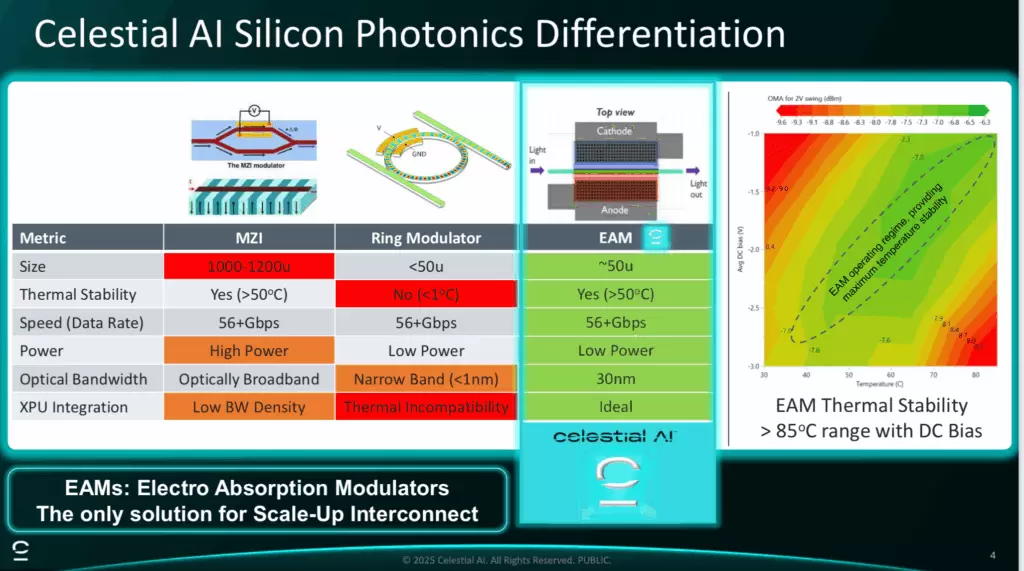
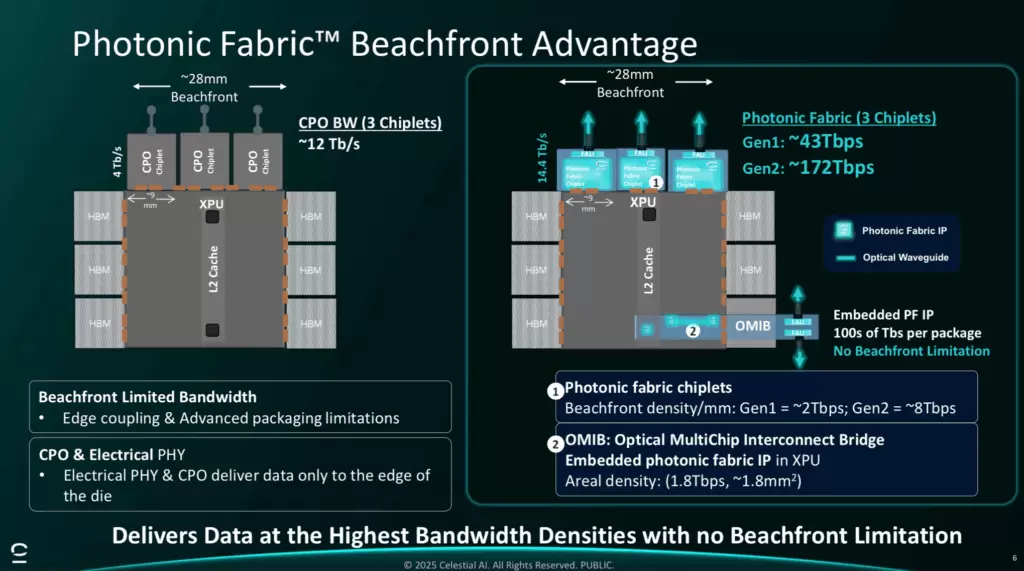
Celestial’s platform integrates silicon photonics directly into 2.5D interposers and bridges using TSMC CoWoS, enabling optical I/O within dies, between chiplets, and across packages. The company highlighted its choice of electro-absorption modulators (EAMs) over ring modulators, citing tolerance to >85 °C swings and resilience to rapid temperature excursions of up to 200 °C/s. Custom analog-only SerDes deliver ~2× better efficiency than DSP-based approaches, consuming ~2.4 pJ/bit for electronics and 0.7 pJ/bit for lasers. Winterbottom stressed how this approach avoids the “beachfront I/O” bottleneck, allowing optical I/O anywhere on the die.
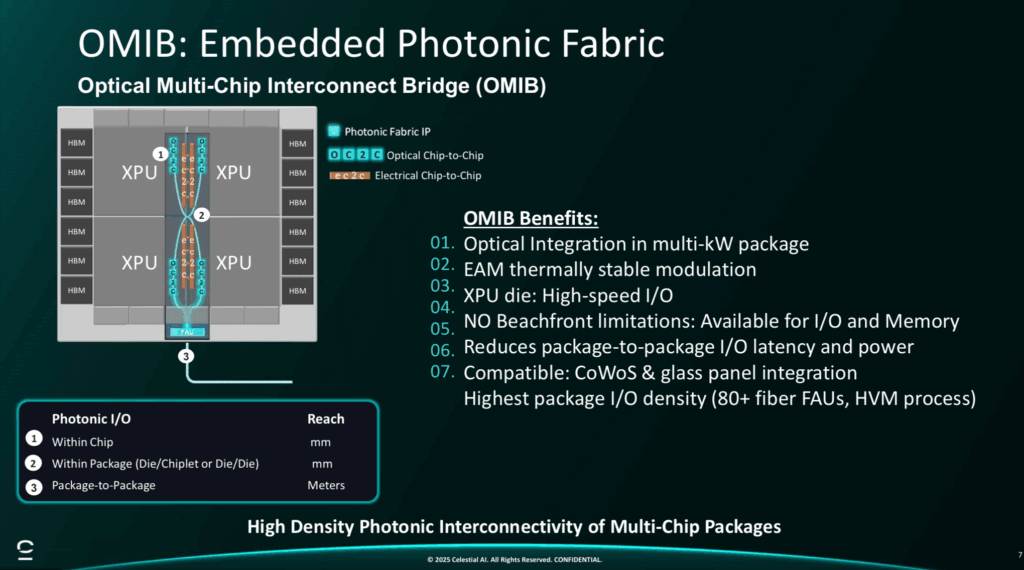
Key new elements at Hot Chips included the Optical Multi-Chip Interconnect Bridge (OMIB), which embeds photonics into package bridges to support in-die optical connections, potentially dropping memory transactions directly into cache and reducing on-die travel latency. Winterbottom also described a photonic switch architecture that relocates I/O to the chip center while freeing die perimeter for HBM and DDR PHYs. Celestial cited measured latencies of ~100 ns for NIC-to-NIC paths and <200 ns for chip-to-memory transactions. The company has completed four TSMC 5/4nm tapeouts of its EICs, demonstrating pre-FEC BER <1e-8 at -10 dBm OMA input with WDM.
- Photonic Fabric Link integrates optics into interposers and bridges for in-die, chiplet, and package-to-package I/O
- Electro-absorption modulators chosen over rings for thermal stability and slew-rate tolerance in 500W+ GPUs
- Analog-only SerDes deliver ~2× power efficiency versus DSP-based designs
- OMIB packaging structure supports optical cache access and multi-die GPU scaling
- Latencies measured: ~100 ns NIC-to-NIC, <200 ns chip-to-memory
- Builds on HoTI25 debut of Photonic Fabric modules and appliance (7.2 Tbps per module, 115 Tbps per 2U system)
“Our roadmap enables co-packaged optics today and evolves to full in-die optical I/O for tomorrow’s largest processors,” said Phil Winterbottom, CTO of Celestial AI.Co-packaged optics are essential in data center applications where the demand for bandwidth is ever-increasing, and the ability to bundle optics and electronics can significantly reduce energy consumption and space requirements.
“In-die” optical I/O is an even more advanced technology that aims to integrate optics directly into a microprocessor’s silicon, effectively eliminating the need for electrical I/O and its associated energy inefficiencies.
“In-die optical I/O has the potential to truly revolutionize the microprocessor industry, enabling processors that are faster, more efficient, and less energy-intensive than ever before,” said Winterbottom. “We’re excited to be at the forefront of this technology and look forward to seeing its impact across various industries over the coming years.”
Celestial AI is at the forefront of this technology development with its innovative roadmap for adoption, ensuring that it remains relevant and competitive in an industry that values high performance and energy efficiency. As part of this plan, the company intends to work closely with industry partners and clients to ensure the technology meets their needs and expectations, and to leverage their expertise in facilitating the transition to this new era of processor technology.
By taking a future-focused approach, Celestial AI not only demonstrates innovation in technology but prepares for a future where efficiency and performance are inseparable, creating a path towards more sustainable data center operations.


🌐 We’re tracking the latest developments in networking silicon. Follow our ongoing coverage at: https://convergedigest.com/category/semiconductors/