


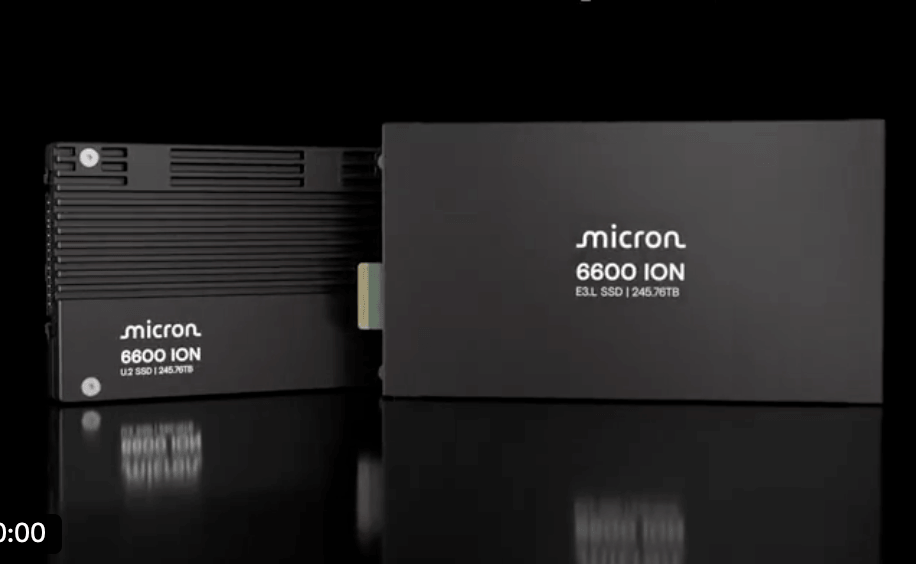
Micron Technology is now shipping the 245TB Micron 6600 ION SSD, a high-capacity data center drive designed to improve rack-scale storage density for AI, cloud, enterprise, and hyperscale workloads. The drive targets next-generation AI data lakes and large-scale file and object storage environments where capacity, power, cooling, and physical footprint increasingly shape infrastructure economics.
The 245TB Micron 6600 ION SSD uses Micron G9 QLC NAND and comes in U.2 and E3.L form factors. Micron said the E3.L version requires 82% fewer racks to deliver equivalent raw capacity compared with HDD-based deployments. The company also said the drive consumes up to 30 W at maximum power, about half the power of a comparable-capacity HDD deployment.
Micron positioned the SSD as a rack-level TCO play rather than only a drive-capacity milestone. In internal testing, Micron said the 245TB 6600 ION delivered up to 84x better energy efficiency for AI workloads, 8.6x faster AI preprocessing, 3.4x better ingest throughput, and up to 29x lower latency compared with HDD-based systems. For object storage workloads, Micron reported up to 435x better throughput per watt, 96x faster time to first byte, and 58x better aggregate throughput.
• Capacity: 245TB per SSD
• Form factors: U.2 and E3.L
• NAND: Micron G9 QLC NAND
• Power: up to 30 W maximum power
• Target workloads: AI data lakes, cloud-scale file storage, object storage, enterprise and hyperscale deployments
• Rack impact: 82% fewer racks versus HDD-based deployments for equivalent raw capacity
• Sustainability claims at 1EB scale: 921 MWh saved annually, 438 metric tons of CO2 reduction, and HVAC savings of more than 3.14 billion Btu per year, equal to about 920 MWh of thermal energy
• Demo: Dell Tech World, May 18–21, 2026, in Micron booth #226, shown in a 40-slot Dell PowerEdge server optimized for data lake storage
“AI workloads are driving massive growth in shared data, continuing the shift of data center storage share from HDDs toward SSDs. With 245TB in a single SSD, the Micron 6600 ION makes solid state storage the clear choice for modern data centers,” said Jeremy Werner, senior vice president and general manager of Micron’s Core Data Center Business Unit.
🌐 Analysis: Pricing dynamics in early 2026 reinforce Micron’s positioning around density and efficiency. Both HDD and SSD markets are experiencing supply constraints as AI infrastructure buildouts accelerate across hyperscalers and cloud providers. Nearline HDD capacity demand—driven by bulk storage for AI training datasets and cold storage tiers—has pushed pricing upward after several years of relative stability. At the same time, SSD pricing, particularly for high-capacity QLC-based drives, has also risen as NAND supply tightens and demand shifts toward higher-layer counts and advanced nodes such as 3D NAND.
On the HDD side, limited supplier concentration—primarily Seagate Technology, Western Digital, and Toshiba—has constrained rapid capacity expansion. These vendors have focused on profitability and disciplined output rather than aggressive volume scaling, contributing to tighter supply. Meanwhile, hyperscalers continue to absorb large volumes of 20TB+ nearline drives, sustaining upward pressure on $/TB. Lead times have extended in some cases, particularly for the highest-capacity HAMR and ePMR-based drives.
In the SSD segment, suppliers including Micron Technology, Samsung Electronics, and SK hynix face competing pressures: strong demand for AI-optimized storage and ongoing transitions to higher-layer NAND (e.g., 232-layer and beyond). QLC NAND, which underpins ultra-high-capacity drives like the 6600 ION, has moved from a cost-optimization tier into a strategic enabler for AI data lakes. As a result, pricing has firmed, particularly for enterprise-grade, high-endurance QLC SSDs. The net effect is a market where both HDD and SSD pricing trends move upward simultaneously—an uncommon scenario historically—driven by synchronized demand from AI, cloud expansion, and data sovereignty initiatives.