



Microsoft reported fiscal third quarter 2026 revenue of $82.9 billion, up 18% year-over-year, as growth in cloud and AI infrastructure continued to accelerate across its platform portfolio. Operating income rose 20% to $38.4 billion, while net income reached $31.8 billion, up 23%, reflecting expanding margins and strong demand for AI-driven services. Diluted earnings per share increased to $4.27.
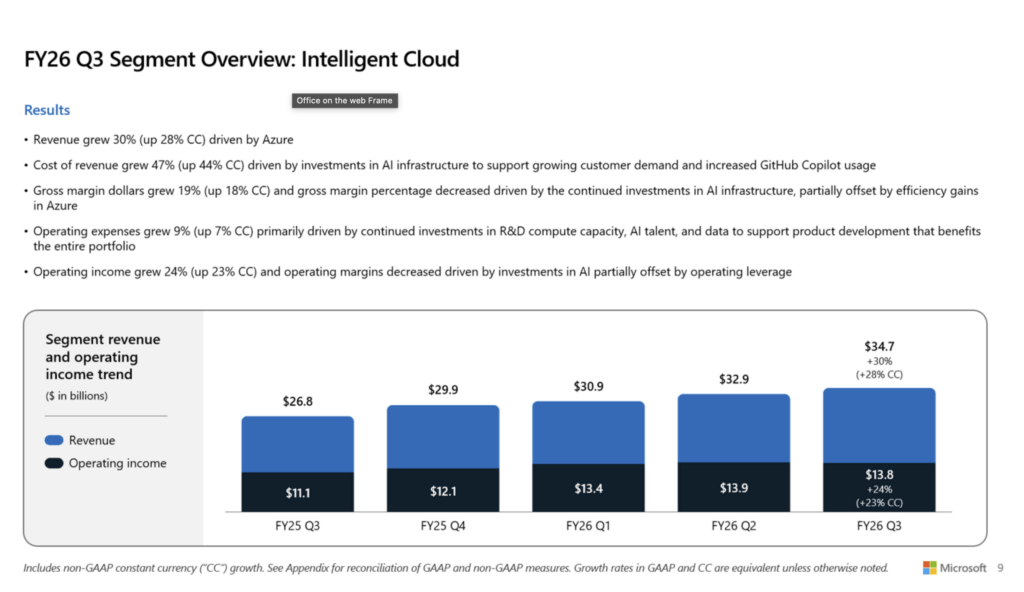
Microsoft Cloud revenue climbed 29% to $54.5 billion, supported by sustained enterprise adoption and a surge in AI workloads. The company disclosed that its AI business exceeded a $37 billion annual revenue run rate, growing 123% year-over-year. Within the Intelligent Cloud segment, revenue rose 30% to $34.7 billion, with Azure and other cloud services growing 40%, underscoring continued hyperscaler and enterprise demand for AI infrastructure and platform services.
Growth extended across Microsoft’s enterprise software portfolio. Productivity and Business Processes revenue increased 17% to $35.0 billion, led by Microsoft 365 Commercial (+19%) and Dynamics 365 (+22%). Microsoft 365 Consumer grew 33%, while LinkedIn revenue rose 12%. In contrast, More Personal Computing declined 1% to $13.2 billion, reflecting weaker performance in Windows OEM and Xbox content, partially offset by 12% growth in search advertising.
- Microsoft Cloud revenue: $54.5 billion, up 29%
- AI business annual run rate: $37 billion, up 123%
- Azure growth: +40% year-over-year
- Commercial remaining performance obligation: $627 billion, up 99%
- Productivity and Business Processes: $35.0 billion (+17%)
- Intelligent Cloud: $34.7 billion (+30%)
- More Personal Computing: $13.2 billion (-1%)
- Capital returned to shareholders: $10.2 billion
“Our AI business surpassed an annual revenue run rate of $37 billion, up 123% year-over-year,” said Satya Nadella.

Addendum: Key Takeaways from Microsoft Q3 FY2026 Earnings Call
- Rapid data center scaling: Added ~1 gigawatt of capacity in the quarter; on track to double global data center footprint within two years, with new builds across four continents
- Deployment velocity improving: Reduced GPU “dock-to-live” deployment times by ~20%; new Wisconsin data center came online six weeks ahead of schedule
- AI infrastructure optimization: Achieved ~40% improvement in inference throughput for core models; continued vertical optimization across silicon, systems, and software stack
- Custom silicon ramp: Maia 200 AI accelerator now deployed in production with >30% improvement in tokens-per-dollar; Cobalt CPU active in ~50% of regions and scaling with large enterprise workloads
- Multi-model strategy gaining traction: Over 10,000 customers using multiple models on Microsoft Foundry; increasing adoption of OpenAI, Anthropic, and open-source models in parallel
- AI platform scale metrics: ~300 customers expected to process >1 trillion tokens this year; token volume growing ~30% quarter-over-quarter
- Fabric + Foundry convergence: 15,000+ customers using both platforms (+60% YoY); OneLake data volume up nearly 4x YoY, reinforcing Microsoft’s “data + AI” flywheel
- Database acceleration: Cosmos DB revenue grew ~50% YoY, driven by AI-native application workloads
- Copilot enterprise penetration: Over 20 million paid Microsoft 365 Copilot seats; largest deployment includes 740,000 seats at Accenture; multiple enterprises committing 90,000+ seats
- Usage intensity shift: Copilot engagement now comparable to Outlook; monthly active usage of first-party agents up 6x year-to-date
- Agent platform scale: Tens of thousands of companies managing tens of millions of agents via Agent 365 control plane
- Enterprise adoption pattern: Transition from seat-based licensing to hybrid “seat + consumption” pricing model, especially in customer service and developer workflows
- Developer ecosystem growth: ~140,000 organizations using GitHub Copilot; enterprise subscribers nearly tripled YoY; CLI usage doubling month-over-month
- Security implications of AI: Over 2 million alerts handled by AI-driven security agents this quarter; 35 billion Copilot interactions audited via Purview (+7x YoY)
- CapEx intensity rising: Q4 CapEx expected to exceed $40 billion; full-year 2026 CapEx projected at ~$190 billion, with continued supply constraints through 2026
- Infrastructure mix: ~2/3 of CapEx allocated to short-lived assets (GPUs/CPUs), highlighting rapid refresh cycles tied to AI demand
- Margins and efficiency: AI margins benefiting from usage-based pricing, proprietary IP leverage, and hardware/software optimization despite heavy infrastructure investment
- Supply-demand imbalance persists: Azure demand continues to exceed available capacity, with allocation decisions balancing enterprise workloads and first-party AI services
- Business model evolution: Microsoft emphasizes “user + usage” economics, with value tied directly to measurable productivity gains and workflow compression
- Consumer platform signals: Bing reached 1 billion monthly active users; Edge gained share for 20 consecutive quarters; Windows active devices surpassed 1.6 billion
🌐 Analysis
Microsoft’s results highlight the continued shift toward AI-driven cloud consumption, with Azure emerging as a primary beneficiary of enterprise AI deployment cycles. The near doubling of remaining performance obligations signals strong forward visibility tied to long-term AI infrastructure commitments.
The scale of Microsoft’s AI revenue run rate positions it alongside major hyperscale competitors such as Amazon Web Services and Google Cloud, both of which are also reporting accelerated AI-driven growth. Microsoft’s deep integration with OpenAI and its expanding enterprise AI stack—from infrastructure to applications—continues to differentiate its full-stack approach in the emerging agentic computing era.