


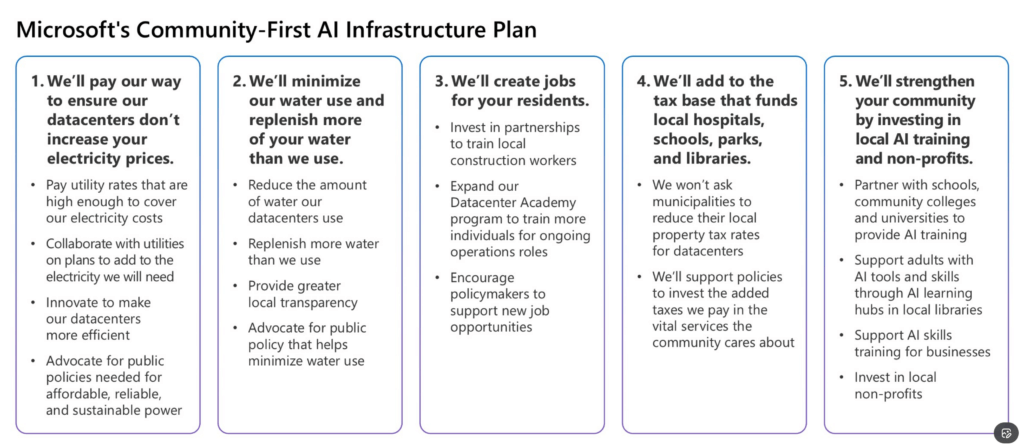
Microsoft rolled out a five-point “Community-First AI Infrastructure” plan as it accelerates data center expansion across the United States, framing AI infrastructure as the next major chapter in the nation’s long history of large-scale buildouts. The initiative sets out concrete commitments aimed at addressing rising local concerns over electricity costs, water use, workforce impacts, and community benefits tied to hyperscale data center growth.
The company positions the effort against a backdrop of rapidly rising AI-driven infrastructure demand, with data centers requiring significant private investment in land, construction, power, cooling, and high-bandwidth connectivity. Microsoft argues that long-term success for AI infrastructure depends on ensuring local communities see clear net benefits, particularly as electricity rates rise, water systems age, and skilled labor shortages intensify nationwide.
Under the framework, Microsoft commits to paying the full cost of the infrastructure impacts its data centers create, while expanding job training, contributing to local tax bases, and investing in AI education and nonprofit organizations. The company plans to launch the initiative in early 2026, beginning in Washington, DC, with similar country-specific programs to follow internationally.
- Electricity: Microsoft says it will pay rates that fully cover the cost of serving its data centers, fund transmission and substation upgrades when required, contract early for new generation capacity, and advocate for faster permitting and grid modernization so residential customers do not see higher power bills.
- Water: The company commits to reducing data center water-use intensity by 40 percent by 2030, expanding closed-loop and recycled-water cooling designs, fully funding local water infrastructure upgrades, replenishing more water than it consumes in each watershed, and publishing regional water-use data.
- Jobs: Microsoft plans to expand partnerships with trade unions, community colleges, and vocational schools, including its Datacenter Academy program, to train local residents for construction and operations roles as demand for skilled labor outpaces supply.
- Local tax base: The company says it will pay full property taxes without seeking abatements, citing past data center investments that have significantly increased local revenues for hospitals, schools, parks, and libraries.
- AI training and nonprofits: Microsoft will fund AI literacy programs in K-12 schools, colleges, libraries, and small businesses in data center communities, while extending employee volunteer and donation matching programs to local nonprofits.
“We believe the long-term success of AI infrastructure requires that companies like Microsoft pay their own way and act as constructive partners in the communities where we build, own, and operate datacenters,” the company said.

🌐 Analysis
Microsoft’s plan formalizes practices that many hyperscalers have addressed piecemeal, particularly as state regulators, utilities, and municipalities scrutinize AI-driven power and water demand more closely. As competitors also race to secure grid capacity, cooling solutions, and skilled labor, structured community engagement and cost-allocation frameworks are becoming a strategic necessity rather than a public-relations exercise.
In September 2025, Microsoft unveiled Fairwater, its most advanced AI datacenter to date, located in Mt. Pleasant, Wisconsin. Spanning 315 acres and 1.2 million square feet (111,484 m²), the facility houses three massive buildings and operates as a single AI supercomputer interconnected by a flat networking architecture. The site is powered by hundreds of thousands of NVIDIA GB200 GPUs configured in tightly coupled racks, delivering 10X the performance of the world’s fastest supercomputer. The project required 46.6 miles (75 km) of foundation piles, 26.5 million pounds (12 million kg) of structural steel, 120 miles (193 km) of underground cable, and 72.6 miles (117 km) of mechanical piping.
The Fairwater datacenter is optimized for training and inference of trillion-parameter AI models. Each rack holds 72 NVIDIA Blackwell GPUs linked by NVLink and NVSwitch, creating pooled memory and bandwidth at terabytes-per-second scale. Racks are arranged in a two-story configuration to minimize latency, and the overall system functions as a unified accelerator cluster capable of processing 865,000 tokens per second. Complementing the compute infrastructure, storage systems span five football fields, with re-architected Azure Blob Storage sustaining over 2 million transactions per second per account.
Environmental considerations are central to the design. Fairwater uses a closed-loop liquid cooling system—the second largest water-cooled chiller plant globally—recycling water continuously without evaporation losses. Over 90% of workloads run on liquid-cooled systems, while the rest use air cooling with water only on peak-temperature days. Microsoft also announced parallel AI datacenter projects in Narvik, Norway, and Loughton, UK, built with partners nScale and Aker JV. These sites will feature NVIDIA’s next-generation GB300 GPUs and integrate into Microsoft’s AI WAN, linking more than 400 datacenters across 70 global regions.
🌐 We’re tracking the latest developments in AI infrastructure, data centers, and cloud platforms. Follow our ongoing coverage at: https://convergedigest.com/category/ai-infrastructure/