


Finland is rapidly emerging as a strategic hub for AI infrastructure in Europe, attracting a wave of hyperscale and “neocloud” data center investments that leverage the country’s low-carbon energy mix, cool climate, and expanding power infrastructure. A new generation of large-scale AI factory projects is taking shape across the country, designed for high-density compute, liquid cooling, and long-term scalability. At the same time, Finland is accelerating investments in nuclear generation and grid capacity—two factors increasingly central to site selection for multi-hundred-megawatt AI deployments.
Nebius is advancing one of the most ambitious builds with a planned 310 MW AI data center in Lappeenranta, targeting initial customer capacity in 2027, following the expansion of its Mäntsälä site to approximately 75 MW. TikTok has committed €1 billion to a second Finnish site in Lahti’s Kiveriö district, with an initial 50 MW IT load and expansion potential to 128 MW. Pure DC has secured land in Seinäjoki for a 500 MW campus based on modular 40 MW AI-ready blocks designed for direct-to-chip liquid cooling, while Winda Energy and Gi21 Capital are planning a 100 MW facility in Janakkala with construction expected to begin in 2027. These developments complement Google’s continued expansion of its seawater-cooled Hamina campus, along with additional land holdings in Vaala (approximately 900 hectares), Kajaani, and Muhos to support future growth.

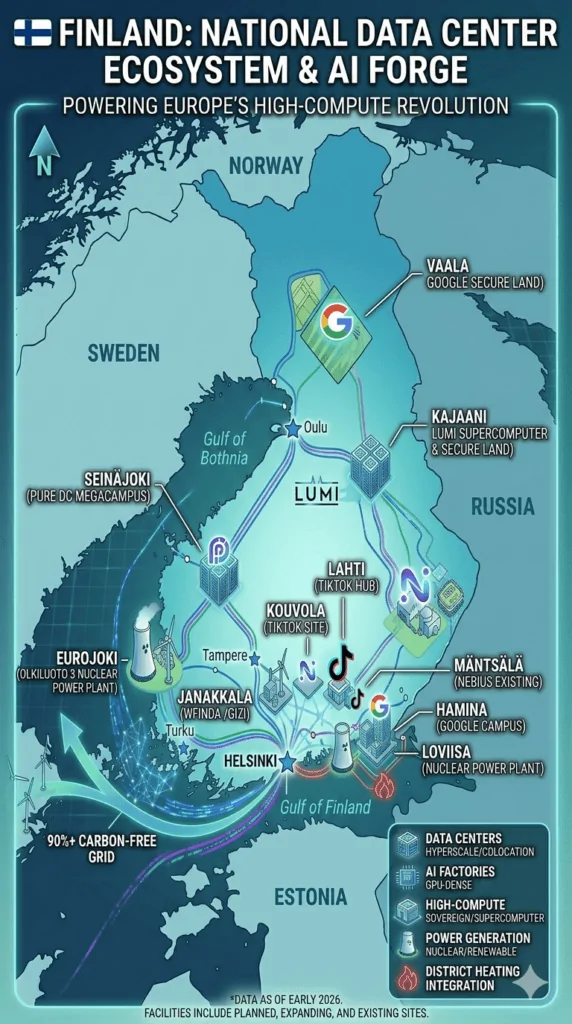
Microsoft is also advancing a major hyperscale cloud region in Finland, with sites in Espoo, Kirkkonummi, and Vihti designed to support AI and cloud workloads at scale. A defining feature of Microsoft’s deployment is its integration with district heating networks, where excess heat from the data centers is captured and redistributed to local communities. In the Helsinki metropolitan area, these systems are expected to serve approximately 250,000 residents, representing one of the most extensive examples of data center heat reuse globally. While total capacity has not been publicly disclosed, the architectural approach aligns with next-generation AI campuses that prioritize both energy efficiency and grid integration.
Finland’s ability to support this level of infrastructure build-out depends heavily on its expanding energy base and transmission network. The country generates the majority of its electricity from hydro, wind, and nuclear sources, anchored by the Olkiluoto 3 reactor, a 1,600 MW-class European Pressurized Reactor that entered full commercial operation in 2023 and significantly increased baseload supply. Nuclear power now plays a central role in stabilizing Finland’s grid as intermittent wind generation scales. At the same time, transmission system operator Fingrid is processing connection requests totaling approximately 24 GW—driven largely by data center demand—and is executing major upgrades to accommodate this growth. Projects such as the Aurora Line, which added roughly 800–900 MW of cross-border capacity with Sweden in 2025, along with planned reinforcements in southern Finland between 2027 and 2029, are critical to enabling new AI infrastructure clusters.
These energy and grid investments directly support Finland’s competitive positioning. The country’s cold climate reduces cooling requirements, while its power profile enables low-carbon operations at scale. Waste heat recovery is becoming a standard design element, allowing operators to integrate with municipal district heating systems and improve overall energy utilization. Current data center electricity consumption stands at approximately 285 MW, but forecasts indicate growth toward 1.5 GW by 2030 as new projects come online and grid capacity expands. However, policy changes—including a shift in electricity taxation for data centers to the general industrial rate starting July 1, 2026, increasing costs by approximately €0.0219 per kWh—introduce new considerations for long-term investment decisions.
- Nebius plans a 310 MW AI data center in Lappeenranta, with initial capacity expected in 2027; existing Mäntsälä site scaled to ~75 MW
- TikTok commits €1 billion to a second Lahti facility, starting at 50 MW IT load with expansion potential to 128 MW
- Pure DC targets a 500 MW campus in Seinäjoki using modular 40 MW AI-ready blocks with direct-to-chip liquid cooling
- Winda Energy and Gi21 Capital plan a 100 MW data center in Janakkala, with construction expected to begin in 2027
- Google continues to expand its Hamina seawater-cooled campus and holds additional land for future developments in Vaala, Kajaani, and Muhos
- Microsoft is building a multi-site hyperscale region across Espoo, Kirkkonummi, and Vihti, with large-scale waste heat recovery serving ~250,000 residents
- Finland’s power mix is anchored by nuclear, including the ~1,600 MW Olkiluoto 3 reactor, alongside hydro and wind generation
- Fingrid is managing ~24 GW of new grid connection requests, with major transmission upgrades underway, including the Aurora Line (~800–900 MW capacity addition)
- National data center load projected to grow from ~285 MW today to ~1.5 GW by 2030
“We have been building in Finland for many years and are pleased to be expanding our presence here. Lappeenranta represents a significant addition to our global AI infrastructure build-out and will make a significant contribution to achieving our capacity goals.”
| Finland AI Infrastructure and Power Ecosystem – Key Projects and Enablers | |
|---|---|
| Nebius – Lappeenranta | 310 MW AI data center; initial capacity expected 2027; complements 75 MW Mäntsälä site |
| TikTok – Lahti (Kiveriö) | €1B investment; 50 MW initial IT load; scalable to 128 MW |
| Pure DC – Seinäjoki | 500 MW campus; modular 40 MW units; direct-to-chip liquid cooling |
| Microsoft – Southern Finland Region | Multi-site hyperscale deployment (Espoo, Kirkkonummi, Vihti); district heating integration serving ~250,000 residents |
| Google – Hamina + Expansion Land | Seawater-cooled campus; additional land in Vaala (~900 hectares), Kajaani, Muhos for future growth |
| Winda / Gi21 – Janakkala | 100 MW planned; construction targeted for 2027 |
| Nuclear Power | Olkiluoto 3 (~1,600 MW) provides baseload stability; nuclear share increasing in energy mix |
| Grid Expansion | ~24 GW connection requests; Aurora Line adds ~800–900 MW cross-border capacity; further reinforcements planned through 2029 |
| Market Outlook | Data center load ~285 MW today; projected to reach ~1.5 GW by 2030 |
🌐 Analysis: Finland’s positioning reflects a broader shift in European AI infrastructure toward regions with abundant low-carbon power and favorable thermal conditions, similar to developments in Norway and Sweden. The scale of announced projects—particularly multi-hundred-megawatt AI campuses—aligns with hyperscaler and neocloud demand for vertically integrated “AI factories” that combine compute, networking, and advanced cooling at unprecedented density.
At the same time, rising electricity taxes and grid constraints introduce new variables for operators evaluating total cost of ownership. Finland’s ability to execute planned transmission upgrades and maintain competitive power pricing will likely determine how much of the projected 24 GW pipeline converts into deployed capacity over the next decade.