


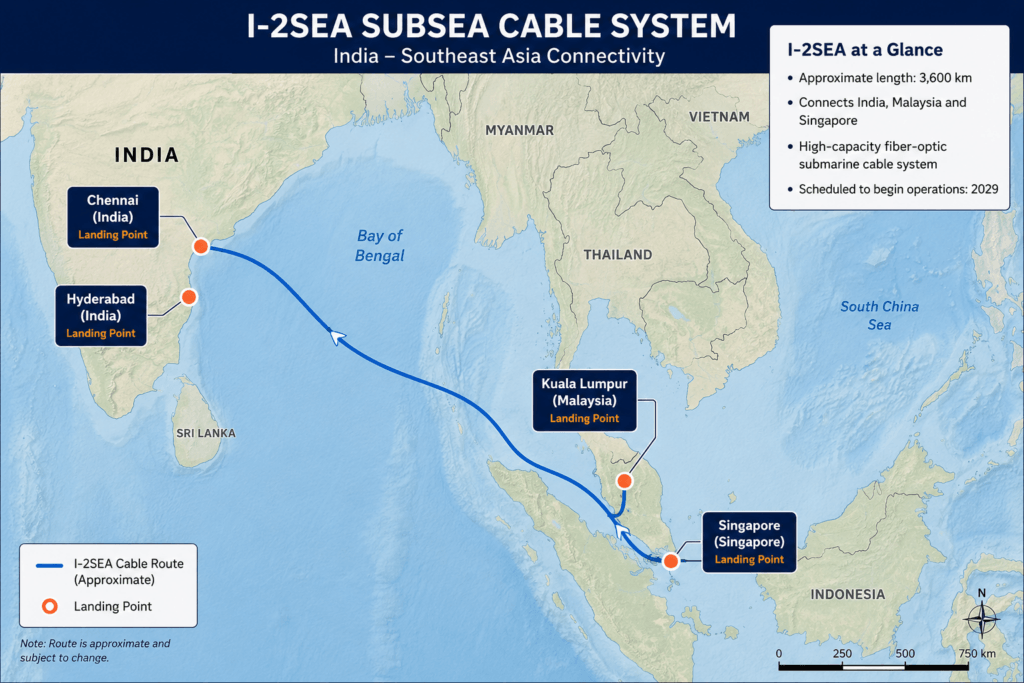
NEC has signed a supply contract with a consortium comprising Lightstorm, Microsoft, Singtel, and Tata Communications to build the India-Southeast Asia (I-2SEA) submarine cable system. The approximately 3,600-km subsea fiber-optic cable will connect India, Malaysia, and Singapore, strengthening digital infrastructure between South Asia and Southeast Asia. The system is scheduled to enter service in 2029.
The I-2SEA cable will provide a direct high-capacity route linking Hyderabad and Chennai—two of India’s fastest-growing hubs for AI infrastructure and hyperscale data centers—with Singapore, a leading regional cloud and AI interconnection hub, and Kuala Lumpur, which continues to expand as a major data center corridor. The consortium said the new system is designed to address rising bandwidth requirements driven by generative AI, cloud computing, and digital services while improving route diversity and network resilience.
NEC will supply the submarine cable system as part of the multi-company consortium. The company said the project builds on more than six decades of experience in submarine cable deployment, during which it has installed more than 450,000 km (approximately 280,000 miles) of subsea cable worldwide, with extensive deployments across the Asia-Pacific region.
• Approximately 3,600 km submarine cable connecting India, Malaysia, and Singapore.
• Consortium members include Lightstorm, Microsoft, Singtel, Tata Communications, and NEC.
• Connects Hyderabad, Chennai, Kuala Lumpur, and Singapore.
• Supports growing AI, hyperscale cloud, and digital infrastructure demand.
• Improves route diversity, regional connectivity, and network resilience.
• Planned commercial service date: 2029.
“It is a great honor to participate in the I-2SEA construction project. NEC is a leading vendor with over 60 years of experience in the submarine cable systems business. To date, the company has laid more than 450,000 km of submarine cables—equivalent to approximately 11 times around the Earth—and has a particularly strong track record in the Asia-Pacific region. Through our participation in this project, we will further contribute to strengthening the region’s digital infrastructure,” said Tomonori Uematsu, Corporate SVP and Head of NEC’s Submarine Network Division.
🌐 Analysis: The I-2SEA project reflects the accelerating investment in subsea infrastructure supporting AI-driven cloud expansion across Asia. Rather than relying solely on traditional hubs, hyperscalers are expanding compute capacity into India and Malaysia, increasing demand for new low-latency, high-capacity international fiber routes that complement established connectivity into Singapore.
The project also reinforces NEC’s position as one of the world’s leading suppliers of submarine cable systems. Competition in the subsea market remains strong among suppliers including ASN, HMN Tech, and SubCom, while cloud providers and telecom operators continue to invest in new cable systems to improve resilience, increase international capacity, and support the growing network requirements of AI workloads.
🌐 We’re tracking the latest developments in subsea cable infrastructure, policy, and deployments. Follow our ongoing coverage at: https://convergedigest.com/category/subsea/
🌊 NEC Corporation: Subsea Cable Market Profile Updated: July 2026 One of the world’s leading turnkey suppliers of optical submarine cable systems, with more than six decades of experience across Asia-Pacific, trans-Pacific, island connectivity, and hyperscale-era digital infrastructure. | |
| Market Position | NEC is widely regarded as one of the global “Big Four” turnkey suppliers of submarine cable systems alongside Alcatel Submarine Networks (ASN), SubCom, and HMN Tech. |
| Track Record | NEC says it has laid more than 450,000 km of submarine cable, equal to approximately 280,000 miles, or about 11 times around Earth’s circumference. |
| Turnkey Scope | Complete end-to-end delivery including marine surveys, route engineering, system design, optical cable manufacturing, repeaters, branching units, power feeding equipment, marine installation, testing, commissioning, and lifecycle support. |
| Vertical Integration | NEC’s subsea supply chain includes OCC Corporation, which manufactures submarine optical cable, and NEC Platforms, Ltd., which manufactures optical repeaters, branching units, and other critical subsea transmission equipment. |
| Technology Leadership | NEC has helped advance coherent optical submarine networking, high-fiber-count cable architectures, and Space Division Multiplexing (SDM) technologies designed to increase fiber density, improve power efficiency, and enable future petabit-scale submarine systems. |
| AI & Cloud Era | Modern NEC submarine systems are increasingly designed to support hyperscale cloud platforms, AI infrastructure, GPU clusters, content providers, and high-capacity international data center interconnection requiring low latency, massive bandwidth, and resilient routing. |
| Selected Projects & Milestones | |
| 1960s-Present | More than 60 years of submarine cable expertise covering marine surveys, route planning, cable and repeater manufacturing, deployment, testing, and long-term lifecycle support. |
| SEA-US | Approximately 11,200 km trans-Pacific cable linking Indonesia, the Philippines, Guam, Hawaii, and the U.S. West Coast while providing an important alternative route to heavily utilized regional corridors. |
| JUPITER | Approximately 14,600 km trans-Pacific cable connecting Japan, the Philippines, and the United States with design capacity exceeding 60 Tbps using advanced coherent optical technology. |
| Asia Direct Cable (ADC) | High-capacity intra-Asia submarine cable connecting China, Japan, the Philippines, Singapore, Thailand, and Vietnam, supporting regional cloud, enterprise, and content traffic. |
| Apricot | Approximately 12,000 km SDM-enabled cable connecting Japan, Taiwan, Guam, the Philippines, Indonesia, and Singapore, providing additional route diversity across Asia. |
| East Micronesia Cable System (EMCS) | Completed in May 2026, the approximately 2,250 km EMCS connects the Federated States of Micronesia, Kiribati, and Nauru. The project, supported by Australia, Japan, and the United States, provides Nauru with its first international submarine cable connection. |
| Strategic Importance | NEC’s subsea portfolio reflects the industry’s shift toward AI-era digital infrastructure, where international fiber systems increasingly serve hyperscale cloud providers, sovereign digital infrastructure initiatives, and geographically diverse data center ecosystems across the Indo-Pacific region. |