


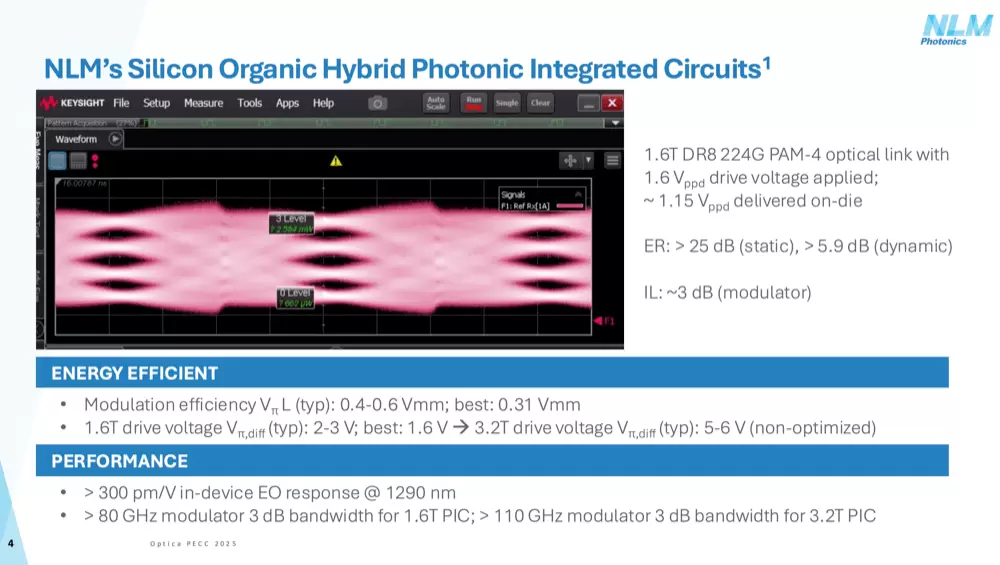
Seattle-based NLM Photonics announced that it is sampling 1.6T and 3.2T silicon-organic hybrid (SOH) photonic integrated circuits (PICs) to select customers and plans to demonstrate a 1.6T DR8 device at OFC 2026. The PICs integrate NLM’s Selerion™-HTX electro-optic organic material with silicon photonics manufactured on Advanced Micro Foundry’s (AMF) 200 mm GP O-band silicon photonics platform.
The company’s 1.6T SOH PIC delivers 200 Gbps per lane bandwidth and is roughly 40 percent smaller than typical 1.6T silicon photonic devices. NLM says the design achieves lower drive voltages and higher extinction ratios compared with conventional silicon photonics modulators. A second device, the 3.2T PIC, reaches more than 110 GHz performance within the same form factor, targeting next-generation optical modules for AI and hyperscale data center interconnects.
NLM will present the technology through private demonstrations and open sessions during OFC 2026 in Los Angeles. The company previously reported record-setting laboratory demonstrations of 1.6T and 3.2T optical links in 2025 and now aims to move toward ecosystem engagement and early commercial adoption.
- NLM’s 1.6T DR8 SOH PIC supports 200 Gbps per lane, targeting next-generation 1.6T optical modules.
- The 3.2T PIC exceeds 110 GHz electro-optic bandwidth, enabling future 400 Gbps-per-lane optical interconnects.
- Both devices integrate Selerion™ organic electro-optic materials with silicon photonics manufacturing.
- Fabrication takes place on Advanced Micro Foundry’s 200 mm GP O-band silicon photonics platform.
- Target markets include AI infrastructure, hyperscale data centers, and emerging quantum networking systems.
“Silicon photonics has run head-on into fundamental bandwidth and efficiency limits at a point in history where it is built into greater than half the transceivers in the AI and datacom markets,” said Brad Booth, CEO of NLM Photonics. “Our recipe provides that solution – bridging silicon photonics’ volume manufacturing capability with silicon organic hybrid performance and power improvements.”
🌐 Analysis
NLM Photonics traces its roots to research in organic electro-optic polymers led by materials scientist Dalma Novak and collaborators at the University of Washington and associated photonics programs. The company formed to commercialize high-speed electro-optic materials that can be integrated with conventional silicon photonics processes. CEO Brad Booth, a long-time networking industry executive and former chair of the Ethernet Alliance, joined to guide the company’s transition from materials research into a commercial semiconductor-style ecosystem targeting hyperscale optical interconnects.
The company’s core technology centers on silicon-organic hybrid (SOH) modulators, where organic electro-optic polymers are deposited on silicon waveguides to dramatically increase modulation efficiency. Traditional silicon photonics modulators rely on carrier-depletion mechanisms that require higher drive voltages and have bandwidth limits typically below ~70 GHz. SOH devices instead use the Pockels effect in engineered polymers, enabling bandwidths exceeding 100 GHz and substantially lower energy per bit. NLM’s Selerion™ material platform, including the Selerion-HTX variant, aims to provide the thermal stability, manufacturability, and long-term reliability required for data-center optical modules