


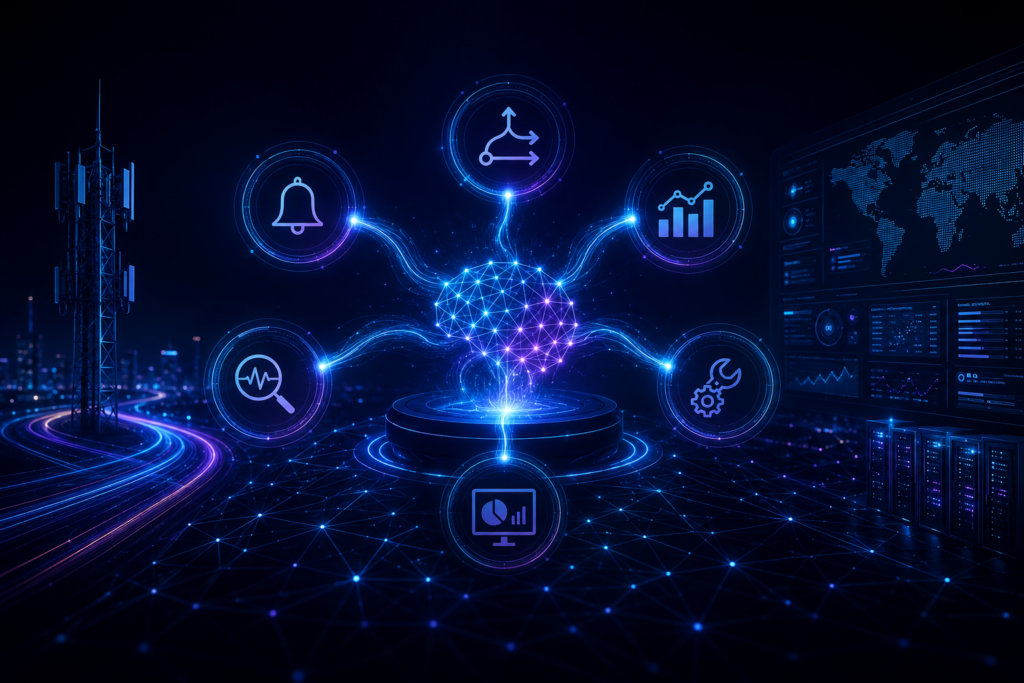
Nokia and Google Cloud expanded their partnership to integrate Google’s Gemini AI models into Nokia’s autonomous networking software portfolio. The companies will introduce six specialized AI agents within Nokia Assurance Center, enabling telecommunications operators to automate network operations, accelerate troubleshooting, and move closer to fully autonomous network management.
The new multi-agent architecture combines Gemini’s multimodal reasoning capabilities with Nokia’s network operations expertise. The platform includes agents for orchestration, event triage, KPI interpretation, anomaly detection, remediation recommendation, and dashboard generation. Nokia developed the framework using Google’s Agent Development Kit (ADK) and Gemini Enterprise Agent Platform, deploying the agents on standard Google Cloud infrastructure using Kubernetes and Google Cloud Storage. Nokia said the architecture is designed to operate within existing customer environments while avoiding the need for specialized managed services.
Nokia said the platform introduces a “glass box autonomy” model that keeps human engineers in control of critical network decisions while allowing AI agents to analyze network data, recommend actions, and automate approved workflows. The Router Agent and Event Triage Agent are already operational. Nokia plans to launch the initial SaaS offering through Google Cloud Marketplace in September 2026, with additional agents and integration across Nokia Unified Inventory, Data Suite, and Orchestration products scheduled to roll out through 2027.
• Six specialized AI agents will be introduced:
• Router Agent – orchestrates workflows and manages communication among agents
• Event Triage Agent – analyzes alarms, identifies root causes, and assesses operational impact
• KPI Selector Agent – interprets network performance metrics and measurement data
• Anomaly Reasoner Agent – distinguishes genuine network issues from false alarms
• Action Reasoner Agent – recommends remediation actions based on automation catalogs
• Dashboard Agent – generates analytics dashboards and reports using natural language prompts
• Nokia says the agents can reduce troubleshooting times by 50% to 80% for certain network issues.
• The platform supports both human-in-the-loop operations and closed-loop automation for approved low-risk scenarios.
• The initial starter pack of certified agents will be available through Google Cloud Marketplace beginning in September 2026.
• Additional functionality will expand across Nokia’s broader software portfolio through rolling updates during 2026 and 2027.
“The AI era demands a new kind of network—one that is programmable, AI-native, and able to operate at machine speed,” said Vivek Jaiswal, Senior Vice President, Autonomous Networks at Nokia. “With Gemini-powered agents integrated into Nokia’s automation portfolio, we’re helping telecom providers move beyond manual operations to maximize performance, ensure reliability, and find new efficiencies within their data.”
🌐 Analysis
This announcement highlights the growing adoption of agentic AI within telecommunications operations. Rather than relying on a single AI assistant, Nokia is deploying a multi-agent architecture in which specialized agents collaborate to perform distinct operational functions. The approach aligns with broader industry efforts to apply generative AI and agent-based systems to network operations, service assurance, and lifecycle automation.
The partnership also strengthens Nokia’s position in autonomous networking, an area receiving increased attention from operators seeking to reduce operational complexity and improve service reliability. Nokia’s emphasis on “glass box autonomy” reflects a strategy that combines automation with operator oversight. The use of Gemini within Nokia’s Assurance Center further demonstrates how large language models are moving beyond conversational interfaces and into operational decision-support systems for telecom infrastructure.
|
Nokia + Google Cloud Partnership Timeline
Updated June 2026 • Key Announced Milestones (Most Recent First)
|
|
| Relationship Evolution: Cloud Infrastructure → Cloud-Native Telecom → Network APIs → Agentic AI → Autonomous Networks | |
| June 2026 |
Gemini AI Agents for Nokia Assurance Center Six specialized AI agents introduced for event triage, anomaly analysis, remediation recommendations, dashboard creation, and autonomous network operations. Initial SaaS launch scheduled for September 2026. |
| March 2026 |
Agentic AI for Network as Code Nokia and Google Cloud expand their Network as Code initiative with Gemini-powered agents and Google’s Agent Development Kit to help developers build telecom-enabled applications. |
| July 2025 |
Nokia APIs Added to Google Marketplace Nokia expands its Network as Code ecosystem by making telecom APIs more accessible through Google Cloud’s developer and marketplace environment. |
| September 2024 |
Network as Code & Telco APIs Nokia and Google Cloud collaborate to expose carrier network capabilities through APIs, enabling developers to integrate network intelligence into enterprise applications. |
| January 2021 |
Cloud-Native 5G Partnership Nokia selects Google Cloud as a strategic partner for cloud-native 5G core deployments and enterprise telecommunications services. |
| October 2020 |
Five-Year Strategic Cloud Agreement Nokia selects Google Cloud to modernize internal IT infrastructure, migrate data centers and applications, and accelerate its digital transformation strategy. |
|
Strategic Significance: Over six years, the partnership has steadily moved higher in the telecom software stack—from cloud infrastructure and 5G platforms to programmable networks, agentic AI, and autonomous network operations.
|
|