


Nokia introduced what it describes as the industry’s first commercial AI-RAN platform, combining its AI-native anyRAN software with NVIDIA’s Aerial AI-RAN platform to create a software-defined radio architecture designed for AI-native mobile networks. The platform supports existing 4G and 5G deployments while providing an upgrade path toward 6G. Nokia said operators can deploy the software using existing Nokia AirScale radio units or other Open RAN-compliant radios, allowing gradual modernization without replacing installed infrastructure.
The new platform introduces three deployment options built around accelerated computing. Existing AirScale customers can add a new GPU-powered AirScale Capacity Plug-In Unit to increase network capacity while preserving current baseband deployments. Operators can also deploy a standalone AI-RAN node powered by NVIDIA GPUs or adopt cloud-native AI-RAN on COTS GPU servers supplied through ecosystem partners. Nokia said all three approaches share the same software roadmap and support Open RAN interoperability across multi-vendor environments.
Nokia said AI-based radio algorithms have already demonstrated more than 20% spectral efficiency improvements and that its roadmap targets 50% gains by 2027 and more than 100% by 2028, effectively doubling the capacity obtainable from existing spectrum assets. Rather than relying on periodic hardware refreshes, Nokia plans to deliver ongoing AI algorithms, optimization capabilities and new network functions through a subscription-based software model. Pilot deployments are scheduled to begin later this year, with commercial availability planned for 2027.
• First commercial AI-RAN platform built on Nokia anyRAN software and NVIDIA Aerial AI-RAN
• Supports existing 4G, 5G and future 6G evolution
• Three deployment options: AirScale plug-in, standalone AI-RAN node and cloud-native COTS servers
• Fully Open RAN compliant for multi-vendor deployments
• AI-driven radio algorithms have demonstrated over 20% spectral efficiency gains
• Nokia targets 50% spectral efficiency improvement by 2027 and more than 100% by 2028
• Software subscription model delivers continuous AI enhancements without hardware refreshes
• Pilot deployments begin later this year; commercial rollout planned for 2027
• AI-RAN architecture leverages NVIDIA accelerated computing alongside merchant silicon from Marvell
“AI-RAN is the biggest innovation in radio in decades. AI-RAN makes the network intelligent, extends AI into the physical world, and allows telcos to get more from their existing infrastructure, including a software upgrade path to 6G,” said Justin Hotard, President and CEO of Nokia.
🌐 Analysis
This announcement represents the commercialization milestone for Nokia’s AI-RAN strategy that was previewed at MWC 2026. During MWC, Nokia and NVIDIA demonstrated GPU-accelerated AI-RAN with operators including T-Mobile, SoftBank, Indosat, BT, Vodafone, Elisa and NTT DOCOMO, validating that AI inference workloads and Layer 1 RAN processing could execute concurrently on shared NVIDIA accelerated computing platforms. Today’s launch transitions those demonstrations into a defined commercial product portfolio with deployment options spanning traditional purpose-built RAN, Cloud RAN and hybrid architectures.

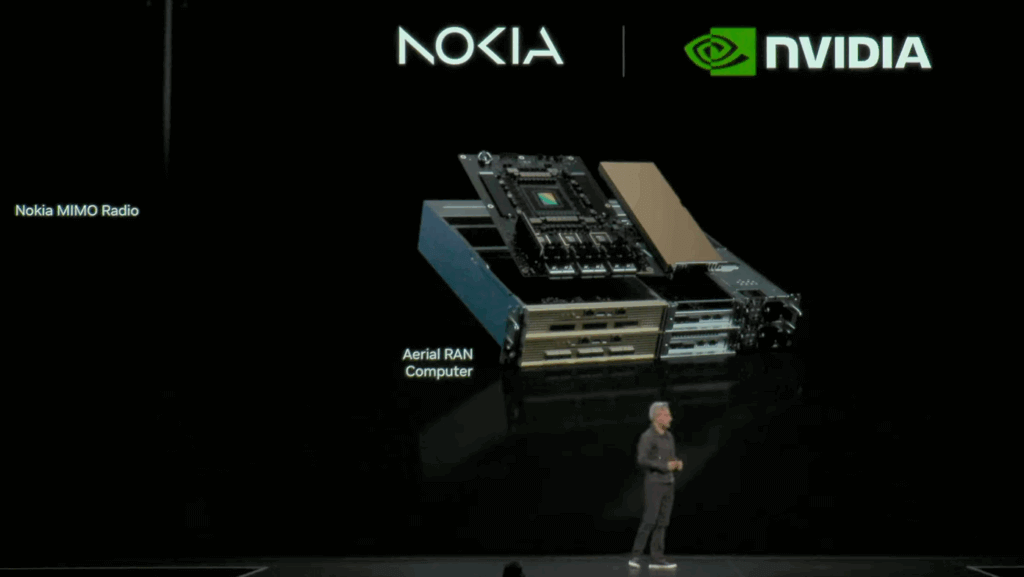
The announcement also reflects the expanding strategic relationship between Nokia and NVIDIA. NVIDIA has become a foundational technology partner for Nokia’s AI-native network strategy by integrating CUDA and the NVIDIA Aerial AI-RAN platform into Nokia’s anyRAN software architecture. Rather than treating AI solely as a network management application, the companies are positioning the radio access network itself as distributed AI infrastructure capable of simultaneously supporting mobile connectivity and AI workloads. The broader ecosystem—including Dell Technologies, Supermicro, Quanta, Red Hat and Marvell—illustrates how AI-RAN is evolving into an open accelerated computing platform that could influence both 5G Advanced deployments and the architectural foundations for future 6G networks.
|
AI-RAN Alliance Global industry consortium advancing AI-native radio access networks |
|
| Founded |
February 2024 Announced at Mobile World Congress (MWC) 2024. |
| Founding Members | NVIDIA, SoftBank Corp. and T-Mobile US. |
| Mission | Accelerate development of AI-native Radio Access Networks by combining AI computing and wireless infrastructure, improving spectral efficiency, enabling shared GPU processing, and creating new AI-driven telecom business models. |
| Core Objectives |
• Increase spectrum efficiency through AI • Execute AI and RAN workloads on shared accelerated infrastructure • Monetize unused RAN compute capacity • Enable distributed edge AI computing • Lay the architectural foundation for AI-native 6G |
| Architecture Framework | AI for RAN AI and RAN AI on RAN |
| Membership | More than 75 member organizations including mobile operators, network vendors, semiconductor companies, GPU suppliers, cloud providers, server manufacturers, software companies, research institutions and system integrators. |
| Representative Members | NVIDIA • Nokia • Ericsson • Samsung Networks • Fujitsu • Dell Technologies • Red Hat • Supermicro • Quanta Cloud Technology (QCT) • AMD • Arm • Cisco • Juniper Networks • BT • Vodafone • T-Mobile US • SoftBank • NTT DOCOMO • Elisa • Indosat Ooredoo Hutchison • Keysight • VIAVI • Capgemini • Amdocs |
| Technical Milestones |
2024 – Alliance established and technical working groups launched. 2025 – Published initial AI-RAN architectural guidance and demonstrated concurrent AI inference and RAN processing on GPU platforms. MWC 2026 – Nokia, NVIDIA, T-Mobile, SoftBank and Indosat completed commercial-grade GPU-accelerated AI-RAN demonstrations using live spectrum, commercial radios and standard 5G devices. July 2026 – Nokia introduced the industry’s first commercial AI-RAN platform based on anyRAN software and NVIDIA Aerial AI-RAN. |
| Strategic Vision | Transform radio access networks from fixed-function infrastructure into programmable AI computing platforms that continuously evolve through software, simultaneously support communications and AI services, and serve as a foundation for AI-native 6G. |
| Industry Significance | The AI-RAN Alliance is driving one of the most significant architectural shifts in mobile networking since virtualization. Its work aims to replace fixed-function baseband hardware with programmable accelerated computing capable of increasing spectral efficiency, reducing cost per bit, and enabling operators to generate new revenue from edge AI services running alongside traditional cellular workloads. |