


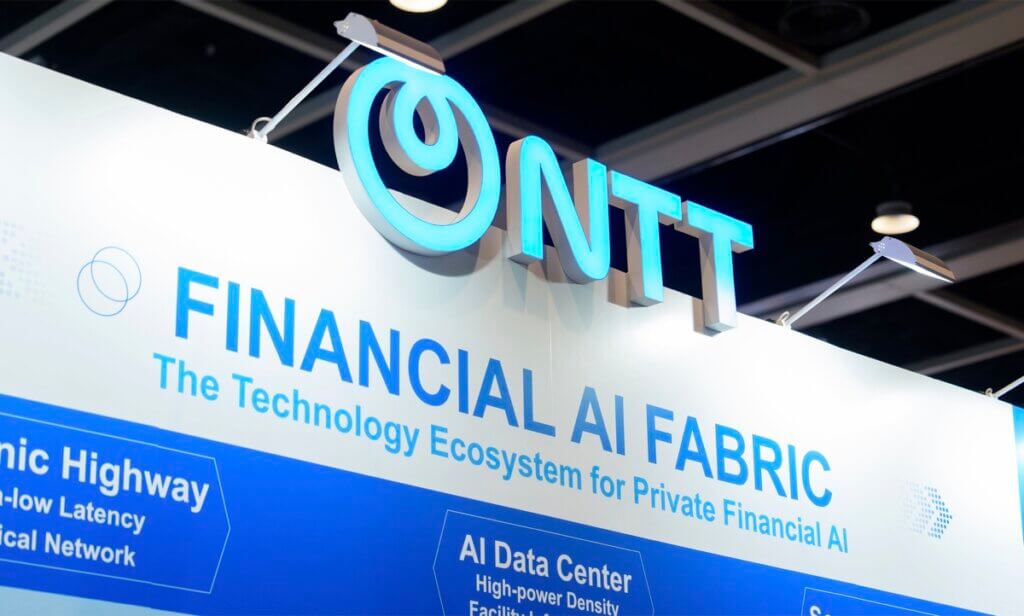
NTT Com Asia introduced its Financial AI Fabric (FAIF) blueprint at LEAP East 2026, outlining an infrastructure architecture designed to help financial institutions in Hong Kong deploy sovereign private AI environments. The framework combines high-speed optical networking, AI-ready data centers, and sovereign GPU infrastructure to support regulated financial workloads moving from pilot deployments into production. NTT positions the blueprint as a strategic infrastructure roadmap for banks, insurers, and other financial services institutions (FSIs) facing increasingly stringent regulatory, performance, and data sovereignty requirements.
The Financial AI Fabric consists of three core infrastructure layers. The first is an optical networking layer built on NTT’s APN InterLink, which leverages the company’s Innovative Optical and Wireless Network (IOWN) technology to provide ultra-low-latency, photonic connectivity between distributed AI resources. The second layer comprises NTT’s AI-ready data centers, including its Tseung Kwan O Financial Data Center (FDC) and Tai Po Data Center (TPDC), both equipped with Direct Liquid Cooling (DLC) systems for high-density AI infrastructure and managed through NTT’s OCEAN Intelligence platform for predictive operations and energy optimization. The third layer provides sovereign GPU infrastructure, which NTT says will evolve into a GPU-as-a-Service (GPUaaS) offering later this year, enabling financial institutions to access localized AI compute while maintaining regulatory compliance and data residency.
NTT said the infrastructure roadmap reflects growing demand from Hong Kong’s financial sector for hybrid AI architectures spanning public cloud, colocation facilities, and sovereign infrastructure. The company noted that APN InterLink entered commercial service in Hong Kong on November 1, 2025, providing an optical transport foundation for latency-sensitive financial applications and distributed AI workloads. NTT executives said the Financial AI Fabric is intended to provide a structured path for enterprises seeking to deploy AI in production while satisfying operational resilience, security, and compliance requirements.
• Introduced Financial AI Fabric (FAIF) blueprint at LEAP East 2026 in Hong Kong.
• Targets regulated financial institutions deploying sovereign private AI.
• Architecture combines APN InterLink photonic networking, AI data centers, and sovereign GPUs.
• APN InterLink uses IOWN technology for ultra-low-latency optical connectivity.
• Hong Kong deployment includes Tseung Kwan O Financial Data Center and Tai Po Data Center.
• Both facilities utilize Direct Liquid Cooling for high-density AI infrastructure.
• OCEAN Intelligence platform provides AI-driven operations, predictive maintenance, and energy optimization.
• GPU-as-a-Service platform is scheduled to launch later in 2026.
“The infrastructure requirements of financial services are changing rapidly as AI workloads become business-critical,” said Steven So, Chief Operating Officer of NTT Com Asia. “To successfully move AI from experimentation and sandbox environments into full-scale production, financial institutions need trusted, high-performance infrastructure. The Financial AI Fabric service blueprint outlines exactly how we aim to build a collaborative, secure ecosystem that empowers enterprises to achieve true sovereign private AI while seamlessly navigating stringent regulatory environments.”
🌐 Analysis: Financial institutions increasingly require AI infrastructure that satisfies data sovereignty, regulatory compliance, and predictable performance, creating demand for localized GPU resources interconnected by high-capacity optical networks. NTT’s blueprint aligns with a broader industry trend in which telecom operators and infrastructure providers—including Equinix, Digital Realty, Singtel, and regional cloud providers—are integrating AI-ready data centers, liquid cooling, and sovereign compute capabilities into enterprise infrastructure offerings. The emphasis on photonic networking through IOWN also highlights NTT’s continued strategy of differentiating its infrastructure portfolio through all-optical networking technologies for AI-scale workloads.