
OCI MSA Defines Silicon-Centric Optical PHY for AI Scale-Up as v1.0 Specification Details Emerge
The Optical Compute Interconnect (OCI) Multi-Source Agreement (MSA) has advanced from concept to detailed specification with the release of its v1.0 Optical PHY, defining a silicon-centric optical interconnect for next-generation AI scale-up fabrics. Founding members include AMD, Broadcom, Meta, Microsoft, NVIDIA, and OpenAI. The initiative targets a key bottleneck in AI system design: the power, reach, and density limitations of copper interconnects inside large accelerator clusters.
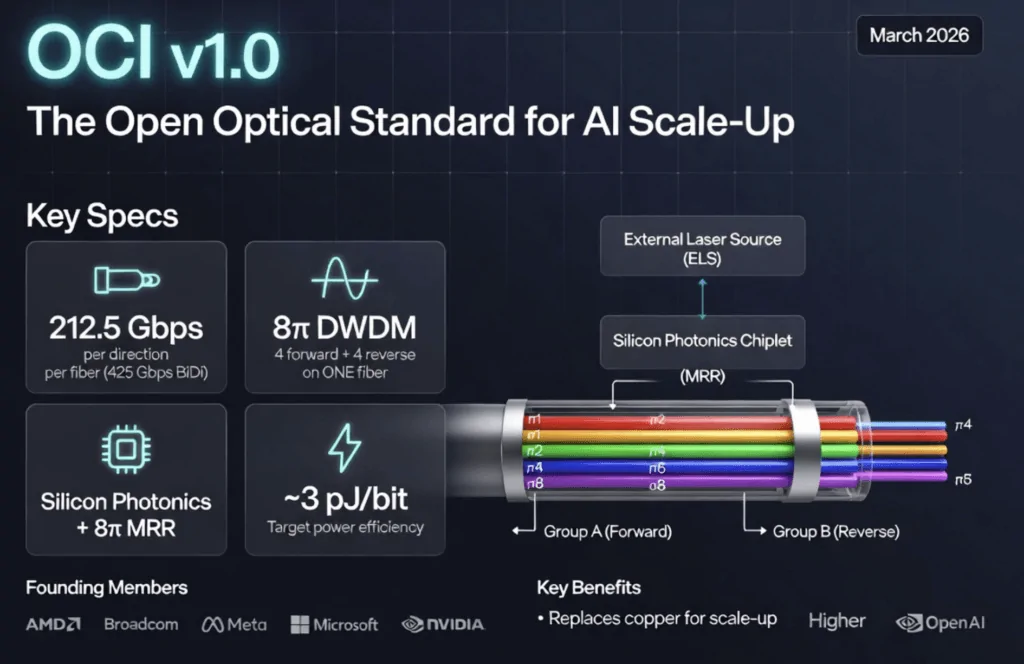
The OCI v1.0 PHY specification formalizes a simplified optical architecture optimized for short-reach, high-density environments. It uses 53.125 Gbaud NRZ modulation across four wavelengths per direction, delivering 212.5 Gbps per direction over a single fiber (425 Gbps aggregate in bidirectional operation). The design combines NRZ signaling with DWDM in the O-band, avoiding PAM4 and heavy DSP overhead to minimize latency and power. The specification defines a bidirectional wavelength plan on a single fiber with typical center wavelengths (±0.2 nm tolerance): 1308.0, 1310.28, 1312.58, 1314.88 nm (forward) and 1327.69, 1330.05, 1332.41, 1334.78 nm (reverse). While typical scale-up deployments target distances under 100 meters, the link budget supports reaches up to approximately 500 meters.
OCI also establishes a silicon-centric integration model using micro-ring resonator (MRR/MRM) modulators and external laser sources (ELS), typically delivered via OIF-compliant ELSFP modules. This approach moves optics closer to compute while thermally isolating the laser source from the ASIC. The specification extends CMIS 5.3 to support distributed optical engines, including Remote Laser Management (RLM), per-channel Versatile Diagnostic Monitoring (VDM), and real-time tuning of temperature-sensitive ring resonators. The architecture enables direct-drive or SerDes-minimized configurations, reducing electrical I/O power and supporting dense optical integration via co-packaged optics and chiplets.
- Modulation: 53.125 Gbaud NRZ (no PAM4, minimal DSP/FEC)
- Per fiber throughput: 212.5 Gbps per direction (425 Gbps aggregate BiDi)
- Wavelengths: 4λ per direction using O-band DWDM (BiDi on single fiber)
- Optical devices: Micro-ring resonator modulators (MRR/MRM)
- Laser model: External Laser Source (ELS, OIF ELSFP)
- Reach: <100 m typical (scale-up), up to ~500 m supported
- Integration: Pluggable, on-board optics, co-packaged optics, chiplets
- Management: CMIS 5.3 with OCI-specific extensions (RLM, VDM, tuning)
- System scaling: 16–32+ fibers per interface targeting 4–8 Tbps aggregate bandwidth
| OCI Gen1 Optical PHY (v1.0) – Technical Profile | |
|---|---|
| Signaling | 53.125 Gbaud NRZ |
| Wavelength Scheme | 4λ per direction, BiDi DWDM (O-band) |
| Per Fiber Capacity | 212.5 Gbps/dir (425 Gbps aggregate) |
| Wavelength Plan | 1308–1315 nm (forward), 1327–1335 nm (reverse) |
| Optical Technology | Silicon photonics with MRR/MRM modulators |
| Laser Architecture | External Laser Source (ELS, OIF ELSFP) |
| Integration Models | Pluggable, on-board optics, co-packaged optics (CPO), chiplets |
| Management | CMIS 5.3 + OCI extensions (RLM, VDM, tuning) |
| Target Use Case | AI scale-up fabrics (GPU/XPU interconnect) |
| Scaling Model | 16–32+ fibers → 4–8 Tbps per interface |

🌐 Analysis
OCI changes AI system architecture by moving optics directly into the scale-up fabric rather than treating it as an external networking layer. This enables a shift from copper-based board-level design to optical-native packaging, where compute ASICs, optical engines, external lasers, and thermal management operate as an integrated system. The result is higher bandwidth density, lower power per bit, and improved scalability for large accelerator clusters.
OCI also sits alongside a growing set of interconnect technologies, including NVLink, UALink, and Ethernet. Its role is distinct: OCI standardizes the optical physical layer, while higher-layer protocols define communication semantics and system behavior. This separation allows multiple interconnect protocols to operate over a common optical substrate, enabling flexibility in system design and reducing dependency on vertically integrated stacks.
Reference: OCI MSA 200G Optical PHY Specification v1.0
https://www.oci-msa.org/downloads/OCI_MSA_200G_Optical_PHY_Specification_v1p0.pdf
| OCI vs UALink: Technical Comparison (May 2026) | ||
|---|---|---|
| Feature / Aspect | OCI | UALink |
| Primary Focus | Optical Physical Layer (Layer 1) | Accelerator protocol and memory-semantic interconnect |
| Physical Layer | Optical (NRZ + DWDM + single-mode fiber) | 224G-class PAM4 SerDes (electrical, supports copper and optical media) |
| Bandwidth | 212.5 Gbps per direction per fiber | ~200 Gbps usable per lane (224G SerDes class) |
| Latency | Ultra-low (no DSP/FEC overhead) | ~1 µs rack-scale round-trip, deterministic |
| Reach | <100 m typical, up to ~500 m supported | <4 m copper, extended reach via optics |
| Power Efficiency | Targets ~3 pJ/bit via NRZ and minimal DSP | Optimized electrical efficiency using PAM4 SerDes |
| Role in System | Optical transport substrate for scale-up fabrics | Defines communication semantics, coherency, and memory model |
| Relationship | Complementary: UALink protocols can operate over OCI optical PHY, enabling a common optical infrastructure for multiple interconnect stacks. | |