


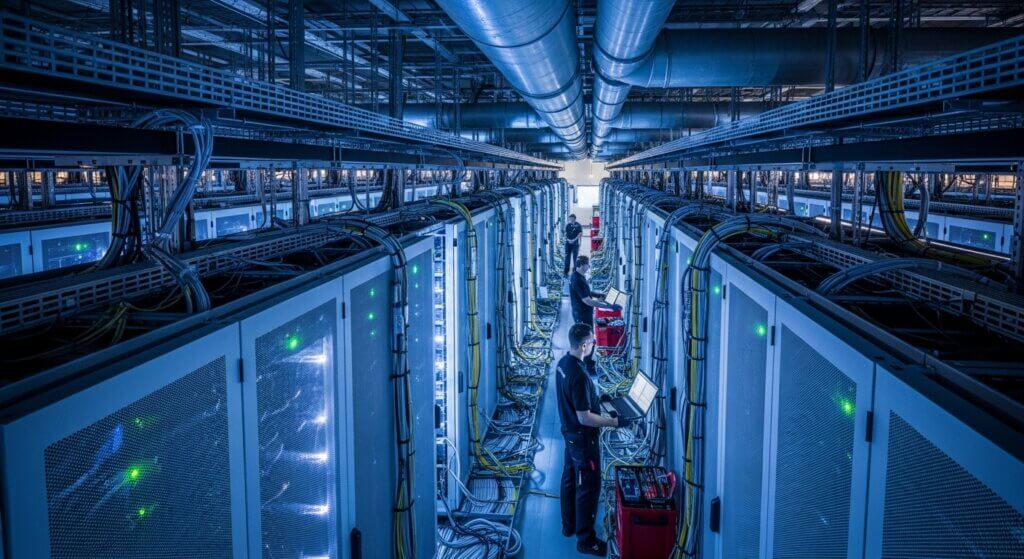
Oracle plans to power on a new AI data center campus in Saline Township, Michigan, with construction set to accelerate ahead of a full build starting in Q1 2026. Oracle will operate the facility as the future tenant, outfitting it with advanced infrastructure for OpenAI. The project brings together Oracle, developer Related Digital, and utility partner DTE Energy, following approval of long-term power agreements by the Michigan Public Service Commission.
The Michigan campus expands Oracle’s global data center footprint, which includes 147 active sites worldwide and 64 more under development. Oracle says the Saline Township facility will rely on closed-loop, non-evaporative liquid cooling, keeping annual water usage comparable to that of an average office building rather than systems that evaporate millions of gallons per day. Power for the site will come under a 17+ year electric service agreement with DTE, with Oracle covering 100% of energy costs, battery storage, new transmission lines, and an onsite substation.
Oracle and state officials positioned the project as both an AI infrastructure investment and a local economic driver. Construction is expected to generate thousands of union jobs, while long-term operations will support hundreds of permanent positions and broader employment across Washtenaw County. The project also includes commitments for school funding, local tax revenue, and community infrastructure investments, alongside land preservation and conservation measures on the majority of the 575-acre site.
- AI data center campus to be developed on ~250 acres in Saline Township, Michigan
- Oracle to operate the site and provision infrastructure for OpenAI
- Closed-loop, non-evaporative liquid cooling to limit water consumption
- 17+ year electric service agreement with DTE approved by the Michigan Public Service Commission
- Oracle to fund new transmission lines, onsite substation, and battery storage
- Estimated 2,500 union construction jobs during buildout
- Around 450 permanent on-site jobs and ~1,500 additional jobs across Washtenaw County
- ~$8 million annually earmarked for area schools and at least $1.6 million per year in direct township tax revenue
- More than $14 million in community benefits for emergency services, infrastructure, and public spaces
- 47.5 acres placed under conservation easement, with remaining land preserved as open space, farmland, wetlands, and woodlands
“We will do everything in our power to ensure that our new neighbors in Saline Township reap the benefits of this investment, while helping Michigan and the United States remain leaders in AI innovation,” said Josh Pitcock, Senior Vice President at Oracle.
🌐 Analysis
Oracle’s Michigan project highlights how hyperscale cloud providers are pairing long-term power contracts with dedicated transmission and substation investments to de-risk large AI data center deployments. Similar models are emerging across the U.S. as cloud and AI infrastructure providers seek regulatory certainty, predictable energy costs, and community support while scaling capacity for customers such as OpenAI and other large model developers.