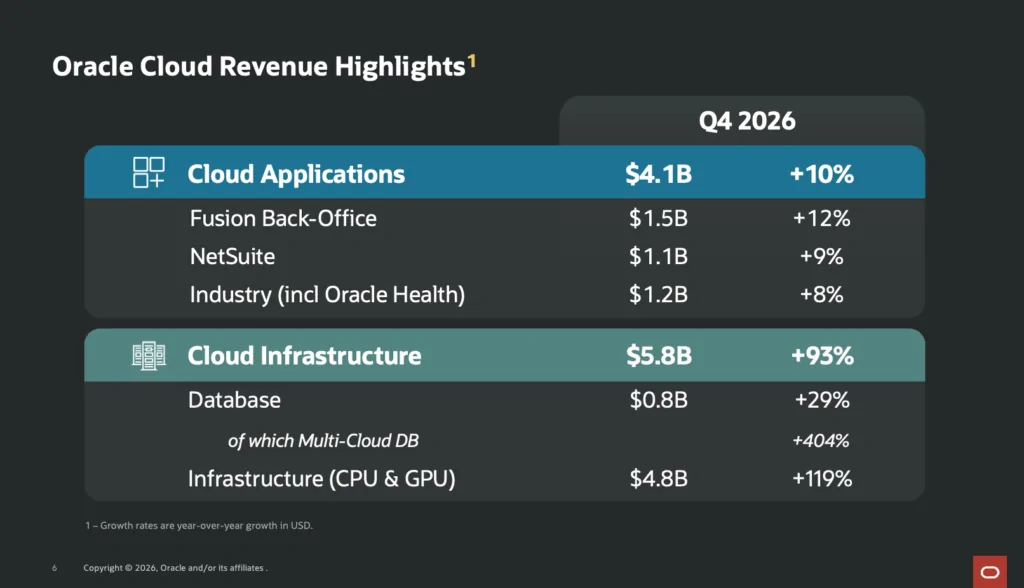
Oracle reported record fiscal fourth-quarter and full-year 2026 results, fueled by surging demand for AI infrastructure and cloud services. The company posted Q4 revenue of $19.2 billion, up 21% year-over-year, while cloud revenue climbed 47% to $9.9 billion. The standout performance came from Oracle Cloud Infrastructure (OCI), where IaaS revenue surged 93% to $5.8 billion. For the full fiscal year, OCI revenue reached $18.1 billion, up 77%, helping total cloud revenue grow 39% to $34.0 billion.
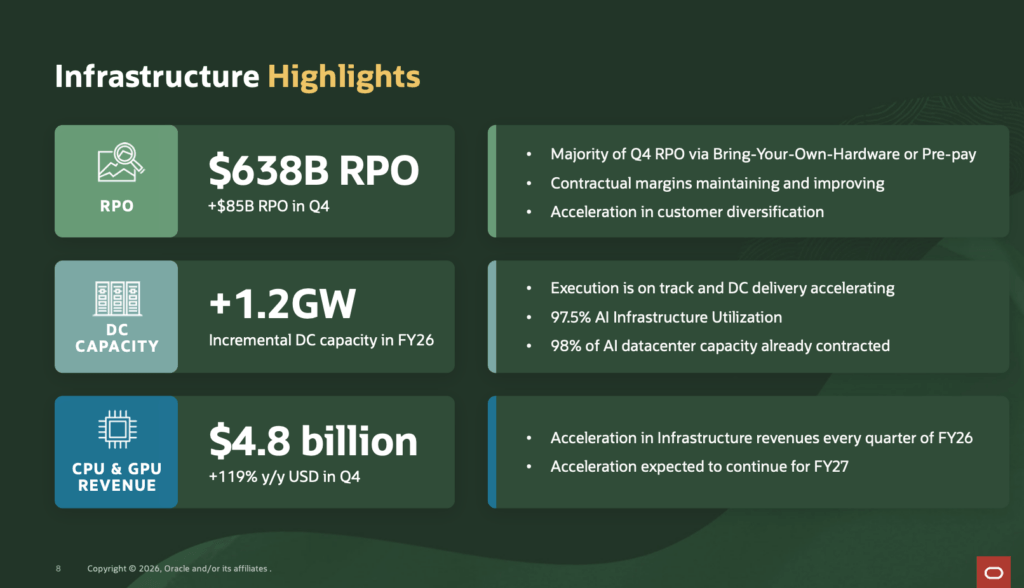
The scale of Oracle’s AI infrastructure opportunity became evident in its remaining performance obligations (RPO), which jumped to a record $638 billion, up 363% year-over-year and $85 billion sequentially. Oracle disclosed that large AI contracts accounted for most of the increase, with customers either prepaying for GPUs or supplying GPUs directly to Oracle. These prepaid and customer-supplied GPU commitments now total $75 billion, significantly reducing the capital burden associated with building AI-focused cloud infrastructure. Oracle also reported negative free cash flow of $23.7 billion for fiscal 2026 as it accelerated investment in data center expansion and AI capacity.
Oracle continues to position itself as a major AI infrastructure provider alongside hyperscale cloud competitors. The company said demand for AI training and inferencing workloads is driving both revenue growth and future capacity requirements. Oracle raised $48 billion through debt and equity financing during fiscal 2026 and expects to raise another $40 billion in fiscal 2027 to support cloud infrastructure expansion. The company highlighted rapid growth in its Oracle Multicloud AI Database business, which grew 404% in Q4, and outlined plans to integrate AI across its healthcare portfolio, including a new AI-based version of the Cerner patient care management platform.
• Q4 total revenue: $19.2 billion, up 21%
• Q4 cloud revenue (IaaS + SaaS): $9.9 billion, up 47%
• Q4 OCI (IaaS) revenue: $5.8 billion, up 93%
• FY2026 total revenue: $67.4 billion, up 17%
• FY2026 OCI revenue: $18.1 billion, up 77%
• Remaining Performance Obligations (RPO): $638 billion, up 363%
• AI-related prepaid and customer-supplied GPU commitments: $75 billion
• FY2026 operating cash flow: $32.0 billion, up 54%
• FY2026 free cash flow: negative $23.7 billion due to AI infrastructure investments
• Oracle expects FY2027 revenue of approximately $90 billion
“Our database and applications businesses are both benefiting from Oracle’s early adoption of AI. The Oracle Multicloud AI Database grew 404% in Q4—making it our fastest growing business ever,” said Larry Ellison, Chairman and CTO of Oracle.
Highlights of the quarterly investor call following the earnings release:
• Oracle expects only 12% of its RPO to convert to revenue over the next 12 months, with another 34% expected between months 13 and 36, suggesting a long-duration AI infrastructure buildout.
• CFO Hilary Maxson said Oracle expects high-20% project-level ROIC for its infrastructure business at steady state, with potentially higher returns for prepaid and bring-your-own-hardware models.
• Oracle said component cost inflation, especially memory and storage, has not materially reduced margins because contracts use fixed pricing only when costs are locked; otherwise, customer pricing can float with input costs.
• Oracle delivered more than 1.2 GW of capacity to customers in FY2026 and expects Q1 FY2027 delivery to approach 1 GW, nearly matching the prior four quarters combined.
• Oracle highlighted progress at five major AI infrastructure sites: Abilene, Texas; Shackelford, Texas; Doña Ana County, New Mexico; Saline, Michigan; and Port Washington, Wisconsin.
• Abilene has delivered 42% of total capacity, with another 35% expected within 90 days and the remainder in the following quarter.
• Shackelford, Doña Ana County, Saline, and Port Washington are scheduled to begin customer deliveries during 2027, with several power and network milestones ahead of schedule.
• Oracle reported 97.5% global GPU utilization, indicating that returned or non-renewed GPU capacity gets quickly reassigned to other customers.
• Clay Magouyrk said Oracle renewed 49% of customers representing 92% of 35,000 GPUs up for renewal in Q4, while most non-renewed GPUs were resold to other customers during the same quarter.
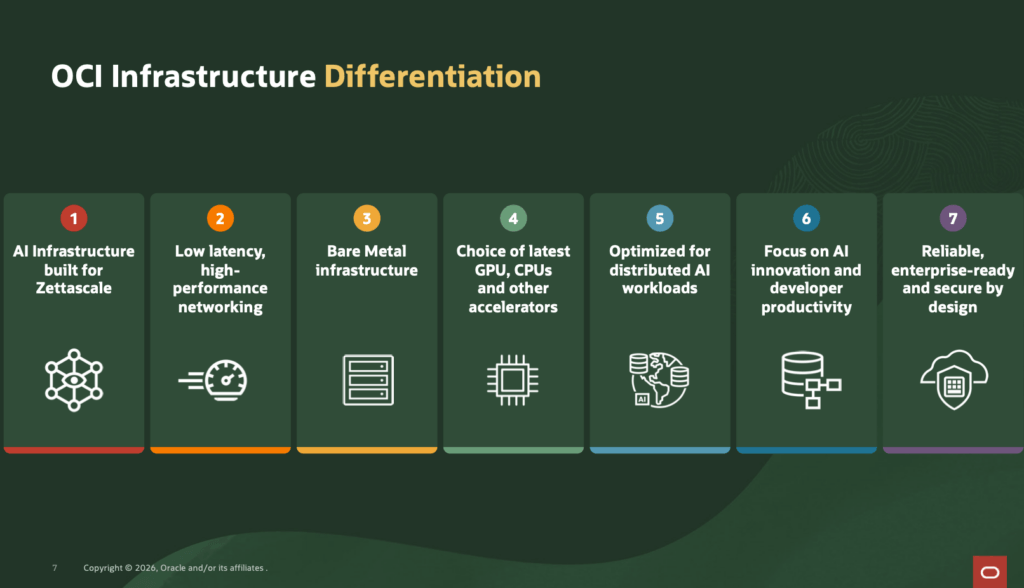
• Oracle said its AI infrastructure differentiation includes data center design, power distribution, data hall layout, networking, security, and cloud operations—not just GPU procurement.
• Oracle said bring-your-own-hardware customers still rely on OCI for cloud design, cluster operations, networking, storage, identity, security, load balancing, and general-purpose compute.
• Oracle expects FY2027 net cash outlay for CapEx of about $70 billion, excluding $20 billion to $25 billion in customer prepayments and timing effects tied to third-party manufacturers.
• Oracle expects revenue and earnings growth to accelerate in the second half of FY2027 as more data center capacity comes online.
• Oracle said it is expanding outcome-based pricing across its applications portfolio, including pricing tied to candidate screening, hospitality upsell transactions, and healthcare patient throughput.
• Oracle began a limited rollout of AI token bundles in Q4, with 33 customers pre-purchasing access to more advanced reasoning and model capacity.
• Oracle said more than 1,000 AI agents are now available across its application suites, with more capabilities added on a quarterly release cycle.
• Oracle cited AI Agent Memory and Deep Data Security as new database features aimed at enterprise AI workloads using proprietary data.
• Oracle said its multicloud database business remains in the early stages, with growth expected as new regions and cloud partnerships become available.
• Oracle’s next earnings report is expected on September 10, 2026, and its next Investor Day is scheduled for October 28, 2026, in Las Vegas.
🌐 Analysis: Oracle’s earnings reinforce one of the most important trends in AI infrastructure: cloud providers are increasingly securing long-term AI capacity commitments before data centers are fully built. The disclosure that customers have prepaid or supplied $75 billion worth of GPUs highlights a new financing model emerging across the industry, helping cloud providers accelerate expansion while reducing balance-sheet risk. Similar approaches have appeared in large-scale AI infrastructure projects involving hyperscalers, sovereign AI initiatives, and specialized AI cloud operators.