


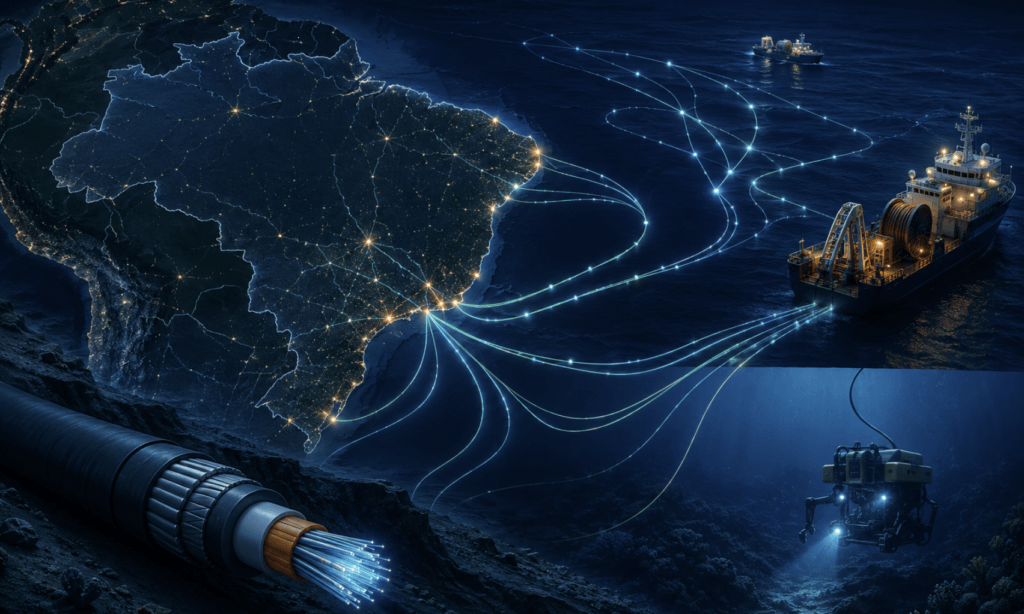
Padtec announced plans to acquire an 85% stake in LEV Brasil – Estudos e Projetos em Geociências Aplicadas LTDA. and Coral Esperançoso Unipessoal Ltda. (together, LEV Brazil), while simultaneously launching a new business unit, Padtec Marine Networks, aimed at expanding its presence in submarine cable infrastructure. The transaction will be submitted for shareholder approval at an Extraordinary General Meeting scheduled for July 8, 2026.
The acquisition combines Padtec’s optical networking expertise with LEV Brazil’s capabilities in marine geosciences, environmental licensing, feasibility studies, and engineering services. The move positions Padtec to offer end-to-end submarine cable project support, spanning route studies, environmental approvals, engineering design, equipment supply, deployment, and ongoing operations. The company said the initiative responds to growing investment in digital infrastructure driven by hyperscale data centers, telecommunications operators, cloud providers, and large technology companies seeking additional capacity, resiliency, and geographic diversity.
Padtec previously participated in the submarine cable sector through the Junior Cable project, commissioned by Google in 2016. The system connected Santos and Rio de Janeiro and was recognized as the first submarine cable route linking the two cities. By integrating LEV Brazil into the newly established Padtec Marine Networks division, the company aims to strengthen its competitive position in a market experiencing renewed investment activity as demand for AI infrastructure, cloud connectivity, and international data transport continues to grow.
- Padtec plans to acquire 85% of LEV Brazil.
- Shareholders will vote on the transaction on July 8, 2026.
- New Padtec Marine Networks unit will focus on submarine cable infrastructure projects.
- Combined capabilities include geosciences, environmental licensing, marine engineering, optical transport systems, deployment, and operations.
- Move targets growing demand from data centers, telecom operators, hyperscalers, and global connectivity providers.
- Padtec cites its experience delivering the Junior Cable system for Google in 2016.
“We are returning strongly to a market we know well and that is becoming increasingly relevant with the expansion of connectivity projects linked to data centers, telecom operators, big tech companies and global providers. Padtec Marine Networks is being created to address a new cycle of investments in digital infrastructure, driven by the growing demand for data transmission capacity, redundancy and high-performance connectivity,” said Carlos Raimar Schoeninger, CEO of Padtec.
| Profile: Padtec | |
|---|---|
| Headquarters | Campinas, São Paulo, Brazil |
| Founded | 2001 |
| Current CEO | Manuel Andrade (Succeeded Carlos Raimar Schoeninger) |
| Core Business | High-capacity optical transport systems (DWDM), packet-optical networking, and carrier-grade telecom infrastructure. |
| Core Technologies | Terrestrial and submarine DWDM, Submarine Line Terminal Equipment (SLTE), open optical networks, and optical storage/interconnect solutions. |
| New Business Unit | Padtec Marine Networks Launched to mark the company’s return to the subsea turnkey market after selling its original subsea assets to IPG Photonics in 2019. |
| Acquisition Target | Acquired LEV Brasil to bolster subsea engineering, surveying, and environmental licensing capabilities. |
| Subsea Portfolio | Historically delivered the Junior Cable system for Google (Santos to Rio de Janeiro). Currently deploying underwater DWDM networks for the Amazon region’s Norte Conectado project (Infovias 02, 03, and 04). |
| Strategic Focus | Data Center Interconnection (DCI), AI-era cluster connectivity requiring ultra-low latency, and “digital cabotage” coastal submarine networks. |
🌐 Analysis: The transaction reflects increasing convergence between terrestrial optical networking vendors and the subsea infrastructure ecosystem. Rising AI workloads, cloud expansion, and demand for regional data center interconnection are driving a new wave of submarine cable investments, particularly in emerging markets where additional route diversity and capacity are needed.
🌐 Analysis: Padtec’s acquisition of LEV Brazil addresses a critical requirement in the subsea sector: environmental permitting and marine route engineering expertise. As hyperscalers continue investing in private and consortium-owned cable systems, vendors that can provide integrated planning, deployment, and optical transport capabilities may gain an advantage in securing new projects.
| Subsea Infrastructure Market Drivers (2026 Outlook) | |
|---|---|
| AI & Distributed Compute | Massive synchronization requirements for geographically split AI training and inference clusters demand massive, ultra-low-latency intercontinental pipelines. This is accelerating the upgrade cycle to 800G and 1.6T coherent optics on marine landing terminal equipment. |
| Hyperscaler Domination | Cloud titans (Google, Meta, Amazon) have fundamentally transitioned from bandwidth renters to primary infrastructure architects. Massive private investment is locking up proprietary fiber pairs, creating a notable “open-market capacity freeze” for traditional telecom carriers. |
| Geopolitical Route Diversity | Following high-profile vulnerabilities and chokepoints (e.g., Red Sea disruptions), there is aggressive demand for mesh-network resilience. This is funding entirely new, historically avoided corridors like the Arctic passage (Far North Fiber) and direct South America-to-APAC routes (Humboldt). |
| Legacy Replacement Cycle | A significant wave of transoceanic systems built during the early 2000s boom are reaching the end of their economic and technical life, necessitating wholesale modern deployments featuring Space-Division Multiplexing (SDM). |
| Marine Logistics & Permitting | Tightening national security screening on landing licenses and intense regional environmental regulations have turned desktop marine studies, deep-sea surveying, and localized environmental permitting into high-value bottlenecks. |
| Grid & Energy Integration | The subsea market is increasingly overlapping with global energy transitions; hyperscale data centers are matching cable landings to stable energy grids, while parallel surges in offshore wind arrays require extensive High-Voltage Direct Current (HVDC) subsea power networks. |
🌐 We’re tracking the latest developments in subsea cable infrastructure, policy, and deployments. Follow our ongoing coverage at: https://convergedigest.com/category/subsea/