


Sandisk reported fiscal third quarter 2026 revenue of $5.95 billion, marking a 97% sequential increase and a 251% year-over-year surge, as demand from AI-driven data center workloads accelerated across its flash storage portfolio. GAAP net income reached $3.6 billion, or $23.03 per diluted share, reflecting a sharp rebound in pricing and a strategic shift toward higher-value enterprise and hyperscale customers.
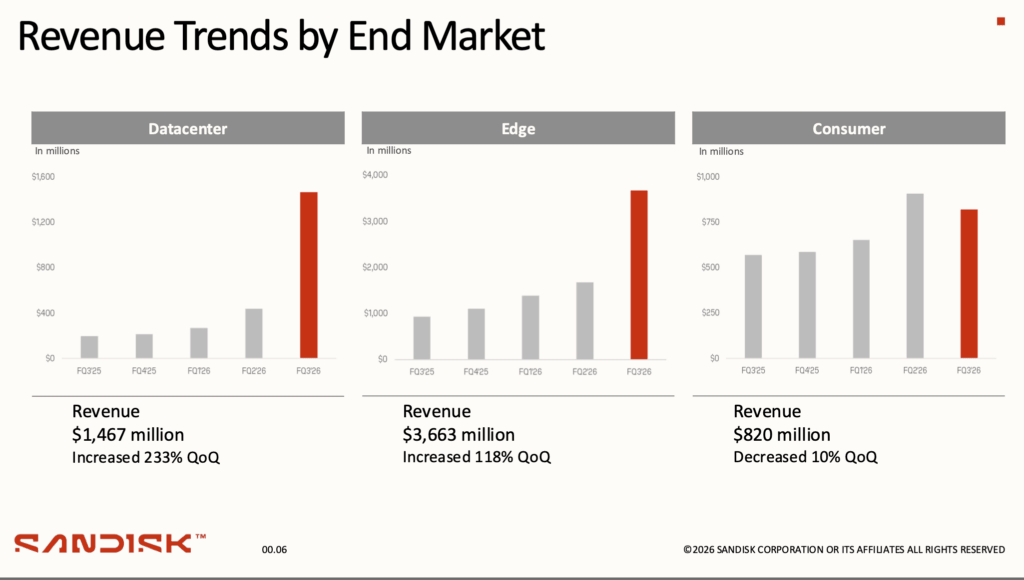
The company’s datacenter segment emerged as the primary growth engine, generating $1.47 billion in revenue, up 233% quarter-over-quarter and 645% year-over-year. This performance reflects strong adoption of TLC-based enterprise SSDs optimized for high-performance compute environments, with additional upside expected from upcoming QLC “Stargate” product shipments. Edge markets also expanded significantly, up 118% sequentially to $3.66 billion, driven by premium storage configurations in PCs and smartphones, while consumer revenue declined 10% sequentially due to seasonal trends.
Profitability improved sharply, with gross margin reaching 78.4%, up from 50.9% in the prior quarter, as pricing conditions strengthened and product mix shifted toward higher-margin segments. Operating income rose to $4.1 billion, while adjusted free cash flow reached $2.96 billion. Sandisk also highlighted progress in transitioning to its New Business Model (NBM), securing three multi-year agreements in the quarter and two additional deals early in Q4, aimed at stabilizing long-term demand and pricing through committed customer engagements.
- Datacenter revenue: $1.47B, up 233% QoQ and 645% YoY
- Edge revenue: $3.66B, up 118% QoQ
- Consumer revenue: $820M, down 10% QoQ (seasonal)
- Gross margin: 78.4%, up 27.5 percentage points QoQ
- Operating income: $4.1B, up 286% QoQ
- Adjusted free cash flow: $2.96B
- Q4 outlook: $7.75B–$8.25B revenue; $30–$33 non-GAAP EPS
“This quarter marks a fundamental inflection point for Sandisk — where our technology leadership is enabling a deliberate shift in our mix toward the highest-value end markets, led by Datacenter,” said CEO David Goeckeler.
🌐 Analysis
Sandisk’s results underscore a broader structural shift in the memory market, where AI infrastructure is reshaping demand curves for NAND and SSDs. Hyperscale and AI cluster deployments increasingly require high-throughput, low-latency storage tiers, pushing vendors toward enterprise-grade TLC and emerging QLC architectures. This aligns with parallel trends across the semiconductor ecosystem, where suppliers such as Micron Technology and SK hynix are also prioritizing high-bandwidth and AI-optimized memory products.
At the same time, Sandisk’s New Business Model—centered on multi-year, financially committed agreements—signals a move to reduce cyclicality in a historically volatile market. This approach mirrors similar strategies in AI infrastructure supply chains, where long-term capacity reservations and co-investment models are becoming more common across GPUs, networking silicon, and now storage. If sustained, this could lead to more predictable pricing dynamics and tighter integration between storage vendors and hyperscale AI platform operators.