


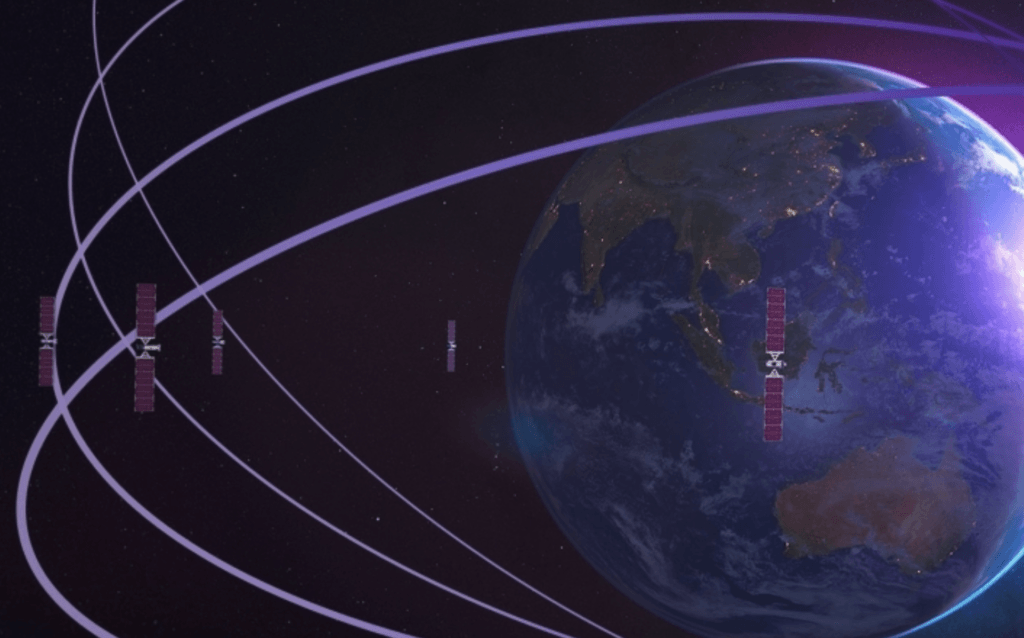
SES is moving forward with a next-generation medium Earth orbit (MEO) constellation called meoSphere, selecting K2 Space as a key partner for satellite platforms in an effort to expand capacity and support multi-mission connectivity services by 2030. The initial phase will include 28 high-power satellites built on K2 Space’s platform, combined with SES-developed software-defined payloads manufactured in Luxembourg.
The meoSphere program reflects SES’s strategy to scale its MEO capabilities beyond the current O3b system, addressing rising demand across government, mobility, and telecommunications markets. Operating at approximately 8,000 km (4,970 miles), the constellation will leverage software-defined networking, optical intersatellite links, and 5G non-terrestrial network (NTN) standards to deliver higher throughput, lower latency, and more flexible capacity allocation. SES also confirmed compatibility with Europe’s IRIS2 sovereign connectivity initiative.
SES positions meoSphere as a multi-mission architecture capable of supporting broadband access, sovereign government networks, and emerging space-based services such as data relay and hosted payloads. The company plans a series of pathfinder missions with K2 Space over the next three years to validate satellite platforms and payload technologies before scaling deployment. The architecture also introduces edge computing and in-space data processing to reduce reliance on ground infrastructure and enable new AI-driven applications.
- SES will deploy an initial 28 satellites using K2 Space’s high-power platform for Phase 1
- Constellation operates at ~8,000 km (4,970 miles) with four orbital planes for global coverage
- Optical intersatellite links enable direct satellite-to-satellite communication and resilient routing
- Network supports up to 100 Gbps optical relay for crosslinks, D2D, and data relay applications
- User terminals support up to 1 Gbps (ESA) and 4 Gbps (parabolic antennas)
- 5G-NTN compliant architecture enables integration with terrestrial mobile networks
- Edge computing and onboard storage support AI workloads and sovereign data use cases
- Designed for interoperability across LEO, MEO, and GEO environments
meoSphere Specifications
| Category | Specification |
|---|---|
| Orbit | 8,000 km (4,970 miles) MEO altitude |
| Constellation | 4 inclined orbital planes, 7 satellites per plane (28 total Phase 1) |
| Satellite Power | ~20 kW per satellite (high-power platform) |
| Platform | K2 Space multi-mission satellite bus with propulsion, power, and flight control |
| Payload | SES software-defined digital regenerative payloads |
| Optical Links | Optical intersatellite links (OISLs) for direct satellite communication |
| Optical Throughput | Up to 100 Gbps relay (crosslinks, D2D, Earth observation, LEO relay) |
| User Throughput | Up to 1 Gbps (ESA terminals), up to 4 Gbps (parabolic antennas) |
| Terminal Sizes | 25×25 cm and 50×50 cm electronically steerable antennas |
| Networking | 5G-NTN and 3GPP compliant |
| Edge Capabilities | Onboard compute and secure storage for AI and analytics |
| Mission Flexibility | Supports hosted payloads, sovereign networks, and multi-orbit interoperability |
“Space is the invisible backbone of the global data economy and national security,” said Adel Al-Saleh, CEO of SES. “Together with K2 Space and other space partners, we’re building meoSphere as essential infrastructure—constructed faster, designed to handle massive data demands globally, and built to support the secure, resilient sovereign networks that our global government allies depend on.”
🌐 Analysis: SES is extending its MEO strategy into a more software-defined, multi-mission architecture that aligns with broader industry trends toward hybrid multi-orbit networks and space-based data routing. The inclusion of optical intersatellite links, edge compute, and 5G-NTN integration positions meoSphere as part of a converged space-terrestrial infrastructure stack rather than a standalone satellite system.
🌐 Analysis: The partnership with K2 Space reflects a shift toward higher-power satellite platforms and faster manufacturing cycles, similar to moves by emerging LEO players and defense-oriented space startups. SES’s dual supply chain approach and alignment with IRIS2 also signal increasing geopolitical and sovereign requirements shaping next-generation satellite networks.
🌐 We’re tracking the latest developments in satellite and space-based networking infrastructure. Follow our ongoing coverage at: https://convergedigest.com/category/space