


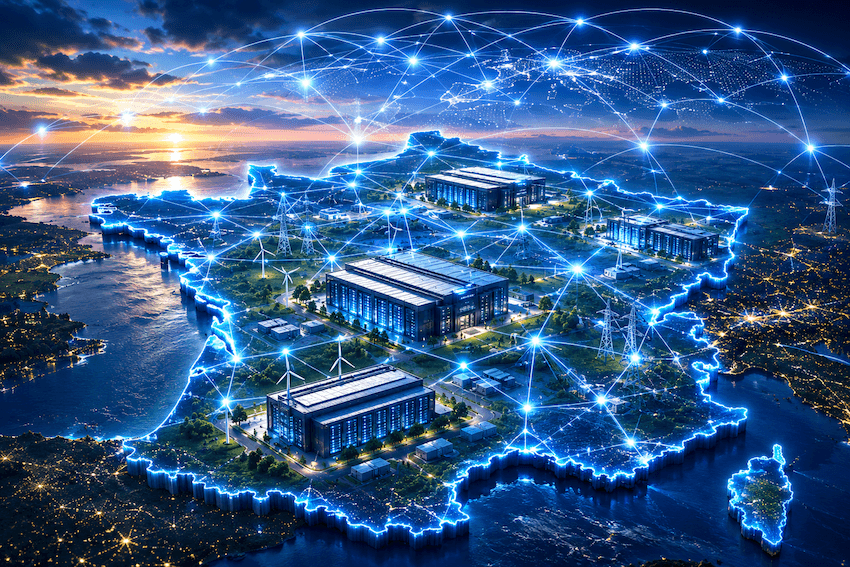
SoftBank Group outlined plans to build and operate 5 GW of AI data center capacity in France, marking one of Europe’s largest announced AI infrastructure investments to date. The initiative carries a projected investment of up to €75 billion ($81 billion USD) and begins with a first phase of €45 billion ($48.6 billion USD) to deliver 3.1 GW in the Hauts-de-France region. The announcement came as part of the 2026 Choose France summit hosted by President Emmanuel Macron, underscoring France’s push to become a strategic European hub for AI compute, digital infrastructure, and industrial manufacturing.
The initial deployment spans three planned sites in Dunkirk (Loon-Plage), Bosquel, and Bouchain, with completion targeted by 2031. SoftBank said the infrastructure will support demand from AI model developers, hyperscale cloud providers, enterprises, research institutions, and public-sector organizations requiring large-scale accelerated compute. The buildout leverages several of France’s core advantages for AI infrastructure, including access to abundant low-carbon electricity, industrial land, and proximity to major European economic corridors linking Paris, Brussels, Amsterdam, London, and Frankfurt.
A key element of the strategy is an industrial partnership with Schneider Electric to establish a large-scale production cluster at the Port of Dunkirk. The site will include a SoftBank-operated facility producing data center enclosures and a Schneider Electric facility integrating prefabricated power modules for AI infrastructure deployments. SoftBank said the project is intended to localize parts of the AI data center supply chain in Europe while supporting faster deployment cycles for next-generation AI facilities. Separately, SoftBank and French AI infrastructure company Sesterce confirmed plans for a 1 GW AI data center campus in Bosquel as part of the broader 5 GW commitment.
- Total planned AI data center capacity in France: 5 GW
- Total projected investment: up to €75 billion ($81 billion USD)
- First phase investment: €45 billion ($48.6 billion USD)
- First phase capacity target: 3.1 GW
- Main deployment regions:
- Dunkirk (Loon-Plage)
- Bosquel
- Bouchain
- Bosquel campus:
- 1 GW AI data center campus
- Joint venture between SoftBank Group and Sesterce
- Expected to create 400 permanent skilled operational roles
- Industrial partnership:
- Schneider Electric to provide integrated power infrastructure and prefabricated data center power modules
- Regional impact:
- Thousands of expected jobs across construction, operations, robotics, energy systems, and advanced manufacturing
- €10 million regional endowment fund planned to support AI adoption, education, and local innovation in Hauts-de-France
Masayoshi Son, Chairman and CEO of SoftBank Group, said: “AI is entering a new era, and the countries that build the infrastructure for this transformation will shape the future of technology, industry and society. SoftBank is proud to make this major commitment to France.”
🌐 Analysis: SoftBank’s announcement adds France to the growing list of global regions competing to secure AI compute infrastructure at gigawatt scale. Similar large-scale announcements in recent months from CoreWeave, IREN, and hyperscalers across the U.S. and Middle East highlight how access to power, land, and grid interconnection now shapes the next phase of AI investment.
For Europe, the project also reflects a broader policy shift toward digital sovereignty. France has increasingly positioned itself as a preferred location for AI infrastructure thanks to nuclear-powered electricity generation, industrial redevelopment zones, and government support for strategic compute capacity. By combining AI data centers with localized manufacturing through Schneider Electric, SoftBank is extending the investment beyond compute into the physical supply chain behind AI infrastructure.
🌐 Analysis: The Masa Son Pattern—Visionary or Mirage?
While the sheer scale of the French buildout makes for excellent headlines, seasoned market observers are treating the announcement with a healthy dose of skepticism. Masayoshi Son has a long, documented history of pairing up with powerful world leaders for splashy, multi-billion-dollar infrastructure pledges that don’t always materialize as advertised. Most notably, Son stood beside Donald Trump in late 2016 to pledge a $50 billion U.S. investment, a theatrical performance he repeated in December 2024 by committing $100 billion to the U.S. AI initiative “Stargate.” While SoftBank did technically deploy the 2016 capital, much of it was funneled into disastrous bets like WeWork rather than the foundational industrial job-creation originally implied. For Son, a grand political announcement is often the beginningof a fundraising campaign, not the deployment of existing capital.
The elephant in the room is whether SoftBank actually has the cash to back a €75 billion European expansion alongside its staggering U.S. commitments. The short answer is: not on its own balance sheet. While SoftBank’s net profits rebounded massively by mid-2026—quadrupling to over $32 billion thanks to its chip-giant Arm and early stakes in OpenAI—the holding company historically maintains far less liquid cash (typically hovering around $30 billion) than its headlines demand. To pull this off, Son will almost certainly have to rustle up an entirely new mega-fund or rely heavily on debt and joint-venture partners like Sesterce to shoulder the burden. Given the high-profile wreckage of the first Vision Fund, pitching institutional investors on another massive, capital-intensive infrastructure experiment will be a true test of whether Son’s legendary charisma still holds sway over the market.