


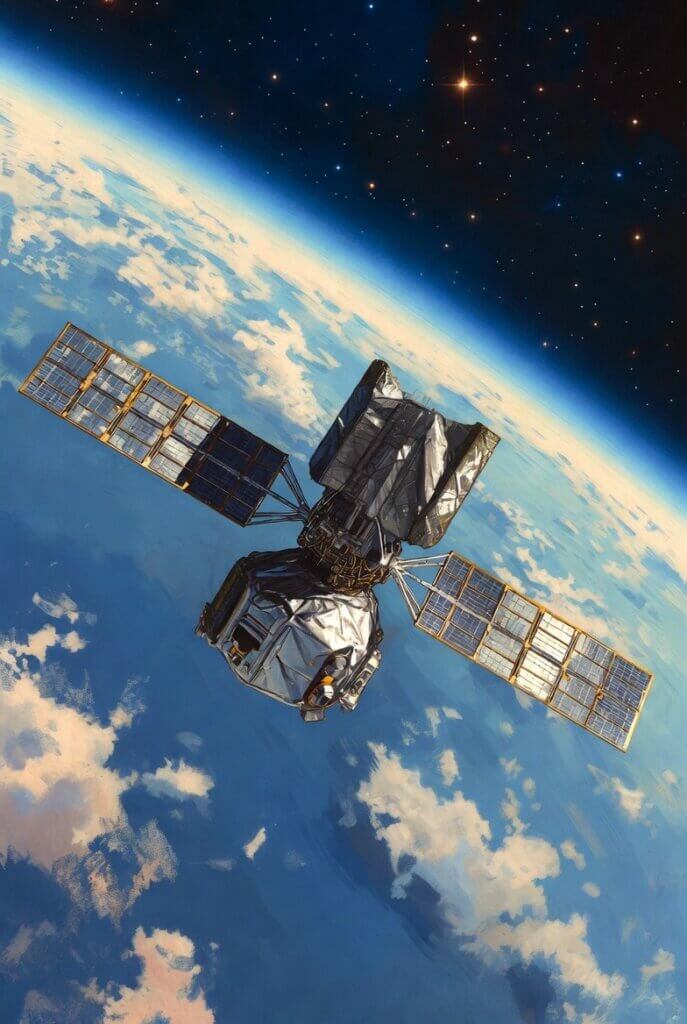
SpaceX has filed an application with the U.S. Federal Communications Commission seeking authority to deploy and operate what it describes as an Orbital Data Center system—a non-geostationary satellite constellation designed primarily for large-scale computing rather than broadband access. According to the filing, the system would consist of up to one million satellites operating as distributed data-center nodes, optimized for artificial intelligence workloads and interconnected primarily through optical inter-satellite links .
The application positions the constellation as a response to accelerating global demand for AI compute, which the company argues is beginning to outpace the scalability of terrestrial data centers due to power availability, cooling constraints, and grid expansion challenges. Rather than focusing on end-user connectivity, the proposed system emphasizes continuous power generation, sustained compute operation, and high-capacity internal networking, with ground connectivity treated as a secondary function.
Orbital Architecture and Power-Driven Design
SpaceX proposes to distribute the satellites across near-circular orbital shells between 500 km and 2,000 km altitude, with inclinations including 30 degrees and sun-synchronous orbits. Each shell would span no more than 50 km, allowing precise control of orbital density and collision risk. Different satellite hardware variants would be deployed across shells to optimize operations for altitude-specific power and thermal conditions .
A key architectural driver is solar exposure. Satellites placed in sun-synchronous orbits are expected to experience greater than 99% access to sunlight, reducing reliance on onboard batteries and enabling continuous operation. Lower-inclination shells are intended to support load balancing, allowing compute workloads to shift across the constellation in response to variations in power generation and demand.
Optical Inter-Satellite Links as the Primary Fabric
The filings make clear that the primary communications and data transport layer for the Orbital Data Center system is a network of high-bandwidth optical inter-satellite links (ISLs). These laser links would connect satellites within the same orbital shell and across different shells, forming a space-based mesh network capable of routing traffic internally without reliance on radiofrequency spectrum .
Traffic destined for Earth would be routed through this optical mesh into SpaceX’s existing Starlink constellation, which already employs optical ISLs, and then downlinked to authorized ground stations. SpaceX characterizes this combined optical network as a high-capacity, high-reliability laser mesh, with aggregate throughput described at the petabit scale.
Radiofrequency communications play a limited role. The filing requests authority to use Ka-band spectrum—specifically 18.8–19.3 GHz (space-to-Earth) and 28.6–29.1 GHz (Earth-to-space)—primarily for telemetry, tracking, and command (TT&C) and other backup functions. These RF operations would be conducted on a non-interference, non-protected basis and are not intended to carry primary compute traffic .
Technical parameters disclosed in the Schedule S supplement include:
- Ka-band antennas with 40 to 42.6 dBi gain
- Electronically steered beams that adjust power to maintain compliance with power-flux density limits
- Configurable channelization ranging from 1 to 100 channels
- Altitude-dependent maximum EIRP density, decreasing at lower orbital heights
Compute Scaling Framed in Mass and Power Terms
Rather than describing compute capacity in terms of processors or servers, SpaceX frames scaling in terms of mass deployed to orbit and sustained power output. The filing presents a scenario in which 1 million tonnes of satellites, each capable of delivering 100 kW of compute per tonne, could add 100 gigawatts of AI compute capacity per year as launch cadence increases .
This approach reflects the underlying engineering constraints of space systems, where mass directly determines power generation, thermal dissipation, and payload capacity. Solar arrays, radiators, compute hardware, propulsion, and structural elements all scale with mass, making “kilowatts per tonne” a system-level metric rather than a processor-level specification. The filing does not disclose processor types, accelerator architectures, or internal memory and interconnect designs.
Thermal Management and Sustained Operation
The application highlights radiative cooling as a fundamental advantage of orbital data centers. Heat generated by onboard compute systems would be dissipated directly into space through radiative surfaces, eliminating the need for water-based or mechanical cooling systems common in terrestrial facilities. SpaceX contrasts this with the increasing energy and water demands of ground-based data centers, particularly those supporting AI workloads .
The combination of near-constant solar power and passive radiative cooling is presented as enabling continuous, high-duty-cycle operation, rather than intermittent or burst-based workloads. While the filing does not explicitly categorize workload types, the system design emphasizes sustained power availability and thermal stability.
Lifecycle Operations and Network Reliability
Given the proposed scale, the filing devotes significant attention to maneuverability, collision avoidance, and end-of-life disposal. Each satellite would include redundant propulsion systems capable of orbit raising, station keeping, collision avoidance, and disposal. SpaceX commits to a collision-avoidance threshold of 1e-5, more conservative than commonly cited industry practices .
For decommissioning, SpaceX outlines a mix of atmospheric re-entry, high-altitude disposal orbits, and heliocentric disposal orbits, intended to reduce congestion in operational shells and minimize long-term debris risks. The company reports a planned disposal success probability exceeding 99%, based on experience with its existing satellite constellations.
Link to filing: https://www.scribd.com/document/990116826/Orbital-Data-Center-LOA-Narrative
Technical: https://www.scribd.com/document/990173574/FCC-Technical-SpaceX-AI-Data-Center
🌐 Analysis
The FCC filings describe a system that applies data-center design principles—power availability, sustained thermal envelopes, and high-capacity internal fabrics—to an orbital environment. By making optical inter-satellite links the primary data plane and treating RF spectrum as a secondary control channel, SpaceX outlines an architecture that more closely resembles a distributed computing fabric than a traditional satellite network. The emphasis on mass- and power-based scaling highlights how launch cadence and system integration, rather than individual chips, define capacity in space-based computing infrastructure.
Recent market speculation has also centered on whether SpaceX could combine with xAI ahead of a potential public offering, though neither company has confirmed such plans. The discussion reflects xAI’s rapidly expanding physical footprint and compute ambitions, highlighted by its large-scale data center build-out in Memphis, Tennessee, where the company has deployed tens of thousands of GPUs and outlined plans to scale toward one of the largest AI training and inference clusters in operation. xAI has positioned these facilities as core infrastructure for training and serving its Grok models, with a focus on sustained, high-utilization workloads rather than short-term experimental capacity. In that context, speculation about closer structural alignment between SpaceX and xAI has drawn attention to how terrestrial hyperscale data centers and proposed orbital compute platforms could, over time, be viewed as complementary layers in a broader AI infrastructure strategy, spanning ground-based clusters and space-based systems optimized for power availability and network reach.
Blue Origin’s recent announcement of TeraWave underscores that SpaceX is not alone in framing space as a future domain for large-scale compute and data movement. While SpaceX’s FCC filings emphasize orbital data centers tightly coupled to optical inter-satellite networking, Blue Origin’s TeraWave initiative focuses on high-capacity space-based power generation and energy transmission, positioning orbital platforms as part of a broader infrastructure layer that could support communications, sensing, and compute workloads. Taken together, the disclosures point to an emerging industry trend in which space systems are no longer designed solely for connectivity or exploration, but as foundational infrastructure for energy-intensive digital workloads, with optical networking, power availability, and thermal management becoming shared architectural concerns across multiple space companies.