SpaceX filed an application with the Federal Communications Commission (FCC) seeking authority to launch and operate a third-generation non-geostationary orbit (NGSO) satellite system comprising 100,000 satellites. The proposed Gen3 constellation would operate across two groups of closely stacked orbital shells at nominal altitudes of 323 to 327.5 kilometers (201 to 203 miles) and 473 to 477.5 kilometers (294 to 297 miles), with orbital inclinations ranging from 26 degrees to 96.9 degrees. SpaceX said the very-low-Earth-orbit architecture would support ultra-low-latency, multi-gigabit symmetrical connectivity for consumers, enterprises, government users, and billions of AI-powered devices.
The Gen3 spectrum architecture would expand beyond the Ku-, Ka-, V-, and E-band resources used or requested for SpaceX’s earlier satellite systems. SpaceX seeks wider contiguous uplink channels in Ku- and Ka-band to support high-definition spatial and auditory data generated by AI applications and industrial automation. The company also plans to use W-band frequencies and D-band spectrum between 122.5 GHz and 275 GHz for gateway and backhaul connectivity. SpaceX argues that these higher-frequency bands could provide the wide bandwidth required to expand aggregate network capacity while using narrow beams and dynamic spectrum-sharing techniques to limit interference.
SpaceX plans to use beamforming, electronic beam steering, dynamic power control, and network orchestration software to coordinate Gen3 operations with other satellite and terrestrial spectrum users. The constellation would leverage existing Gen1 and Gen2 ground infrastructure while SpaceX expands its gateway network and seeks access to additional frequencies. The company also requests inclusion of Gen3 in the FCC’s third processing round for Ku-, Ka-, and V-band systems and seeks waivers where required to operate in frequency bands without formal satellite allocations.
| SpaceX Gen3 NGSO Satellite System | |
| July 7, 2026 | Source: FCC Filing | |
| Constellation Size | 100,000 NGSO satellites |
| Orbital Architecture | Two groups of closely stacked operational shells at 323–327.5 km (201–203 miles) and 473–477.5 km (294–297 miles). |
| Orbital Inclinations | 26° to 96.9°, including sun-synchronous orbit configurations. |
| Target Performance | Ultra-low latency and multi-gigabit symmetrical broadband connectivity. |
| Target Users | Consumers, enterprises, government users, billions of AI-powered devices, and future constellations of AI satellites. |
| User-Link Spectrum | Ku-band Ka-band Expanded contiguous uplink channels designed to support AI applications and high-definition, real-time audiovisual data processing. |
| Backhaul Spectrum | W-band D-band Frontier spectrum, including 122.5–275 GHz, for high-capacity gateway connectivity and expanded backhaul. |
| Network Architecture | Beamforming, electronic beam steering, dynamic power control, intelligent network orchestration, dynamic traffic routing, and spectrum sharing. |
| Ground Infrastructure | Initial Gen3 deployments would leverage existing Gen1 and Gen2 earth station infrastructure, with additional gateway facilities and frequencies added as capacity requirements grow. |
| Spectrum Policy | SpaceX requests global operating authority and waivers for non-conforming operation in frequency bands without formal satellite allocations, subject to non-interference and non-protection requirements. |
| Space Sustainability | Low-altitude deployment, atmospheric re-entry for satellite disposal, collision avoidance and deconfliction procedures, propulsion systems, brightness mitigation, and boresight avoidance technologies. |
“A robust, resilient, and ubiquitous communications infrastructure with the capacity to handle the majority of the world’s internet traffic will allow all people to enjoy the benefits of our shared abundant future and continue the legacy of American leadership in connecting the unconnected,” SpaceX stated in its FCC application.
🌐 Analysis: The Gen3 filing expands SpaceX’s AI infrastructure strategy from orbital computing to the network architecture required to connect AI workloads, devices, ground infrastructure, and potentially large constellations of compute satellites. SpaceX’s previously announced A1 satellite architecture outlined a path toward gigawatt-scale AI data centers in low-Earth orbit, while Gen3 proposes the communications fabric around that vision: 100,000 VLEO satellites, expanded uplink capacity, D-band backhaul, dynamic spectrum sharing, and network orchestration capable of connecting billions of AI devices and future AI satellite constellations.
The scale of the Gen3 proposal becomes clearer when compared with SpaceX’s existing Starlink network. As of July 7, 2026, public satellite trackers and recent launch reporting place the Starlink constellation at roughly 10,700 satellites in orbit, with the exact total changing as SpaceX launches new spacecraft and deorbits older satellites. SpaceX therefore proposes a Gen3 constellation nearly ten times larger than the current Starlink fleet. The company launched nearly 1,600 Starlink satellites during the first half of 2026 alone, demonstrating a deployment cadence unmatched by other commercial satellite operators, but reaching 100,000 satellites would require another major increase in launch throughput.
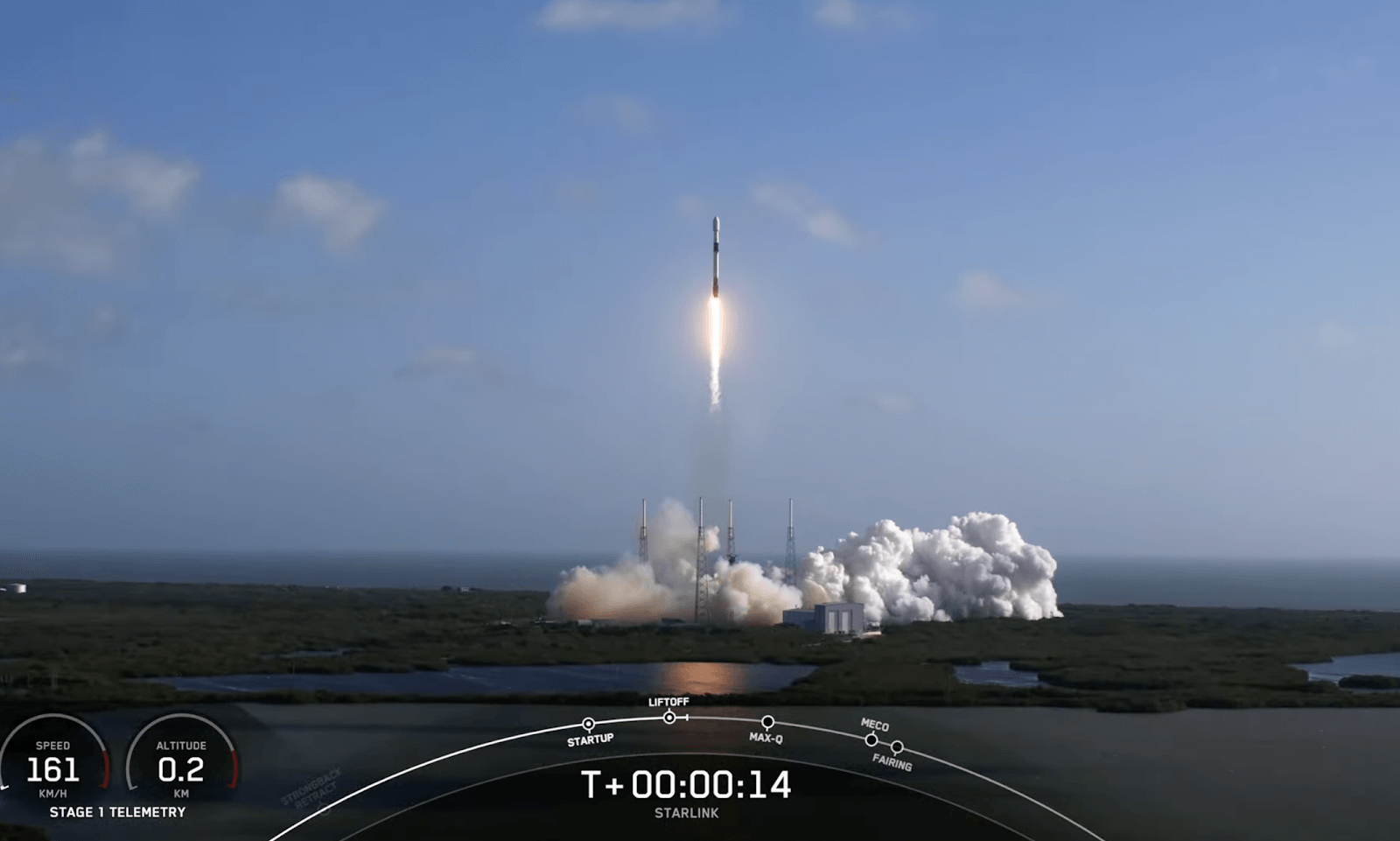
Falcon 9 remains the operational workhorse for Starlink deployment. Recent missions typically carry about 24 to 29 Starlink V2 Mini satellites, depending on orbital destination and mission configuration. At 29 satellites per mission, deploying 100,000 satellites would require approximately 3,449 Falcon 9 launches; at 24 satellites per mission, the requirement rises to approximately 4,167 launches. These figures exclude satellite replacements, launch failures, constellation replenishment, and the possibility that Gen3 spacecraft could differ substantially in mass and dimensions from current Starlink satellites. The comparison illustrates why Falcon 9 alone is unlikely to provide the launch economics and deployment throughput required for a 100,000-satellite architecture.
Starship changes the deployment equation, but the scale remains substantial. SpaceX has designed Starship to deploy up to roughly 60 larger Starlink V3 satellites per mission, compared with about two dozen Starlink satellites on a typical Falcon 9 launch. If Gen3 satellites could be deployed at the same rate of 60 spacecraft per Starship mission, placing 100,000 satellites into orbit would require approximately 1,667 Starship launches. Starting from today’s Starlink fleet of roughly 10,700 satellites would still require about 1,489 Starship launches to reach 100,000 spacecraft, assuming existing satellites counted toward the target and no replacements were required. The strategic connection to SpaceX’s A1 satellite announcement is significant: A1 outlined a path toward gigawatt-scale AI data centers in low-Earth orbit, while Gen3 proposes a communications architecture built around massive uplink capacity, D-band backhaul, dynamic spectrum sharing, and network orchestration. Realizing either architecture at full scale depends on Starship progressing from a developmental launch system into a rapidly reusable transportation platform capable of sustaining launch rates far beyond those achieved by Falcon 9.
🌐 We’re tracking the latest developments in space infrastructure, satellite networks, and emerging orbital computing architectures. Follow our ongoing coverage at: https://convergedigest.com/category/space/