


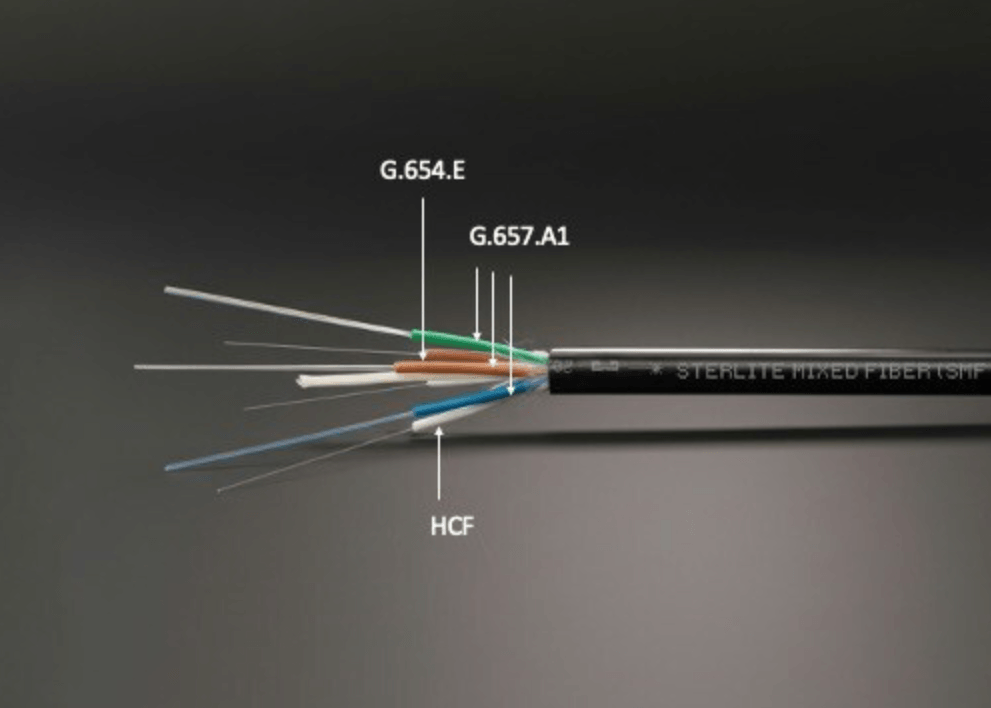
Sterlite Technologies Ltd (STL) launched India’s first Hollow Core Fibre (HCF) cable, targeting ultra-low latency connectivity requirements for AI-driven data center and hyperscale networks. The announcement positions HCF as a next-generation optical medium designed to support high-frequency trading, AI training clusters, and latency-sensitive cloud workloads.
Unlike conventional optical fibre that transmits light through a glass core, STL’s HCF uses an air-filled core, enabling signal propagation speeds approximately 46% faster while reducing latency and optical impairments. The company also introduced a hybrid cable architecture that integrates HCF alongside G.654.E fiber for ultra-low loss long-haul transmission and G.657.A1 fiber for flexible deployment in dense network environments. This multi-fibre design aims to address varying performance requirements across data center interconnect (DCI), metro, and access layers.
STL emphasized that the new cable aligns with increasing demand for “AI-ready” infrastructure, particularly as hyperscalers scale GPU clusters and require deterministic, low-latency interconnects. The company highlighted its broader innovation strategy, including more than 780 patents and a “Glass-to-Terabit” roadmap focused on next-generation optical connectivity platforms.
- Introduces India’s first domestically developed Hollow Core Fibre cable
- Achieves ~46% faster signal propagation vs traditional solid-core fibre
- Targets AI data centers, hyperscalers, and high-frequency trading networks
- Hybrid cable integrates HCF, G.654.E (long-haul), and G.657.A1 (flexible deployment) fibres
- Designed to reduce latency, signal loss, and improve overall network efficiency
- Part of STL’s broader push into AI infrastructure and high-performance optical systems
“Our R&D focus has always been on solving the most complex challenges of the future,” said Dr. Badri Gomatam, CTO of STL. “With the launch of Hollow Core Fibre cable, we are providing the ‘speed-of-light’ infrastructure required for the AI revolution.”
🌐 Analysis: Hollow core fibre has been under development for more than a decade, with renewed momentum driven by AI workloads where microseconds matter—particularly in scale-out GPU fabrics and inter-data center links. STL’s move to commercialize HCF in a hybrid cable format suggests a pragmatic deployment model rather than a full replacement of conventional fibre. This aligns with broader industry trends, where vendors are combining multiple optical technologies—coherent optics, advanced fibre types, and new DSPs—to optimize latency, reach, and power in AI infrastructure.