


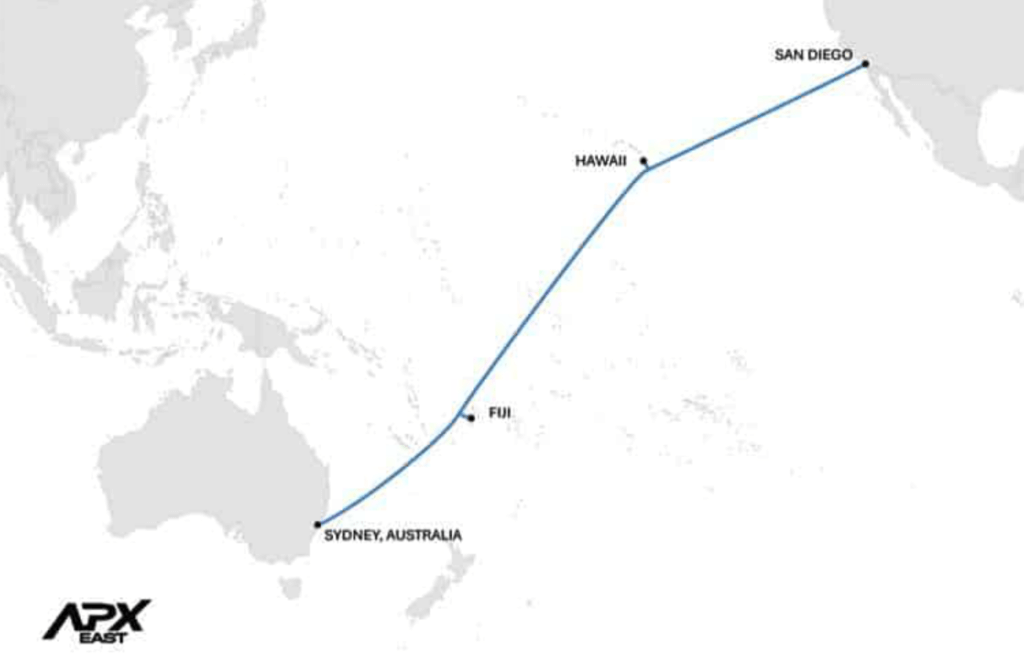
SUBCO announced APX East, a new express submarine cable linking Australia directly to the mainland United States, with a planned Ready for Service date in Q4 2028. The 16-fibre-pair system runs an all-deepwater route between Sydney and California, eliminating intermediate landings or optical regeneration. SUBCO positions APX East as the lowest-latency path between the two countries while simplifying operations for fibre-pair owners.
APX East relies on a continuous optical design that supports single-end power feeding across the full transpacific span, a configuration SUBCO says avoids intermediate points of presence and reduces permitting complexity. Customers install submerged line terminal equipment at each end, with no need for mid-span regeneration. The company also plans optional branches to Hawaii and Fiji, targeted for service in 2029, without affecting the trunk system’s 2028 delivery timeline.
The project targets rising international bandwidth demand driven by large-scale AI infrastructure planned for Australia. SUBCO cites forecasts of 3 GW of AI data center capacity by 2028, requiring between 75 Tbps and 150 Tbps of international connectivity. By avoiding coastal congestion zones near Sydney and landing north of the existing cable protection area, APX East aims to diversify physical routes while accelerating deployment.
- 16 fibre pairs with a continuous, all-deepwater transpacific route
- Direct Australia–US mainland connection with no intermediate landing or regeneration
- Supports single-end power feeding across the entire system
- Planned RFS: Q4 2028 for the main trunk; optional Hawaii and Fiji branches in 2029
- New landing location north of Sydney’s existing cable protection zone
- Marketed as Australia’s first sovereign-owned international hypercable
“APX East will be a critical enabler for Australia’s aspirations to become a leader in the AI world,” said Bevan Slattery, Founder and Co-CEO of SUBCO.
🌐 Analysis
The announcement adds urgency to the transpacific subsea market as hyperscalers and neocloud providers align network capacity with AI data center build-outs rather than traditional cloud growth cycles. APX East’s 2028 RFS places it ahead of several proposed Australia–US systems with later timelines, tightening competition around early access to fibre-pair capacity optimized for AI traffic patterns.
| Cable System | Primary Route | Australia Landing | Singapore Landing | RFS | Notes |
|---|---|---|---|---|---|
| INDIGO Central & West | Australia – Indonesia – Singapore | Sydney, Perth | Yes | 2019 | Low-latency regional system focused on SEA connectivity |
| Hawaiki | Australia / NZ – United States | Sydney | No | 2018 | Early hyperscale-friendly transpacific design |
| Southern Cross NEXT | Australia / NZ – United States | Sydney | No | 2022 | High fibre-pair upgrade to legacy Southern Cross routes |
| Apricot | Australia – Japan – Taiwan – Guam – SEA | Sydney | Indirect | 2022 | Google-backed system optimized for cloud traffic |
| JGA South | Australia – Japan | Sydney | No | 2023 | Direct Oceania–North Asia capacity expansion |
| Echo / Bifrost | Australia – SEA – United States | Australia (Echo) | Yes (Bifrost) | 2024–2025 | Hyperscaler-backed transpacific architecture |
| SEA-US | Southeast Asia – United States | No | Yes | 2017 | Early high-capacity Singapore–US system |
| SJC2 | SEA – Japan – Hong Kong | No | Yes | 2018 | Intra-Asia cloud and content backbone |
| ADC (Asia Direct Cable) | Singapore – China – Japan – SEA | No | Yes | 2023 | High fibre-pair density for hyperscalers |
| MIST | Singapore – India – Myanmar – Thailand | No | Yes | 2023 | Westward expansion from Singapore hub |
🌐 We’re tracking the latest developments in subsea cable infrastructure, policy, and deployments. Follow our ongoing coverage at: https://convergedigest.com/category/subsea/