


Tower Semiconductor and Marvell announced that they have shipped more than five million coherent photonic integrated circuits (PICs), marking a significant milestone in the deployment of silicon photonics for AI-driven data center interconnect (DCI) networks. The devices support high-bandwidth optical connectivity between data centers and are designed to improve both performance and power efficiency as AI workloads drive increasing network traffic.
The coherent PICs are manufactured on Tower’s silicon photonics platform and are used in advanced coherent optical transceivers. Unlike direct-detect optical devices, coherent PICs must precisely manage both the phase and polarization of light, requiring more sophisticated design and manufacturing processes. The technology is increasingly important for scale-across AI architectures that connect clusters, campuses, and geographically distributed AI infrastructure.
Tower and Marvell said their collaboration extends beyond manufacturing to the development of next-generation photonics technologies, including integration of non-silicon materials, 3D integration of photonics and electronics, and advanced optical packaging techniques such as V-Groove structures. These technologies are intended to support future generations of coherent optical modules capable of delivering higher capacity and greater energy efficiency for AI data center networks.
• More than 5 million coherent photonic integrated circuits shipped to Marvell customers worldwide
• Devices target AI-driven data center interconnect and scale-across network architectures
• Coherent PICs enable higher-capacity optical links by controlling light phase and polarization
• Collaboration includes advanced silicon photonics process development and packaging technologies
• Focus areas include 3D photonic-electronic integration and advanced optical packaging
“As one of our key ecosystem partners, we look forward to continue working with the Tower team to advance next-generation coherent technologies for scale-across data center architectures, providing customers with the latest efficient, high-performance photonics technologies to power their advanced AI workloads,” said Dr. Radha Nagarajan, Senior Vice President and Chief Technology Officer, Optical Engineering, at Marvell.


🌐 Analysis
The five-million-unit milestone provides a tangible measure of how rapidly coherent optics have moved from long-haul telecom applications into cloud and AI infrastructure. As hyperscalers build increasingly distributed AI clusters, the industry is shifting toward “scale-across” architectures that require high-capacity optical interconnects between data centers, AI campuses, and regional computing facilities. This trend is fueling demand for coherent pluggable optics and the underlying photonic integrated circuits that enable them.
The announcement also highlights the growing strategic importance of foundry ecosystems in silicon photonics. While Marvell supplies coherent DSPs and optical subsystem technology, manufacturing partners such as Tower play a critical role in delivering the silicon photonics platforms needed for volume deployment. The broader market is seeing similar investments from companies including Broadcom, Cisco, Coherent, Intel, and NVIDIA as the industry races to scale optical connectivity for next-generation AI infrastructure.
| Understanding Coherent Optics & Photonic Integrated Circuits (PICs) | |
| What is Coherent Optics? | A transmission technology that encodes information onto the amplitude, phase, polarization, and wavelength of light. Long established in telecom carrier networks for cross-country reach, it is now being adapted for short-reach data center applications. |
| The Role of the DSP | The Digital Signal Processor (DSP) acts as the “computational brain” of the system. It runs complex algorithms to mathematically clean up signal distortion, mitigate chromatic dispersion, and correct optical impairments in real time, making the high-speed data readable at the receiving end. |
| Why AI Needs It Now | As AI clusters scale beyond a single data center building into multi-building campuses, traditional direct-detect optics hit physical bandwidth and distance limitations. Coherent optics provides the ultra-high capacity, low-latency link required to sync GPUs across these distributed, scale-across environments. |
| What is a PIC? | A Photonic Integrated Circuit (PIC) integrates multiple micro-optical functions—such as lasers, modulators, waveguides, and detectors—directly onto a single silicon substrate, mimicking how electronic microchips integrate millions of transistors. |
| Why PICs Matter | They sharply reduce hardware footprint, power consumption, and assembly costs while improving reliability. PIC architecture is foundational for manufacturing optical modules capable of hitting 800G, 1.6T, and next-generation 3.2T data rates. |
| Direct Detect vs. Coherent | Traditional direct-detect (PAM4) systems are simpler and cheaper, but they only measure whether light is on or off (intensity). Coherent systems capture both phase and polarization, packing significantly more data into the same optical stream. |
| Key Building Blocks |
• Silicon Photonics PIC (Light Modulation & Routing)
• Coherent DSP (Signal Correction & Equalization) • High-efficiency Laser Sources (InP or External) • High-density Co-Packaging (Optics-to-ASIC Integration) • Ultra-high-speed Electrical Interfaces |
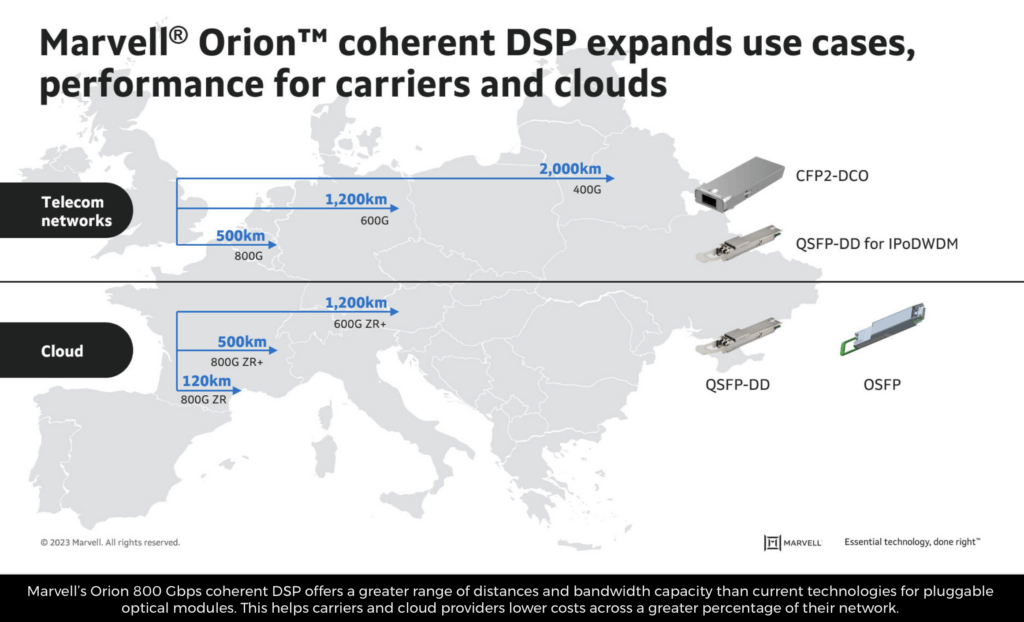
| The Big Picture | Coherent technology is moving inward. Standard pluggable form factors like QSFP-DD and OSFP are enabling hyperscalers to deploy coherent links right into standard switches. This shifts optical technology from a standalone telco transport layer into an integrated element of the AI compute cluster. |
🌐 We’re tracking the latest developments in networking silicon. Follow our ongoing coverage at: https://convergedigest.com/category/semiconductors/