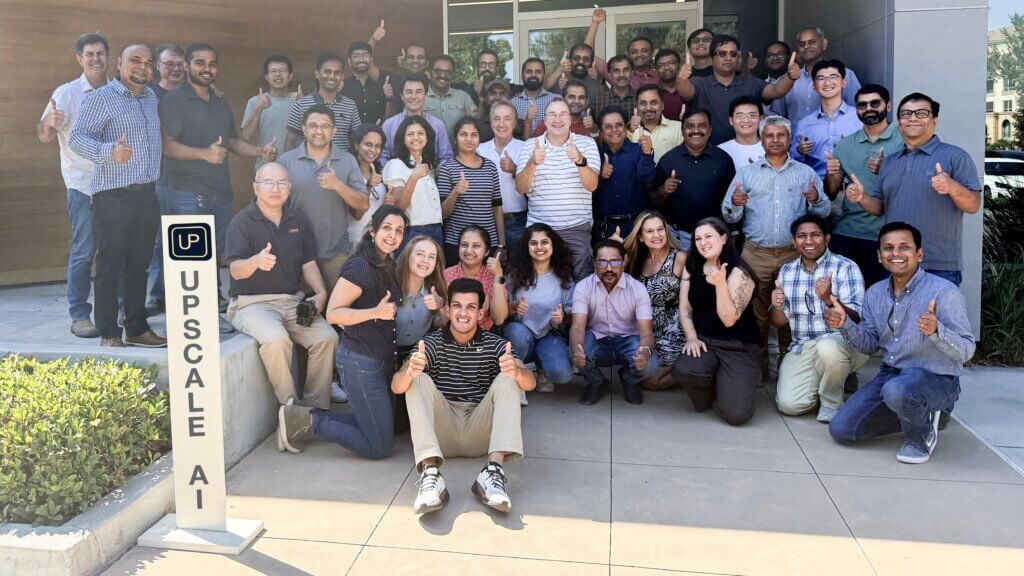
Upscale AI raised $200 million in Series A funding to advance a full-stack AI networking platform designed for large-scale, tightly synchronized AI clusters. The round was led by Tiger Global, Premji Invest, and Xora Innovation, with participation from Maverick Silicon, StepStone Group, Mayfield, Prosperity7 Ventures, Intel Capital, and Qualcomm Ventures. The financing brings Upscale AI’s total funding to more than $300 million.
Upscale AI targets what it describes as a core limitation in current AI infrastructure: networks originally built to connect general-purpose compute now struggle to support rack-scale, tightly coupled AI systems. The company positions its approach around “scale-up” networking, focusing on unifying accelerators, memory, storage, and networking into a synchronized rack-level system rather than relying on retrofitted data-center fabrics.
At the center of the platform is Upscale AI’s SkyHammer scale-up architecture, which the company says collapses latency and bandwidth constraints inside the rack. The platform spans silicon, systems, and software and aligns with open standards and open-source projects, including Ultra Accelerator Link (UAL), Ultra Ethernet, SONiC, and the Switch Abstraction Interface (SAI). Upscale AI plans to use the new capital to expand engineering and go-to-market teams as it moves toward commercial deployments, with initial shipments expected this year.
- $200 million Series A led by Tiger Global, Premji Invest, and Xora Innovation
- Total funding exceeds $300 million
- Focus on rack-scale “scale-up” AI networking rather than traditional scale-out fabrics
- SkyHammer architecture targets unified GPUs, accelerators, memory, and storage
- Platform spans silicon, systems, and software and aligns with open standards
- Initial networking products expected to ship in 2026
“This investment accelerates our mission to fundamentally re-architect networking for the AI era,” said Barun Kar, CEO of Upscale AI. “With a world-class team and strong customer pull, we have a once-in-a-generation opportunity to build the open AI networking platform the industry has been waiting for.”

🌐 Analysis
The funding round places Upscale AI among a growing group of startups and incumbents betting that AI scale-up networking will require architectures distinct from traditional Ethernet and InfiniBand deployments. As hyperscalers and AI infrastructure operators evaluate alternatives centered on openness and interoperability, Upscale AI’s alignment with UAL and Ultra Ethernet mirrors broader industry efforts to avoid vendor lock-in while scaling rack-level performance.
Upscale AI’s SkyHammer architecture provides important context for this funding round. In an earlier product announcement, the company described SkyHammer as a ground-up interconnect designed specifically for large-scale AI systems, rather than an extension of front-end switching or PCIe-based fabrics. The design treats the AI cluster as a single coherent system, enabling nanosecond-latency load/store access across CPUs, GPUs, accelerators, and memory. Upscale AI positioned the architecture as a direct response to the limits traditional data-center networks face under trillion-parameter AI workloads, where synchronization and deterministic performance increasingly define overall system efficiency.
At the technical level, SkyHammer is built from the ASIC up, with deterministic flow control, adaptive load handling, real-time telemetry, and resiliency engineered directly into the fabric. Upscale AI emphasized that the architecture removes features that add latency and operational complexity, prioritizing predictable behavior at rack and supercluster scale. Support for open and emerging standards—including ESUN, Ultra Ethernet Consortium (UEC), and UALink—signals an intent to maintain interoperability with evolving GPU, XPU, and accelerator ecosystems.
Upscale AI was co-founded by Barun Kar (CEO) and Rajiv Khemani (Executive Chairman), both of whom are serial entrepreneurs in networking, security, and silicon businesses. Their leadership team draws heavily from experience at firms such as Marvell, Broadcom, Intel, Cisco, AWS, Microsoft, Palo Alto Networks, and Juniper Networks.