


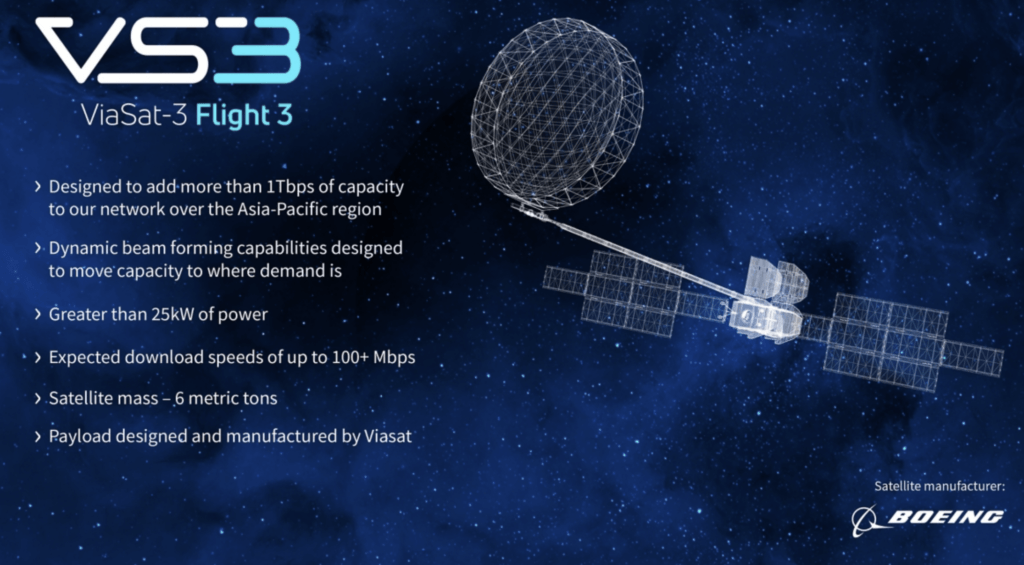
Viasat launched its third ViaSat-3 satellite into orbit aboard a Falcon Heavy rocket from Kennedy Space Center, marking the completion of its next-generation global broadband constellation. The ViaSat-3 Flight 3 (F3) satellite successfully separated from the launch vehicle’s upper stage less than five hours after liftoff, with initial signals acquired shortly thereafter, confirming spacecraft health and readiness for orbit-raising operations.
ViaSat-3 F3 will deliver more than 1 Tbps of throughput capacity across the Asia-Pacific region, leveraging advanced digital payload architecture and dynamic beamforming to allocate bandwidth in real time. The platform is designed to concentrate capacity in high-demand zones, supporting commercial aviation, maritime mobility, enterprise connectivity, and government communications. The satellite’s flexible resource allocation and spectral efficiency aim to address surging demand for resilient, high-capacity SATCOM services, particularly in geographically dispersed and bandwidth-constrained regions.
The launch completes the ViaSat-3 constellation, following ViaSat-3 F1 (launched in 2023) and ViaSat-3 F2 (launched in 2025). Over the coming months, F3 will deploy solar arrays, radiators, and its large reflector before entering geostationary orbit and beginning in-orbit testing. Viasat expects the satellite to enter commercial service in late summer 2026, expanding global network capacity and advancing its multi-orbit architecture strategy.
- ViaSat-3 F3 launched April 29, 2026, at 10:13 a.m. EDT from LC-39A in Florida
- Satellite separated from the upper stage in under five hours; signals acquired minutes later
- Designed capacity exceeds 1 Tbps with real-time beam steering and dynamic allocation
- Coverage focused on Asia-Pacific region, targeting mobility and government markets
- Completes the three-satellite ViaSat-3 global constellation
- Service entry expected in late summer 2026 following orbit raising and testing
“As we celebrate the successful launch of ViaSat-3 F3, it’s once again important to recognize this achievement as a testament to the dedication and expertise of hundreds of Viasat team members and the close collaboration with our partners. ViaSat-3 F3 will provide greater resilience for government and commercial mobility users, leveraging powerful beamforming capabilities to quickly deliver bandwidth in and around geopolitical and other hot spots,” said Mark Dankberg, Chairman and CEO of Viasat.
🌐 Analysis: The completion of the ViaSat-3 constellation positions Viasat, Inc. to compete more directly with high-capacity GEO systems from operators such as Intelsat and Eutelsat, while also complementing emerging LEO architectures. The emphasis on >1 Tbps-class satellites underscores a broader industry trend toward software-defined payloads and dynamic capacity allocation to support mobility and defense use cases.
🌐 Analysis: The use of SpaceX Falcon Heavy reflects continued reliance on heavy-lift launch vehicles for large GEO platforms, even as LEO constellations scale rapidly. Viasat’s multi-orbit strategy aligns with hybrid network models gaining traction across satellite operators seeking to integrate GEO capacity with LEO/MEO assets for latency-sensitive and high-throughput applications.
| Profile: Viasat 2026 | |
|---|---|
| Headquarters | Carlsbad, California, USA |
| Key Leadership | [Mark Dankberg](chatgpt://generic-entity?number=0) (Chairman & CEO) |
| Primary Markets | Government & Defense, Commercial Aviation (IFC), Maritime, Fixed Broadband |
| Key Acquisition | Inmarsat (integrated L-band + Ka-band global coverage) |
| Fleet Status (ViaSat-3) |
• F1 (Americas): In service (2023) • F2 (EMEA): Service entry confirmed (May 2026) • F3 (APAC): Launched April 2026; service expected late summer 2026 |
| Total Throughput | Multi-Terabit global capacity (~1 Tbps per ViaSat-3 satellite) |
| Backlog | ~$4.0 billion (Q3 FY2026), driven by defense and aviation demand |
| Strategic Focus | Multi-orbit architecture combining GEO (high capacity) with LEO/MEO (low latency) |
| Financial Position | Positive free cash flow in FY2026; focus on lowering capital intensity |
| 2026 Milestones |
• Completion of ViaSat-3 global constellation • APAC satellite launch aboard Falcon Heavy • NexusWave multi-orbit service adoption in maritime • Expansion of L-band Direct-to-Device ecosystem |
| Strategic Positioning | Shift toward commercial mobility (IFC, maritime) and defense networking; integrated GEO + L-band + multi-orbit satellite fabric |
🌐 We’re tracking the latest developments in satellite and space-based networking infrastructure. Follow our ongoing coverage at: https://convergedigest.com/category/space