


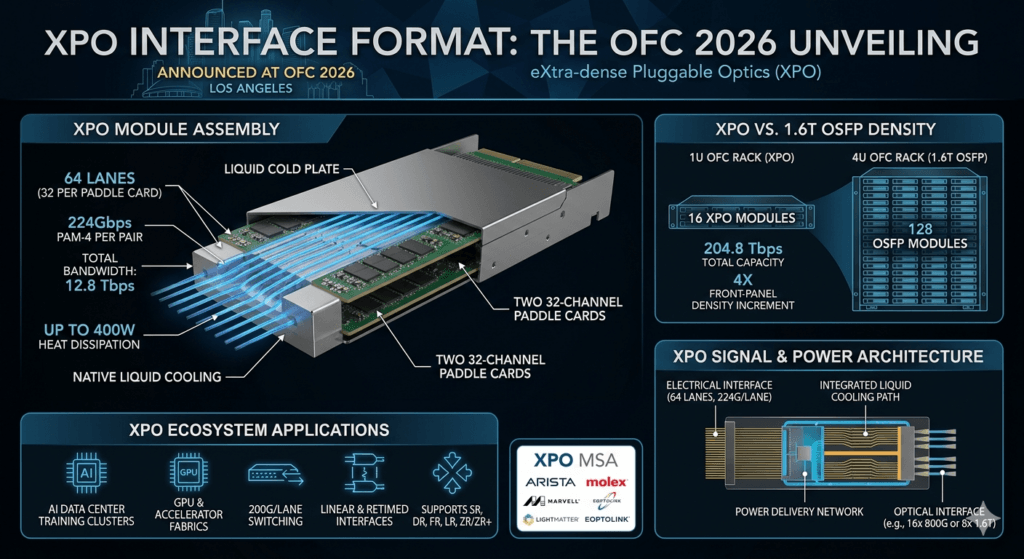
e XPO (eXtra-dense Pluggable Optics) ecosystem is gaining traction following its introduction at OFC 2026, as vendors align around a new 12.8 Tbps pluggable module format designed for AI-scale infrastructure. The initiative, led by Arista Networks and supported by a growing group of optical and silicon providers, targets the next generation of GPU and accelerator fabrics where bandwidth density and thermal limits have become primary constraints.
The XPO specification defines a 64-lane electrical interface operating at 224 Gbps PAM4 per lane, delivering 12.8 Tbps per module. A central innovation is the integration of a native liquid-cooled cold plate, enabling thermal dissipation exceeding 400W—far beyond the capabilities of conventional pluggable optics. The architecture uses dual 32-channel paddle cards to handle high-speed I/O while maintaining a serviceable pluggable design compatible with evolving switch platforms.
Ecosystem momentum is building as companies including Marvell, Lightmatter, Molex, and Eoptolink have signaled support for XPO-based modules and optical engines. The format supports multiple interface architectures—retimed, half-retimed, and linear—and accommodates a wide range of optical reaches including SR, DR, FR, LR, and ZR/ZR+. In a 1U Open Compute rack configuration, XPO enables up to 16 modules delivering 204.8 Tbps of total capacity, representing roughly a 4× increase in front-panel density compared with 1.6T OSFP implementations.
- Defines a 12.8 Tbps pluggable optical module for AI networking
- Uses 64 lanes at 224 Gbps PAM4 signaling
- Integrates native liquid cooling with >400W thermal capacity
- Enables 204.8 Tbps per 1U rack (~4× OSFP density)
- Supports SR, DR, FR, LR, and ZR/ZR+ optical standards
- Compatible with retimed, half-retimed, and linear optical interfaces
- Backed by ecosystem including Arista, Molex, Marvell, Lightmatter, and Eoptolink
🌐 Analysis: The emergence of XPO reflects a broader shift toward liquid-cooled infrastructure as AI clusters push beyond the thermal and power limits of traditional pluggable optics. By extending the pluggable model into the 400W class, XPO provides an alternative path to co-packaged optics while preserving serviceability and modularity. This positions XPO as a potential bridge technology as the industry evaluates longer-term transitions to tighter optical integration.
🌐 Analysis: The growing list of ecosystem participants indicates early alignment across optical module vendors, silicon photonics developers, and system designers. Over the next two to three years, adoption will depend on switch silicon roadmaps, rack-level liquid cooling standardization, and support from hyperscale operators. Competing approaches—including linear pluggable optics and co-packaged optics—continue to evolve in parallel, setting up a multi-path transition for AI interconnect architectures.
What to Watch
- First switch platforms and silicon supporting XPO interfaces
- Alignment with hyperscaler AI cluster designs and deployment timelines
- Integration with rack-level liquid cooling standards and infrastructure
- Vendor demonstrations of 12.8 Tbps modules at upcoming industry events
- Positioning of XPO relative to co-packaged optics (CPO) and linear pluggable optics (LPO)
| XPO Module Format – Key Technical Characteristics | |
|---|---|
| Total Bandwidth | 12.8 Tbps per module |
| Electrical Lanes | 64 lanes (32 per paddle card) |
| Lane Speed | 224 Gbps PAM4 per lane |
| Thermal Design | >400W with integrated liquid cold plate |
| Cooling Method | Native liquid cooling (direct cold plate integration) |
| Form Factor | Extra-dense pluggable (~2.7× OSFP width) |
| Rack Density | 16 modules per 1U = 204.8 Tbps |
| Density Gain | ~4× vs. 1.6T OSFP |
| Interface Types | Retimed, half-retimed, linear |
| Optical Standards | SR, DR, FR, LR, ZR, ZR+ |
| Primary Use Case | AI data centers, GPU fabrics, scale-up/scale-out networks |
| MSA Ecosystem | Arista, Molex, Marvell, Lightmatter, Eoptolink |