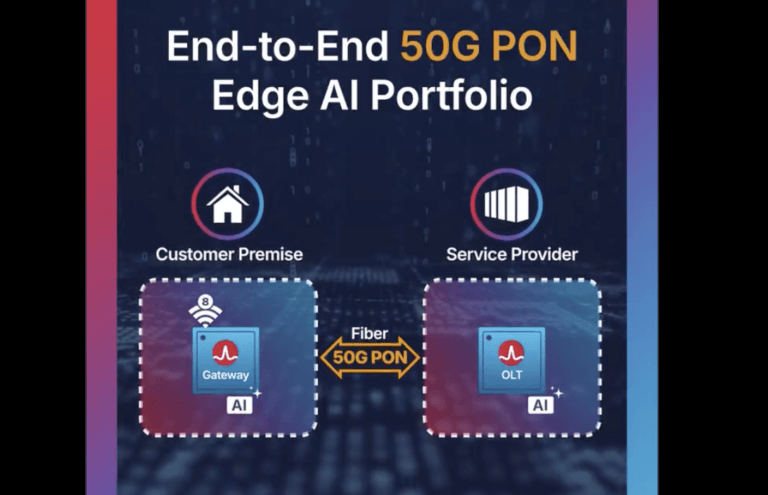
Broadcom introduced a unified Wi-Fi 8 platform at CES 2026 in Las Vegas, centered on a new accelerated processing unit and dual-band Wi-Fi 8 radios designed for AI-enabled residential gateways. The platform combines compute, networking, and on-device AI processing to support real-time applications while targeting higher throughput, lower latency, and improved uptime for service providers.
At the core of the platform is the BCM4918 Wi-Fi 8 accelerated processing unit (APU), a system-on-chip that integrates general-purpose CPU resources with dedicated networking offload, cryptographic acceleration, and an on-device neural engine for AI and machine-learning inference. Broadcom positions the APU as an edge compute platform for tasks such as real-time telemetry analysis, Quality of Experience optimization, and security processing without routing traffic through the main CPU.
The BCM4918 pairs with two new dual-band Wi-Fi 8 radios—the BCM6714 and BCM6719—that integrate 2.4 GHz and 5 GHz operation on a single chip. Combined with the previously announced BCM6718, the portfolio enables tri-band Wi-Fi 8 designs covering 2.4, 5, and 6 GHz, with coordinated radio operation, power optimization, and hardware-assisted telemetry to feed edge-AI models.
- BCM4918 APU integrates CPU, AI inference, networking offload, and cryptographic acceleration on one SoC
- Integrated networking engines enable full CPU bypass for wired and wireless traffic
- BCM6714 and BCM6719 combine dual-band radios with on-chip power amplifiers and telemetry engines
- Third-generation digital pre-distortion reduces peak power consumption by 25%
- Platform supports tri-band Wi-Fi 8 with AI-driven QoE optimization, predictive maintenance, and self-healing features
“Wi-Fi 8 represents a turning point for the industry—where broadband, connectivity, compute, and intelligence truly converge,” said Mark Gonikberg, senior vice president and general manager of Broadcom’s Wireless and Broadband Communications Division. “Our new BCM4918 APU, along with our full portfolio of Wi-Fi 8 chipsets, form the foundation of an AI-ready platform that enables immersive user experiences with efficiency, security, and sustainability.”
🌐 Analysis
Broadcom continues to extend its home gateway silicon roadmap beyond raw throughput by embedding AI inference, telemetry, and security directly into access-side silicon. This approach aligns with broader industry efforts to push intelligence to the network edge, as operators seek to manage increasingly complex in-home networks driven by AI assistants, immersive media, and low-latency applications. Competing Wi-Fi silicon vendors have also emphasized integration and power efficiency, but Broadcom’s focus on a unified compute-and-connectivity architecture reflects growing demand from operators for platforms that reduce system complexity while supporting new service models.
| Category | Wi-Fi 6 / 6E (IEEE 802.11ax) | Wi-Fi 7 (IEEE 802.11be) | Wi-Fi 8 (pre-standard / IEEE 802.11bn) |
|---|---|---|---|
| Standards Status | Ratified | Final approval expected 2024–2025 | Under development (focus on reliability) |
| Primary Design Goal | Spectral efficiency and capacity | Higher throughput and lower latency | Consistent performance, reliability, and coordination |
| Peak Theoretical PHY Rate | Up to ~9.6 Gbps | Up to ~46 Gbps | Not a primary goal; expected to be similar to Wi-Fi 7 |
| Maximum Channel Width | 160 MHz | 320 MHz | 320 MHz (no increase expected) |
| Frequency Bands | 2.4 GHz, 5 GHz, 6 GHz (6E) | 2.4 GHz, 5 GHz, 6 GHz | 2.4 GHz, 5 GHz, 6 GHz with improved coordination |
| Modulation | 1024-QAM | 4096-QAM | 4096-QAM (no new modulation defined) |
| Multi-Link Operation (MLO) | Not supported | Core feature (simultaneous multi-band links) | Enhanced MLO reliability and coordination (in study) |
| Latency Characteristics | Lower than Wi-Fi 5 | Significantly reduced with MLO | More deterministic latency and reduced jitter |
| AP / Network Coordination | Limited (basic coordination) | Improved via MLO | Inter-AP coordination is a primary IEEE 802.11bn focus |
| Telemetry & Observability | Standard counters and statistics | More granular metrics | Vendor-specific hardware telemetry (not standardized) |
| AI / ML Role | External analytics and cloud optimization | AI-assisted radio optimization (implementation-specific) | AI-driven optimization encouraged but not defined by IEEE |
| Typical Deployment Focus | Enterprise, broadband gateways | High-performance residential, XR, gaming | Highly reliable, dense, and managed environments |